A customer cannot inspect every part inside a car, watch every minute in a restaurant kitchen, or know what happens when a shop divides its profits. Buying depends on trust. So does accepting a job: the wage, the hours and the work should mean what an employer says they mean.
Freemasonry brings a vocabulary of measurement to those relationships. The square, level and plumb test conduct rather than commercial success. Henry Ford, J.C. Penney, Dave Thomas and Colonel Harland Sanders all belonged to the fraternity. Their businesses offer different tests of its principles, including examples worth following and failures that membership cannot excuse.
The square at the counter, the level across the desk
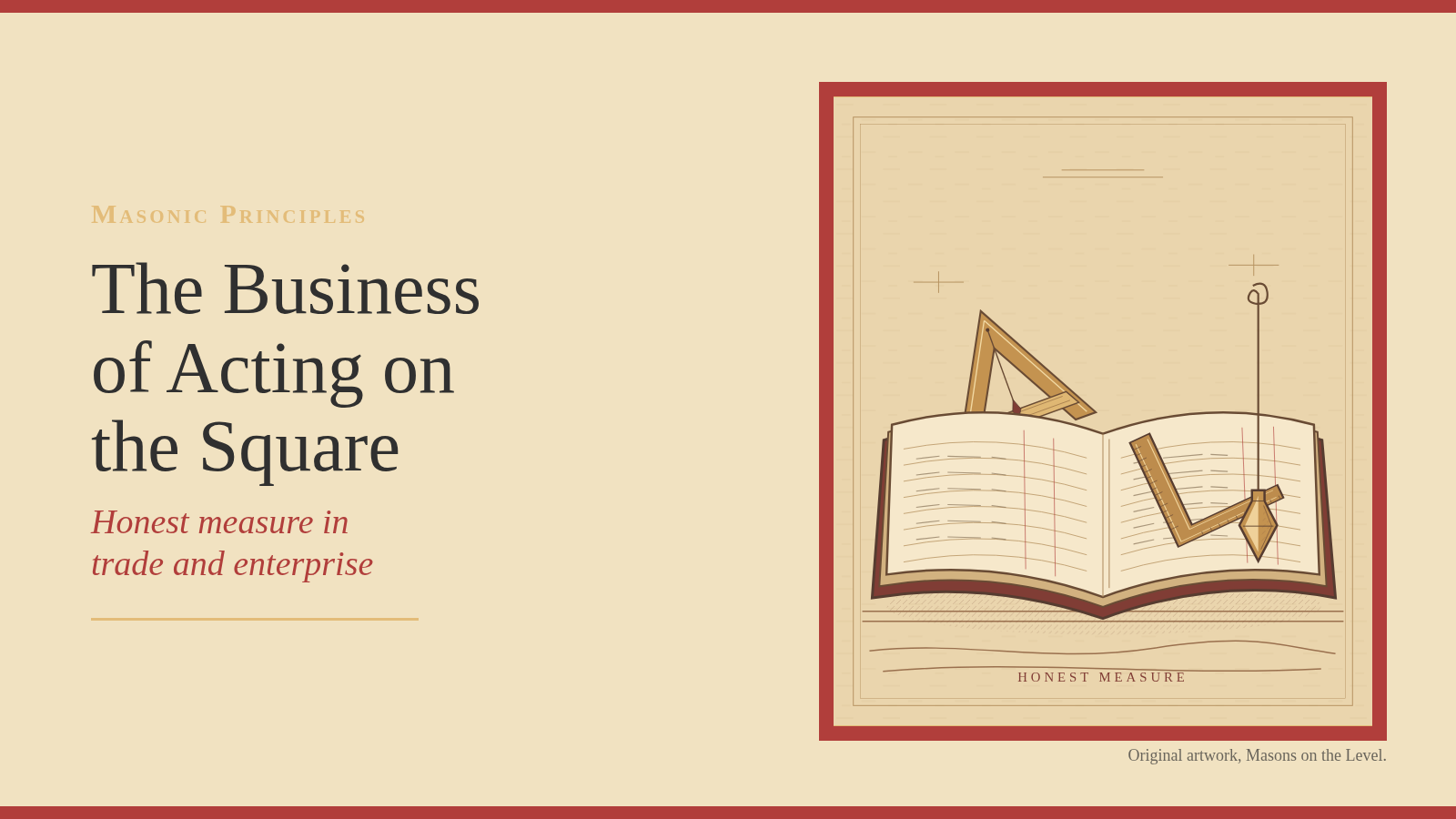
The Grand Lodge of Ohio describes the square as a reminder to act rightly and justly, the level as an emblem of equality, and the plumb as a tool of upright integrity. Applied to business, those meanings concern the terms of a transaction and the people affected by it.
The square asks whether an advertisement matches the product and whether an invoice matches the agreement. The level asks whether a junior employee receives a fair hearing, not merely whether an important customer does. The plumb asks whether we will report a mistake when concealing it would protect a bonus.
Equality does not make every position identical or require every wage to be the same. It does rule out treating a person’s dignity as something that rises and falls with purchasing power or rank. A supplier waiting for payment deserves an honest answer, even when that supplier cannot afford to lose the account.
Ford’s five dollars and the price of the bonus
Henry Ford was raised in Palestine Lodge No. 357 in Detroit in 1894, according to the Grand Lodge of British Columbia and Yukon. His factory would eventually demonstrate both the value and the limits of a celebrated wage policy.
Experiments with the moving assembly line in 1913 and 1914 reduced Model T assembly time from twelve and a half hours to ninety-three minutes. Production became cheaper, but repetitive work drove employees away. The Henry Ford museum records labor turnover of 370 percent. On January 5, 1914, Ford and James Couzens announced the five-dollar day.
Higher pay helped address a business problem and improved workers’ circumstances. Other employers raised wages to compete. But the museum also explains the condition hidden by the headline: the additional money was profit sharing, not an unconditional increase in base pay. Inspectors from Ford’s Sociological Department investigated employees’ homes and habits before the full bonus was paid.
Fair wages involve more than the largest number on a recruitment notice. Workers need clear conditions and reliable payment, without an employer treating their private lives as company property. Ford’s policy makes that distinction unusually visible. Its economic benefits do not erase its intrusion.
Nor can better wages balance away Ford’s antisemitism. The United States Holocaust Memorial Museum documents how his newspaper, The Dearborn Independent, spread lies about Jews through “The International Jew” series beginning in 1920. The material circulated internationally even after his 1927 apology. Meeting on the level is incompatible with that campaign of hatred. A Masonic membership record is not a certificate of ethical conduct.
Penney’s Golden Rule reached the payroll
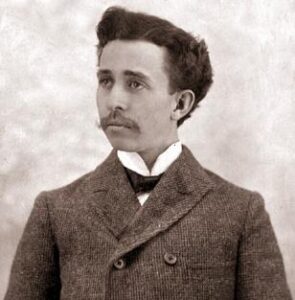
J.C. Penney became a partner in a Golden Rule store in Kemmerer, Wyoming, in 1902. The Grand Lodge of Ohio records his initiation into Wasatch Lodge No. 1 in Salt Lake City on April 18, 1911. The order matters: he was building a business around the Golden Rule before he entered a lodge.
His example is therefore not evidence that Freemasonry invented his convictions. It shows how an established business principle can sit alongside Masonic teaching. Fair dealing concerns employees as well as customers. Ohio’s account describes profit sharing for managers and company stock granted to managers after the 1927 public offering, with stock ownership eventually extended to employees.
During the Depression, Penney borrowed against his life insurance policies to help meet payroll. That detail gives his Golden Rule a sharper meaning than a store name. When personal finances and wages came under pressure together, meeting the company’s commitments required a personal sacrifice.
For a business today, sharing prosperity need not copy Penney’s particular arrangements. It does require asking who contributed to the result, how rewards are determined, and whether employees understand the bargain before doing the work. A discretionary promise of generosity is not the same as compensation people can plan around.
Sanders kept tasting what carried his name
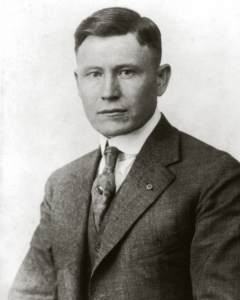
Colonel Harland Sanders first franchised his chicken to Pete Harman in Salt Lake City in 1952. His Masonic record, published by the Grand Lodge of British Columbia and Yukon from Kentucky’s card file, places his initiation in Henryville, Indiana, in 1917 and his later affiliation with Hugh Harris Lodge No. 938 in Corbin, Kentucky, in 1953.
Sanders sold his stake in the business in 1964 but remained its public face. The Grand Lodge of Ohio recounts his anger when later owners changed the gravy to reduce costs. He challenged the use of his image for products he had not developed.
His quarrels were not a complete business ethics program. They do identify a practical responsibility: a familiar name can persuade customers to trust something its owner no longer makes. When quality changes, the endorsement still makes a promise. Acting honestly means checking that promise, not assuming a reputation earned years earlier will cover today’s product.
Thomas carried restaurant success beyond the restaurant
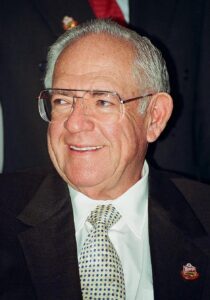
Dave Thomas learned from Sanders while turning around struggling Kentucky Fried Chicken restaurants, then opened Wendy’s in Columbus in 1969. The Grand Lodge of British Columbia and Yukon records his 1959 membership in Sol. D. Bayless Lodge No. 359 in Fort Wayne, Indiana.
Thomas later used his prominence to support foster care adoption through the Dave Thomas Foundation for Adoption. The Grand Lodge of Ohio describes its work with child welfare advocates and policymakers, public awareness and free resources for prospective adoptive families.
That work gives a concrete example of relief beyond the business itself. It should not turn charity into an exemption from ordinary responsibilities. A donation cannot settle an unpaid supplier’s bill or make a misleading advertisement accurate. Commercial conduct and charitable work remain separate things to examine, even when both draw on the same convictions.
The gauge and gavel before the next decision
Ohio’s account of the working tools gives the twenty-four-inch gauge the meaning of using time well, and the common gavel the work of removing personal faults and distractions. In a business, those lessons can begin with an achievable review rather than a declaration of virtue.
Set aside time to examine late payments, unexplained deductions, recurring complaints and schedules that leave staff no dependable rest. Then identify the habit behind a recurring problem: refusing criticism, concealing defects, or rewarding sales without checking how they were won. Correct the practice and tell affected people what will change.
Ford’s wage conditions, Penney’s payroll commitments, Sanders’s concern for product quality and Thomas’s adoption work raise different questions. None replaces the daily task of making the terms clear and keeping them. The working tools give us a way to examine those decisions without mistaking wealth, fame or lodge membership for proof that the work is sound.
Sources
- Grand Lodge of Ohio, “Behind the Masonic Symbols: Masonic Working Tools.”
- Grand Lodge of British Columbia and Yukon, “Henry Ford.”
- Matt Anderson, “Ford’s Five-Dollar Day,” The Henry Ford (January 3, 2014).
- United States Holocaust Memorial Museum, “Antisemitism and Henry Ford’s ‘The International Jew’,” Holocaust Encyclopedia.
- Grand Lodge of Ohio, “JC Penney & The Golden Rule.”
- Grand Lodge of British Columbia and Yukon, “Colonel Harland Sanders.”
- Grand Lodge of Ohio, “Colonel Sanders.”
- Grand Lodge of British Columbia and Yukon, “Rex David Thomas.”
- Grand Lodge of Ohio, “The Lasting Legacy of Entrepreneur, Philanthropist, and Freemason, Dave Thomas.”
- On this site — Henry Ford.
- On this site — J.C. Penney.
- On this site — Colonel Harland Sanders.
- On this site — Dave Thomas.
Which business practice would you change first if you tested it by the square, level and plumb?