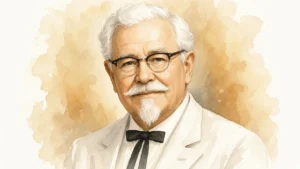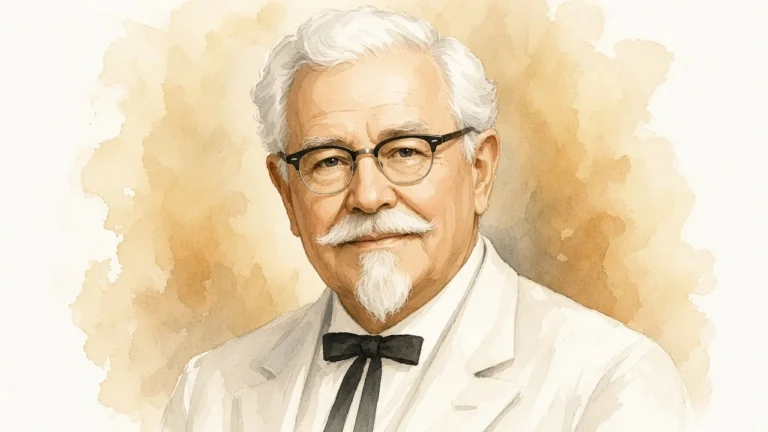
Colonel Harland Sanders
Born September 9, 1890, Henryville, Indiana · Died December 16, 1980, Louisville, Kentucky · Henryville Lodge No. 651, Indiana; later Hugh Harris Lodge No. 938, Corbin, Kentucky
Colonel Harland Sanders turned Corbin roadside chicken into Kentucky Fried Chicken—and made the white suit a global brand.
A Henryville Boy, Many Trades, and a Living-Room Restaurant
Harland David Sanders was born on September 9, 1890, near Henryville, Indiana, the oldest of three children of Wilbur David and Margaret Ann Sanders. The family attended the Advent Christian Church. His father worked an eighty-acre farm until he broke a leg in a fall, then worked as a butcher in Henryville for two years, and died when Harland was only six. The boy took over much of the cooking and, by seven, had mastered several regional dishes. After his mother remarried, he went to work as a farmhand at ten. In 1903 he left the seventh grade to work on a nearby farm, then, at thirteen, moved to Indianapolis and painted horse carriages.
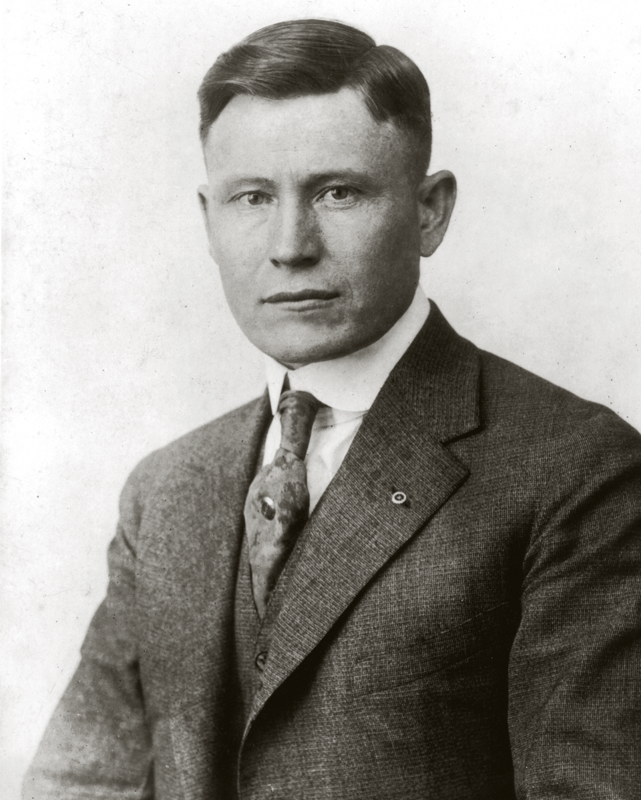
In October 1906 he enlisted in the United States Army with a falsified date of birth, served as a wagoner in Cuba, and was honorably discharged in early 1907, still only sixteen. In Sheffield, Alabama, he worked for an uncle on the Southern Railway as a blacksmith’s helper, cleaned ash pans, and became a steam-engine stoker. There he married Josephine King; they had three children, Margaret Josephine, Harland David Jr., and Mildred Marie. The family moved to Jackson, Tennessee, where he worked for the Illinois Central Railroad and studied law at night. Qualified, he practiced for three years in Little Rock, Arkansas, until a courtroom brawl with a client ended that career. In 1916 he sold life insurance for the Prudential Life Insurance Company. In 1920 he started a ferry on the Ohio River between Jeffersonville and Louisville and later sold his stock for $22,000. He then sold Michelin tires in Winchester, Kentucky, and ran a Standard Oil station in Nicholasville until the Great Depression closed it. Shell Oil offered him a station in North Corbin, Kentucky, and there his professional life in food began.
A Kentucky Colonel, a Salt Lake City Franchise, and a Name on a Hospital Wing
At first, with little space, he served patrons from his own living room. In those years he was drawn into a shootout with Matt Stewart, a local competitor, who was furious that Sanders had repainted a road sign to advertise his own business; Stewart went to prison. Word of the cooking spread, and customers began coming to the area just for his food; he moved to a nearby motel and restaurant that seated 142 people. In 1935 Governor Ruby Laffoon commissioned him a Kentucky colonel in recognition of his contributions to the state’s cuisine. In 1939 the establishment was first listed in Duncan Hines’s Adventures in Good Eating. A fire destroyed the North Corbin restaurant and motel in November 1939. At fifty he acquired a motel in Asheville, North Carolina, and perfected a fried-chicken recipe using a pressure cooker. When the United States entered the Second World War, gasoline rationing forced him to close that motel.
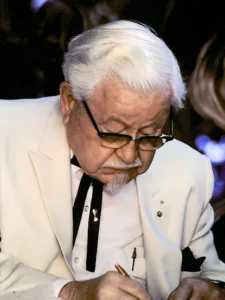
In 1952 he franchised the chicken business for the first time, to Pete Harman, a restaurant owner in Salt Lake City. Harman thought “Kentucky Fried Chicken” would be a novelty in the West. Sanders sold the North Carolina restaurant and traveled the country selling the recipe. His second wife, Claudia, mixed and shipped the spice blend to franchises. Within a decade there were restaurants in Canada, England, Australia, and Mexico. By 1964 he had more than 600 franchised outlets. Life on the road had taken its toll; he sold his stake for $2 million, remaining the company’s spokesman. The next year he and Claudia moved to Mississauga, Ontario, to oversee Canadian franchises. He became known for surprise visits and, in 1973, sued Heublein Inc., then the owner, for using his image to sell products he had not developed, after the company changed the gravy to save money. Heublein countersued for libel in 1975, unsuccessfully, after he denounced the gravy as “sludge” with a “wallpaper taste.” Until his death he traveled some 250,000 miles a year visiting the restaurants. In his last two decades he appeared in public in a white suit and black tie, bleaching his mustache and goatee to match his hair. He died of leukemia on December 16, 1980, at ninety. At that time the chain had an estimated 6,000 outlets in 48 countries and some $2 billion in annual sales. The blend of eleven herbs and spices remains a closely guarded secret.
Henryville Lodge, a Corbin Affiliation, and a Friendship with Dave Thomas
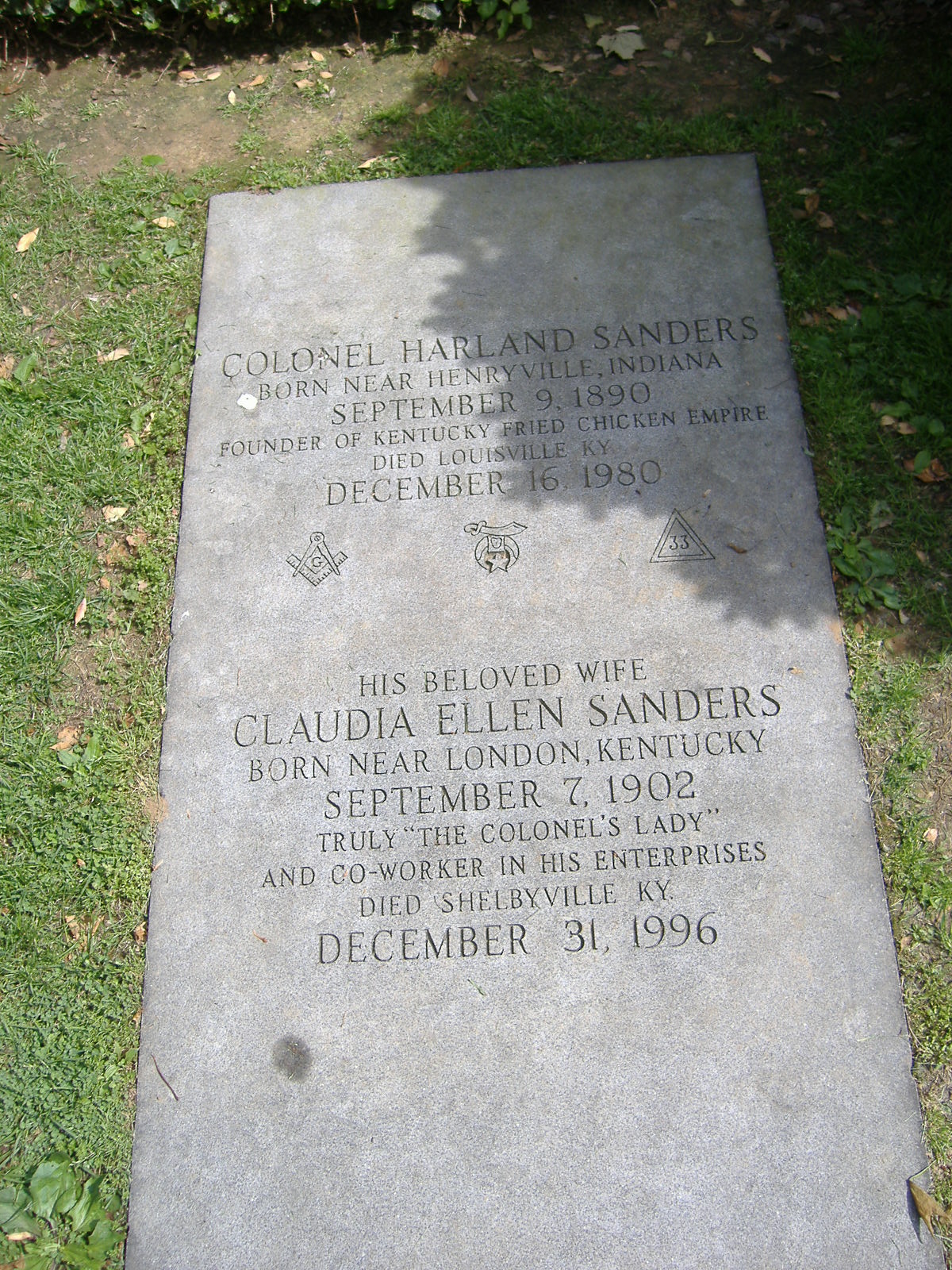
Sanders was initiated on April 6, 1917, in Henryville Lodge No. 651 in Indiana, and received the Fellow Craft and Master Mason degrees in 1919, with Clark Lodge No. 40 conferring them by courtesy. He demitted on February 27, 1920. More than three decades later, on October 27, 1953, he affiliated with Hugh Harris Lodge No. 938 in Corbin, Kentucky, and demitted on April 13, 1976. In his autobiography, Life As I Have Known It Has Been Finger Lickin’ Good, he recalled his installation as a thirty-third degree Scottish Rite Mason in Washington, D.C. He was a Noble of Oleika Shriners in Lexington. His grave marker bears the square and compasses together with Scottish Rite and Shrine emblems.
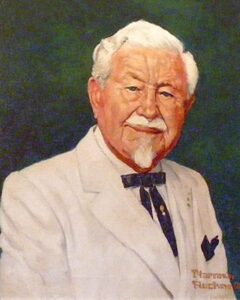

Before Dave Thomas founded Wendy’s, he worked on Kentucky Fried Chicken franchises for the Clauss family’s Hobby House operation in Fort Wayne. He helped simplify the menu so the company could concentrate on fried chicken, encouraged Sanders to appear in advertising, and was sent to Columbus, Ohio, to turn around four struggling restaurants. That experience, and the proceeds from the business, helped finance the first Wendy’s, opened in Columbus in 1969. We have found no evidence that Sanders brought Thomas into Freemasonry, but the two men knew one another professionally, became friends, and were both thirty-third degree Scottish Rite Masons and Shriners. At the Scottish Rite’s 1997 Biennial Session, Thomas, speaking as a thirty-third degree Mason and Grand Cross, remembered Sanders as a friend and fellow thirty-third degree Mason, and as a man who proudly wore a large Masonic ring. Their relationship is also the subject of a separate article on this site, Colonel Sanders and Dave Thomas.
Before his death Sanders established the Colonel Harland Sanders Charitable Organization. A wing of the Mississauga Hospital for women’s and children’s care bears the name The Colonel Harland Sanders Family Care Center. The foundation has also supported other Canadian children’s hospitals, including McMaster Children’s Hospital, the IWK Health Centre, and Stollery Children’s Hospital, and as recently as 2016 it gave $500,000 to Canadian charities.
What did Sanders’s experience with failure contribute to his eventual success?
Sources
- Grand Lodge of Ohio — Colonel Harland David Sanders
- Centennial Lodge No. 326 — Colonel Sanders and Dave Thomas: Fast-Food Pioneers and Masonic Brothers
- Grand Lodge of British Columbia and Yukon — Colonel Harland Sanders (Grand Lodge of Kentucky card file)
- On this site — Dave Thomas
- On this site — Colonel Sanders and Dave Thomas
Life & Masonic Timeline