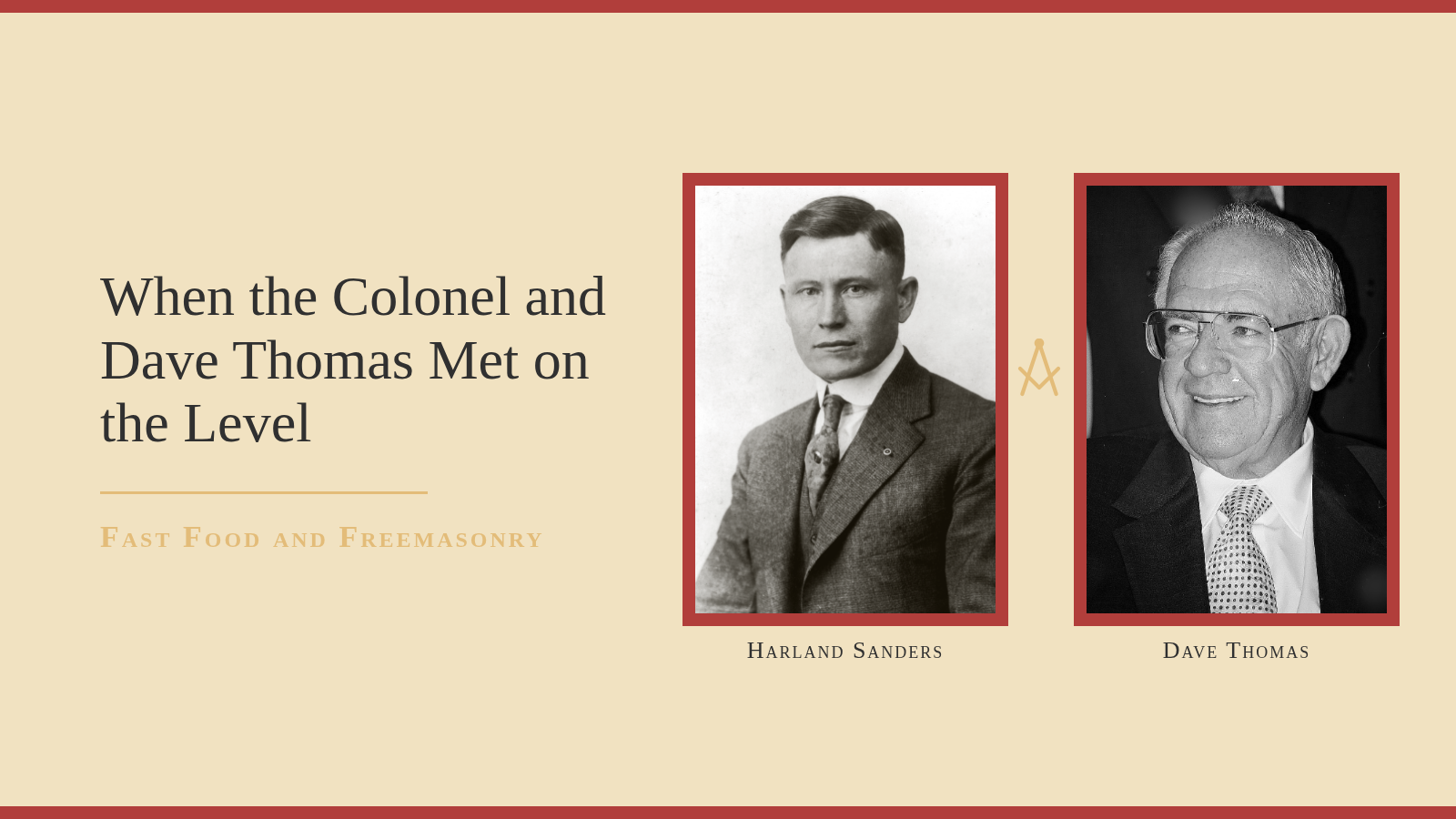
Two of the most familiar faces in American roadside food, a white-suited colonel from Kentucky and a soft-spoken hamburger man from Ohio, were both Freemasons. Their stories say less about chicken and burgers than about what a man does with hard beginnings.
A Boy Who Learned to Cook
Harland David Sanders was born on 9 September 1890 near Henryville, Indiana. His father died when Harland was six. According to the Grand Lodge of Ohio’s profile of him, the boy took on much of the family cooking and had mastered several regional dishes by the age of seven. He was working as a farmhand at ten and left school after the seventh grade.
What followed was a long, uneven road. Sanders served briefly in the Army in Cuba, worked on the railroads, studied law at night and practiced in Little Rock until a courtroom fight with his own client ended that career. He sold insurance, ran a ferry company on the Ohio River and sold tires. During the Depression he ran a service station in North Corbin, Kentucky, and began feeding travelers, at first in his own living room. In 1935 Governor Ruby Laffoon made him a Kentucky colonel. A fire destroyed his restaurant and motel in 1939, and wartime gas rationing hurt the business again.
He was past sixty when, in 1952, he franchised his chicken for the first time, to Pete Harman in Salt Lake City. He sold his stake in the company in 1964 but stayed on as its public face.
Brother Sanders
Sanders’s Masonic record is better documented than most. The Grand Lodge of British Columbia and Yukon’s biography, drawing on the card file of the Grand Lodge of Kentucky, records that he was initiated on 6 April 1917 in Lodge No. 651 at Henryville, Indiana. He received his second and third degrees in 1919, conferred by Clark Lodge No. 40 as a courtesy to his home lodge. He demitted in 1920. More than three decades later, on 27 October 1953, he affiliated with Hugh Harris Lodge No. 938 in Corbin, Kentucky, and remained a member until 13 April 1976. The same source notes that his gravestone bears the square and compasses.
The Grand Lodge of Ohio sums him up as a man who “demonstrated the values of the fraternity throughout his life,” and points especially to relief. Before his death he set up the Colonel Harland Sanders Charitable Organization. A family care center at a Mississauga hospital for women and children bears his name, and his foundation has supported children’s hospitals across Canada.
He was also famously stubborn about quality. In his later years, the Grand Lodge of Ohio recalls, he made surprise visits to restaurants and complained loudly when he felt the food no longer lived up to his name. You may smile at that, but there’s something Masonic in it too. A man’s work should be true to the plumb, even when no one is checking.
Sanders died on 16 December 1980, at the age of ninety.
A Boy Who Was Given a Home
Rex David Thomas was born on 2 July 1932 in Atlantic City, New Jersey, and was adopted as a baby by a family that settled in Michigan. The Grand Lodge of Ohio’s profile tells a hard childhood. He lost his adoptive mother at five, and the family moved often. In Fort Wayne, Indiana, he worked as a paperboy, a golf caddy and a soda-fountain clerk. At fifteen he took a job at the Hobby House restaurant, and when his father moved on again, Dave stayed, left school and worked full time.
The Hobby House connection led him to Kentucky Fried Chicken. He was sent to Columbus, Ohio, to turn around struggling KFC restaurants there, and did. In 1969 he opened his own hamburger restaurant in Columbus and named it after his daughter’s nickname, Wendy.
Brother Thomas
The Grand Lodge of Ohio and the Grand Lodge of British Columbia and Yukon both record that Thomas was a member of Sol. D. Bayless Lodge No. 359 in Fort Wayne, Indiana. He was initiated on 13 April 1959, passed on 20 April and raised on 25 May 1959, at the age of twenty-seven. He later became a 33° Scottish Rite Mason and a Shriner.
The two men knew each other well. Centennial Lodge No. 326, drawing on the Scottish Rite Journal‘s report of the 1997 Biennial Session, records that Thomas spoke there about his friendship with Colonel Sanders as a fellow Mason. It’s tempting to say that Sanders brought Thomas into the Craft. As that same lodge history notes, no reliable record shows that, so we won’t claim it.
The Work He Chose
For all his business success, the cause Dave Thomas gave his later life to was adoption. In 1990 he accepted President George H. W. Bush’s invitation to be spokesman for a national adoption awareness campaign. On 31 July 1992 he founded the Dave Thomas Foundation for Adoption. In 1997 he testified before Congress for an adoption tax credit, and he helped bring about the U.S. Postal Service’s adoption stamp, issued in 2000. The foundation reports that its work has since helped more than 15,000 children in foster care find permanent families.
The foundation calls his “unceasing desire to improve the lives of North America’s most vulnerable children” his greatest contribution, and it’s hard to argue. He had been a child who needed a family, and when he had the means, he spent them making sure other children found one.
Dave Thomas died on 8 January 2002.
What the Craft Might See in Them
Neither man was polished. Both left school early, both failed more than once, and both started over later in life than most of us would dare. The Craft doesn’t claim credit for their success, and it shouldn’t. Plenty of men build businesses without ever entering a lodge.
But Freemasonry does teach a few things that show plainly in these two lives. We’re taught to practice relief, and both men gave a great deal away, especially to children. We’re taught that honest work done well matters even in small things, and Sanders never stopped fussing over his gravy. And we’re taught that a man’s worth isn’t set by where he started. A fatherless farm boy and an adopted son both found their way to the same fraternity. Each of them, in his own fashion, tried to leave the road a little kinder for those coming after.
Who is a brother you’ve known whose hardest beginnings shaped the way he gives back? What did he teach you without ever saying it?
Sources
- Grand Lodge of Ohio, “Colonel Harland David Sanders” (13 July 2022). https://www.freemason.com/colonel-sanders/
- Grand Lodge of British Columbia and Yukon, “Colonel Harland Sanders” (citing the card file of the Grand Lodge of Kentucky). https://freemasonry.bcy.ca/biography/sanders_h/sanders_h.html
- Zach Berger, “The Lasting Legacy of Entrepreneur, Philanthropist, and Freemason, Dave Thomas,” Grand Lodge of Ohio (17 February 2021). https://www.freemason.com/legacy-dave-thomas/
- Grand Lodge of British Columbia and Yukon, “Rex David Thomas.” https://freemasonry.bcy.ca/biography/thomas_d/thomas_d.html
- Dave Thomas Foundation for Adoption, “Our History and Dave’s Story.” https://www.davethomasfoundation.org/about-us/our-history-and-daves-story/
- Centennial Lodge No. 326, “Colonel Sanders and Dave Thomas: Fast-Food Pioneers and Masonic Brothers” (20 August 2026). https://www.centennial326.org/2026/08/colonel-sanders-and-dave-thomas-fast.html