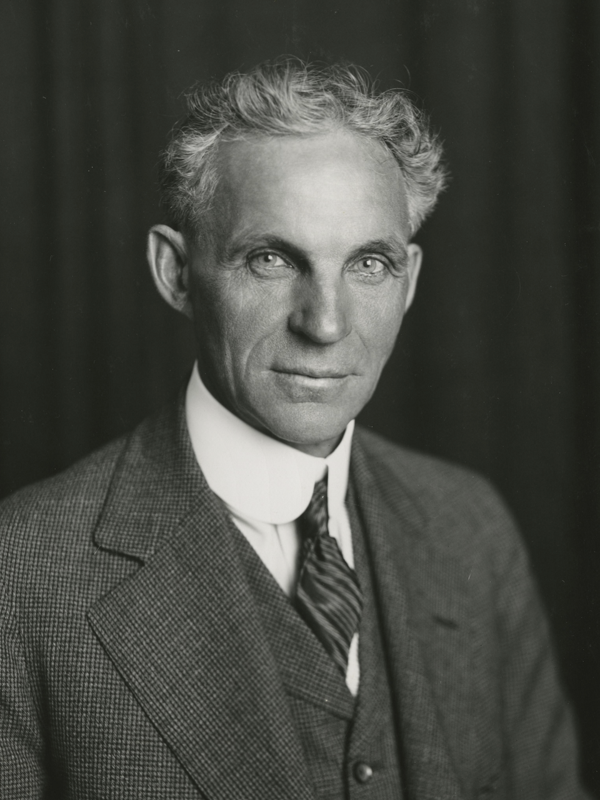
Henry Ford
Born July 30, 1863, Springwells Township (now Dearborn), Michigan · Died April 7, 1947, Dearborn, Michigan · Palestine Lodge No. 357, Detroit (later member of Zion Lodge No. 1)
Founder of the Ford Motor Company, raised in a Detroit lodge in 1894.
Failure is only the opportunity more intelligently to begin again. There is no disgrace in honest failure; there is disgrace in fearing to fail.
The farm boy who rebuilt industry
Henry Ford was born on July 30, 1863, on his father’s farm in Springwells Township, Wayne County, Michigan, in what is now Dearborn. He was the eldest of six. His father, William, had come from County Cork, Ireland, in 1847. The farm never held the boy the way machines did. By twelve he was spending spare hours in a small shop he had equipped himself, and at fifteen he built his first steam engine.
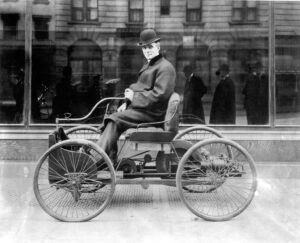
In 1879, at sixteen, he left for Detroit as a machinist’s apprentice. He married Clara Bryant in 1888, and in 1891 he joined the Edison Illuminating Company as a night engineer, taking the job partly to learn electricity. By 1893 he was chief engineer. In his spare time he built an engine on the kitchen table at 58 Bagley Avenue, and in June 1896 he finished his first car, the Quadricycle: four bicycle-style wheels, a tiller for steering and no reverse gear.
His first two automobile companies failed. He kept going, built racing cars to win attention and backers, and on June 16, 1903, he and twelve investors incorporated the Ford Motor Company with $28,000. The Model T followed on October 1, 1908. It was simple, tough and easy to repair on rough country roads, and it sold faster than Ford could build it. By late 1913 the Highland Park plant had a moving assembly line. Experiments through that year and into 1914 cut the time to build a Model T from twelve and a half hours to about ninety-three minutes.
Five dollars that steadied a factory
The line created a new problem. The work was relentless and monotonous, and by late 1913 labor turnover at Highland Park stood near 370 to 380 percent. The Henry Ford records that the company sometimes had to hire nearly ten men to add one lasting job. On January 5, 1914, Ford and his vice president James Couzens answered with what the museum’s curators call his boldest step: five dollars for an eight-hour day, roughly double the previous rate of about $2.34 for nine hours.
The documented motive was practical. High wages were meant to keep a steady crew on a line that depended on them, and to make the tedium more tolerable. The raise was framed as profit sharing, and it came with conditions: the company’s Sociological Department checked workers’ homes and habits before the full bonus was paid. Crowds of applicants flooded Detroit before the company limited hiring to people who had lived in the city for at least six months.
Ford also stated a second purpose in his own terms. As Curator Matt Anderson of The Henry Ford puts it, Ford “slyly observed” that by lifting his workers’ standard of living he was creating customers for the Model T. Workers who stayed and earned more could, in time, buy the cars they built. Other employers raised wages to keep pace. The bargain of hard work for higher pay helped steady Highland Park and widened the market for the car.
From the Oscar II to Willow Run
Ford’s conscience was not quiet about war. Disgusted by the carnage of World War I, he chartered the ocean liner Oscar II in December 1915 and sailed from Hoboken with citizen mediators he hoped might help negotiate peace. The Henry Ford calls the Peace Ship a well-meaning but naive effort. The delegates quarreled, press support faded, and Ford tired of the bickering. The expedition failed. He remained a pacifist who hoped the United States would stay out of world wars, and he spoke against American entry into the European conflict before Pearl Harbor.
Yet once the United States entered each war, his plants built for it. Near the end of World War I, Undersecretary of the Navy Franklin D. Roosevelt engaged Ford to build Eagle boats, warships meant to hunt German submarines. Ford Motor Company accepted a Navy contract, raised a shipyard on the Rouge River, and applied factory methods to the hulls. The company completed sixty Eagle boats between May 1918 and August 1919. Few saw fighting before the Armistice, but the Rouge yard became the seed of Ford’s industrial complex.
In World War II the larger mark was Willow Run. Approached to make parts for the B-24 Liberator, Ford countered with a plan to build complete bombers on a moving line. On farmland near Ypsilanti the company and architect Albert Kahn raised a mile-long plant. After a difficult start, Willow Run hit its stride: by April 1944 it was finishing a Liberator about every sixty-three minutes. By June 1945 workers there had built 8,685 B-24s, counting complete planes and knock-down kits. Pacifism and production sat side by side in the same life.
The darkest part of his record cannot be left out, but it should not be the whole story. In 1918 Ford bought a weekly, The Dearborn Independent. Beginning on May 22, 1920, it ran a long series called “The International Jew,” which drew on the forged Protocols of the Elders of Zion and spread lies about Jewish control of finance, the press and public life. Dealers were pressed to distribute the paper, and the articles were reprinted as books and translated widely. The United States Holocaust Memorial Museum notes that Adolf Hitler praised Ford in the 1920s. In 1927, facing a libel suit from attorney Aaron Sapiro, Ford signed a public apology and closed the paper, yet the books kept circulating. His company, foundation and descendants have since acknowledged this history.
Ford was raised a Master Mason on November 28, 1894, in Palestine Lodge No. 357 in Detroit, during his years as an engineer at Edison Illuminating, before any of his companies existed. He later belonged to Zion Lodge No. 1. The dates of his first two degrees are not in the sources we have read, so we leave them blank. We do not have a public record of what Freemasonry meant to him personally, and we will not invent one. Famous Masons are not saints in aprons. Some lives show what the Craft can help a man become; some show how far a man can drift from what he has been taught. Ford’s life asks both of those questions of us.
Ford remade the factory floor, sailed for peace, built for his country in war, and also published a paper that spread hate. How should a lodge weigh a Brother whose gifts and faults both ran so deep?
Sources
- The Henry Ford, Ford’s Five-Dollar Day (Matt Anderson): https://www.thehenryford.org/collections/explore/articles/fords-five-dollar-day
- The Henry Ford, Crowd of Applicants after Five Dollar Day Announcement: https://www.thehenryford.org/collections/explore/artifact/35765
- The Henry Ford, Peace Ship artifact (Oscar II, 1915): https://www.thehenryford.org/collections/explore/artifact/113132
- The Henry Ford, Research Guide: Eagle Boats: https://askus.thehenryford.org/researchguides/faq/203168
- The Henry Ford, Ford Rouge Factory History and Timeline: https://www.thehenryford.org/collections/explore/popular-research-topics/ford-rouge-factory-tour-history-and-timeline
- The Henry Ford, Willow Run Bomber Plant: https://www.thehenryford.org/collections/explore/sets/detail/willow-run-bomber-plant
- Smithsonian Magazine, How Detroit Went from Motor City to the Arsenal of Democracy: https://www.smithsonianmag.com/smart-news/when-detroit-was-arsenal-democracy-180962620/
- United States Holocaust Memorial Museum, Antisemitism and Henry Ford’s “The International Jew”: https://encyclopedia.ushmm.org/content/en/article/antisemitism-and-henry-fords-international-jew
- Ford Motor Company, Henry Ford biography: https://corporate.ford.com/articles/history/henry-ford-biography
- Grand Lodge of British Columbia and Yukon, Henry Ford: https://freemasonry.bcy.ca/biography/ford_h/ford_h.html
Life & Masonic Timeline
Ford Motor Company. Photographic Department, via Wikimedia Commons · Public domain · Source