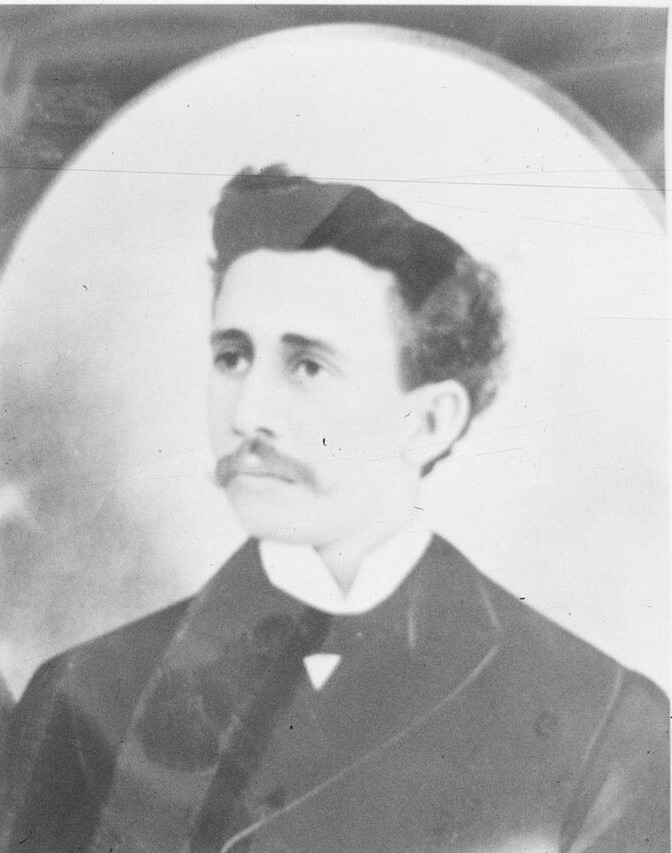
J.C. Penney
Born September 16, 1875, near Hamilton, Missouri · Died February 12, 1971 · Wasatch Lodge No. 1, Salt Lake City, Utah
James Cash Penney built a national chain of department stores on the Golden Rule, sharing ownership and profits with the managers who ran them.
Our idea was to make money and build business through serving the community with fair dealing and honest value.
A Hamilton Farm Boy Who Paid for His Own Clothes
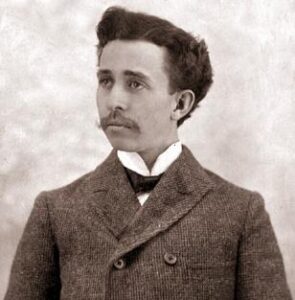
James Cash Penney Jr. was born on September 16, 1875, on a farm near Hamilton, in Caldwell County, Missouri, the seventh of twelve children of James Cash Penney, an unsalaried Baptist minister and farmer, and Mary Frances Paxton Penney. Only six of the children reached adulthood. The family lived by the Golden Rule, self-reliance and a strict sense of honor. When Jim was about eight, his father decided he should pay for his own clothing; the boy raised and sold livestock until neighbors complained of the noise and smell. He graduated from Hamilton High School in 1893 and hoped to become a lawyer. On February 4, 1895, six weeks before his death, his father helped him get a clerk’s job at J. M. Hale and Brothers, the dry-goods store in Hamilton. The day before he died, the elder Penney said, “Jim will make it. I like the way he has started out.”
The son never went to college. His first year’s salary at Hale’s was only $25, and the other salesmen often bullied him and took his customers, so he learned to stand up for himself. He advanced quickly, and by 1897 he was earning $300 a year.
Then his health began to fail, and the family doctor told him that unless he moved to a drier climate he would die of tuberculosis. In June 1897 he went west. After a short time as a dry-goods clerk in Denver he bought a butcher shop in Longmont, Colorado, with all his savings. It failed because he refused to give free liquor to the chef of the local hotel, which supplied most of the shop’s business. In 1898 he went to work as a clerk for Thomas M. Callahan and Guy Johnson in their Golden Rule store in Longmont. Early in 1899 they offered him a clerkship in their Evanston, Wyoming, store at fifty dollars a month, and that year he married Berta Alva Hess. He did so well that they decided to make him a partner in a new store. They first planned to put it in Ogden, Utah, but Penney argued that Ogden was too large and that a smaller town such as Diamondville or Kemmerer would be better. They settled on Kemmerer, and using savings and a loan, he joined the partnership and moved there with his wife and infant son.
The Kemmerer Store, and a Chain of Good Men
The store opened on April 14, 1902, in a one-room wooden building; the family lived in the attic above it. Penney later said they chose the name Golden Rule because “our idea was to make money and build business through serving the community with fair dealing and honest value.” He sold quality goods at fair prices, for cash only, to mining and farm families. Many in town predicted he would fail against the coal companies’ stores, which offered credit. His first day’s receipts were $466.59, and by year’s end he had sold $28,898.11 worth of merchandise. He kept his overhead remarkably low, stocked only lines that sold well, and raised the store’s profits every year. Within a year he was managing two more Wyoming stores. In 1907 he bought out Callahan and Johnson and took on additional stores in Rock Springs and Cumberland.
He called his employees “associates.” Managers became partners in new stores, shared the profits, and were expected to find and train another honest, hardworking man to open the next one. His goal was not a chain of stores but a chain of good men. In 1909 he gave up managing the Kemmerer store and set up a central purchasing headquarters in Salt Lake City for his six stores; over the next three years twenty-eight more opened in Utah, Idaho, Nevada, Oregon, Washington and Colorado. In 1910 Berta died of pneumonia, leaving him with two sons, Roswell Kemper and James Cash. He later wrote that his “world crashed” around him. By 1912 he had thirty-four Golden Rule stores and more than $2 million in sales. In 1913 he and his partners incorporated as the J. C. Penney Company, dropping the name Golden Rule because less scrupulous competitors used it so widely. He moved the headquarters to New York City about 1913–14, to be nearer the merchandise markets, and opened his first Missouri store on April 15, 1918, in Moberly. In 1919 he married Mary Hortense Kimball; she died in 1923, leaving a son, Kimball. In 1926 he married Caroline B. Autenreith, with whom he had two daughters; they remained together until his death.
Five Hundred Stores, a Crash, and a Return
In 1924, after J. M. Hale retired, Penney opened the company’s five-hundredth store in Hamilton, in the same building where he had first clerked, and chose fourteen local citizens as partners. After a public offering in 1927, store managers received shares, and profit-sharing was later extended to all employees. By 1928 the company operated 1,023 stores with annual sales of more than $176 million. Its success drew imitators; in the 1920s even the mail-order giants Sears, Roebuck and Montgomery Ward began opening similar stores, and in 1929 both held talks with Penney about a merger, though no agreement was reached. The Depression barely slowed the company, which grew from 1,392 stores in 1929 to 1,473 in 1932. Penney himself was less fortunate. Bad investments in Florida real estate and banking cost him almost his entire fortune of $40 million. He met the crisis by going back to work full time for the company and eventually recouped most of his losses. He served for many years as chairman of the board and remained a director until his death. In 1950 he published Fifty Years with the Golden Rule.
Wasatch Lodge No. 1, Cattle, and a Home for Retired Ministers

Penney was initiated and raised in Wasatch Lodge No. 1 in Salt Lake City, the city where he had set up his headquarters in 1909. In parts of the country his stores and Masonic lodges came to share buildings, with a Penney store on the ground floor of a Masonic hall, where a store downstairs was a steady source of rent for a lodge meeting upstairs, and the phrase “J. C. Penney lodge” grew out of the arrangement, though neither Penney nor his company built Masonic temples. In Minnesota, Mesaba Lodge No. 255 at Hibbing and Wadena Lodge No. 156 each had a Penney store as their main tenant, for 63 and 70 years respectively, and Mesaba Lodge’s correspondence shows that its building was put up with the intent of having J. C. Penney move in when it was finished.
In the 1920s he bought his father’s farm near Hamilton and established a purebred Aberdeen Angus herd there, and he developed a purebred Guernsey herd at Emmadine Farm in New York, which he gave to the University of Missouri in 1952. In Florida he established a 120,000-acre scientific farming community and the Memorial Home Community, a 60-acre residential community for retired ministers, lay church workers, missionaries and their families. He endowed a chair at Westminster College in Missouri, helped found and fund Junior Achievement, became a charter member of the Distributive Education Clubs of America in 1957, and in 1954 established the James C. Penney Foundation to support work on community renewal, the environment and world peace. Though he never went to college, he received honorary degrees from several, among them the University of Missouri. He died in New York City on February 12, 1971, at the age of ninety-five. At his death the company operated some 1,660 stores in North America.
How did Penney’s practice of sharing store ownership put the Golden Rule to work beyond a slogan?
Sources
- State Historical Society of Missouri — J. C. Penney
- Grand Lodge of British Columbia and Yukon — James Cash Penney
- National Register of Historic Places nomination — J. C. Penney Historic District, Kemmerer, Wyoming (1977)
- Minnesota Masonic Heritage Center — “J.C. Penney” lodges
Life & Masonic Timeline
J. C. Penney, c. 1902. University of Colorado Boulder Libraries, via DPLA and Wikimedia Commons. Cropped. · Public domain · Source