I have seen The Magic Flute hundreds of times. I have heard it on film and in the theatre, at the Sydney Opera House and in Frankfurt, and in more productions than I can usefully count. I love the music, and I love the hidden symbolism that Wolfgang Amadeus Mozart and his lodge brother Emanuel Schikaneder built into it.
Even so, I have come to hear it less as a purely Masonic opera than as a Mozart opera. It carries his own life and his own beliefs, not only the Freemasonry he loved.
It is an opera full of dichotomies: sun and night, bass and soprano, male and female, solemnity and silliness, contrasting the opposites and colors found in life.
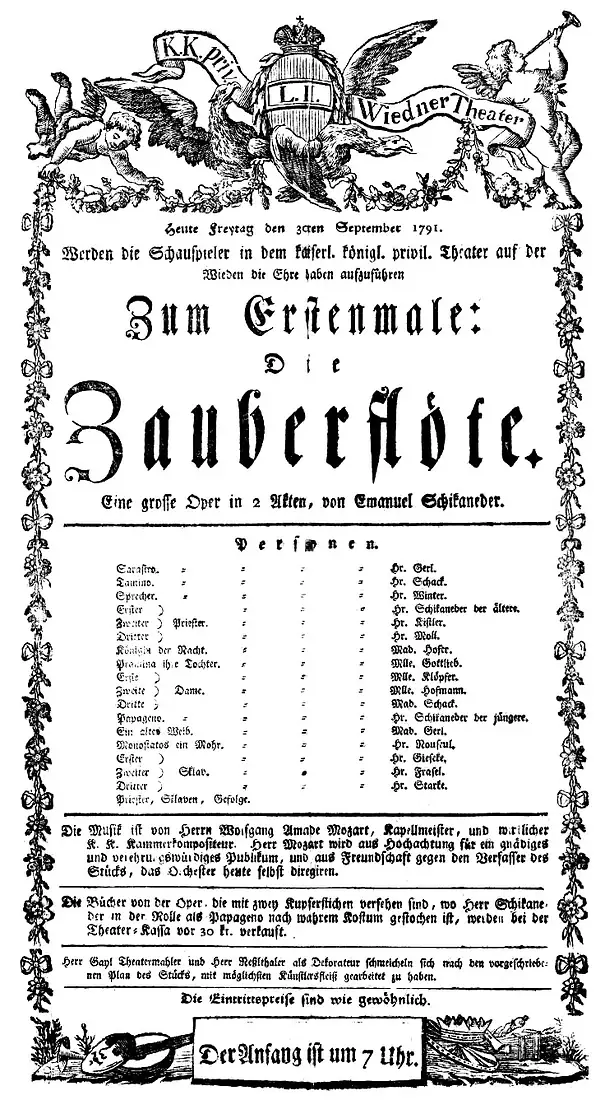

Those Three Chords
There are sounds in this score that, to a Mason’s ear, recall the knocks heard at a degree. They run through the opera as a theme. The overture opens with those famous threefold chords, solemn and widely spaced. They return at the start of Act 2, in the priests’ scene, where the first printed libretto of 1791 calls for the horns to be sounded three times, and Mozart writes the threefold chord into the score, as the editors of the Neue Mozart-Ausgabe note. The number three keeps returning in other ways as well: three ladies, three boys, three temples. You do not need to be a Mason to hear how carefully he planted that pattern.
The trials themselves are part of the same design. Tamino and Pamina pass through fire and water together, and Mozart writes some of the most beautiful harmonies in the opera over that passage, the flute leading them while the orchestra holds them up. It is a test, and it is also a love story: they endure it side by side.
Just before those trials, two Armed Men bar the way. In my hearing, the threefold theme of the overture and the priests’ scene is still in the air in their music, though I do not claim they sound those same three chords. Musicologists have identified their melody as the old Lutheran chorale “Ach Gott, vom Himmel sieh darein,” sung over a strict contrapuntal accompaniment, a setting Markus Rathey examines in Mozart, Kirnberger and the Idea of Musical Purity. Whenever I hear that scene, I also hear a kinship with Mozart’s Masonic Funeral Music, the Maurerische Trauermusik, K. 477: the same grave color, the same solemn wind writing, the same sense that something holy and costly is being asked of the people on the stage. That comparison is my own. I offer it as a listener, not as a claim that the two pieces were built from the same tune.
The Aria That Still Walks Out of the Opera House
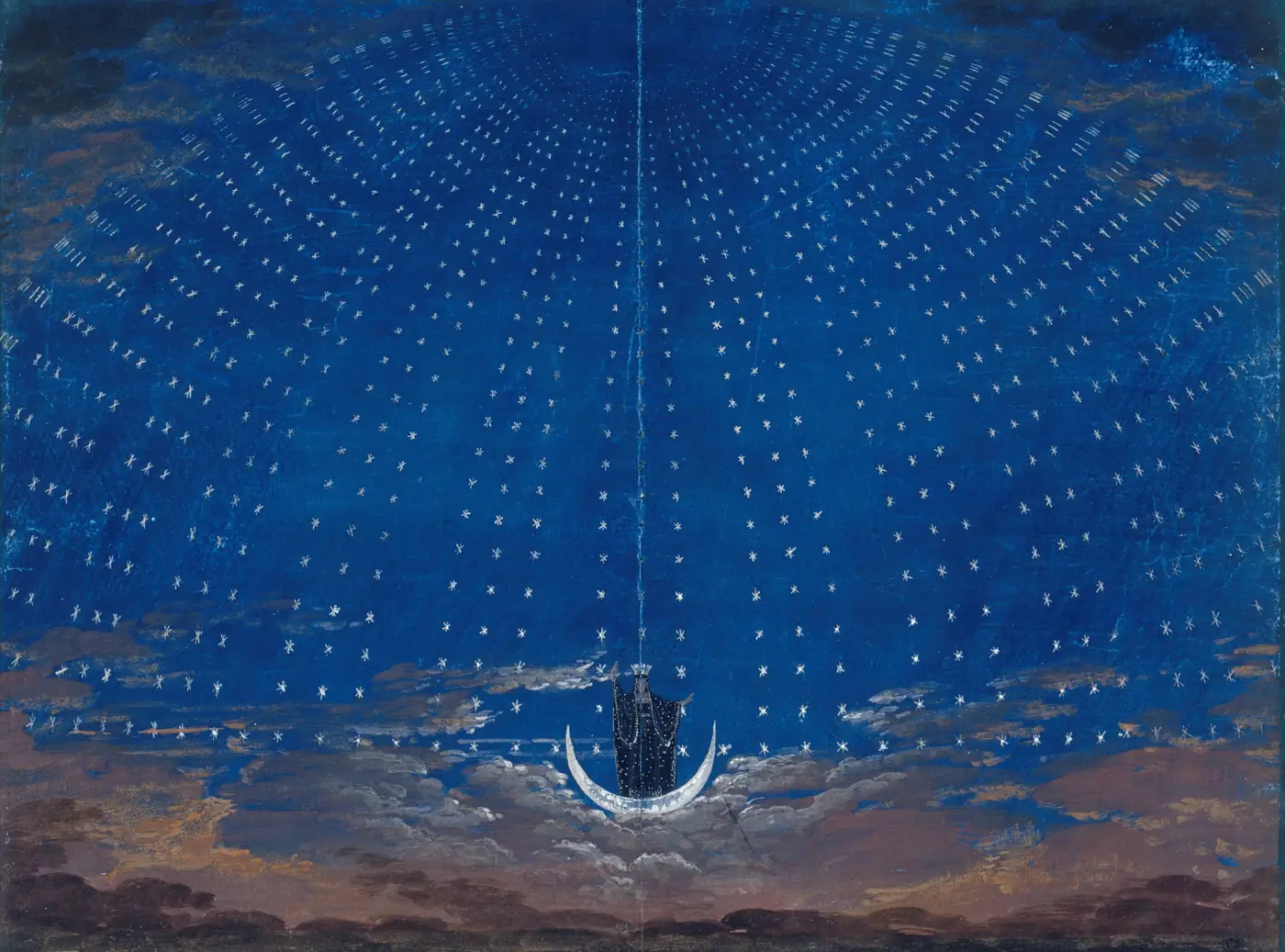
The Queen of the Night’s great aria, “Der Hölle Rache kocht in meinem Herzen,” still turns up far from any opera house. In the film Eat Pray Love, it is the music that plays while Julia Roberts sits down to a plate of spaghetti in Italy, a reminder of how completely that furious coloratura has entered ordinary popular culture, as the English National Opera notes in 10 Famous Opera Songs in Movies.

Sarastro, the Embodiment of Freemasonry
Sarastro is, to my ear, the embodiment of Freemasonry on that stage: masculine, just, understanding, forgiving, and truthful. You see it in the way he judges between Monostatos and Pamina. At the end of the first act, Monostatos drags Pamina before him and claims credit for having caught her. Sarastro sees through the performance at once. He “rewards” the overseer with seventy-seven strokes on the soles of the feet, and he treats Pamina with care, refusing to force her heart. Later, when Monostatos again threatens her, Sarastro stops him, tells the truth of the matter, and lets mercy have the last word. Then he sings “In diesen heil’gen Hallen / kennt man die Rache nicht” — in these holy halls, one does not know revenge.
I never tire of hearing René Pape sing that role. He has made Sarastro one of his signature parts, including at the Metropolitan Opera — as he noted ahead of a 2017 performance there in Sarastro at the Metropolitan Opera — and I love the many different performances he has given of it. Each one seems to find another shade of that justice and calm.
More Than a Prince, a Man
The most Masonic line in the opera, for me, comes when the priests are considering whether to accept Tamino. The Speaker worries about the hard trials ahead. “Er ist Prinz!” he says — he is a prince. Sarastro answers, in the wording of the first printed libretto of 1791, “Noch mehr — — Er ist Mensch!” More than that, he is a man. The same exchange stands in the Digitale Mozart-Edition of Die Zauberflöte, KV 620, and in Die Zauberflöte: Eine große Oper in zwey Aufzügen, the libretto printed at Vienna by Ignaz Alberti in the year of the premiere.
Er ist Prinz!
Noch mehr — — Er ist Mensch!He is a prince!
— Emanuel Schikaneder, Die Zauberflöte, 1791
More than that — he is a man!
That is the whole point. Rank is not the measure. In published Masonic monitors you can read the same idea in plain language. George Thornburgh’s Masonic Monitor of the Degrees of Entered Apprentice, Fellow Craft and Master Mason, in the 1909 Louisiana edition, puts it this way: “Masonry regards no man for his worldly wealth or honors; it is therefore the internal and not the external qualifications of the man that recommend him to become a Mason.” Wording varies from one monitor to another, but the principle is the same one Sarastro speaks: it is the man who matters, not the prince.
Man and Wife, Reaching to the Divine
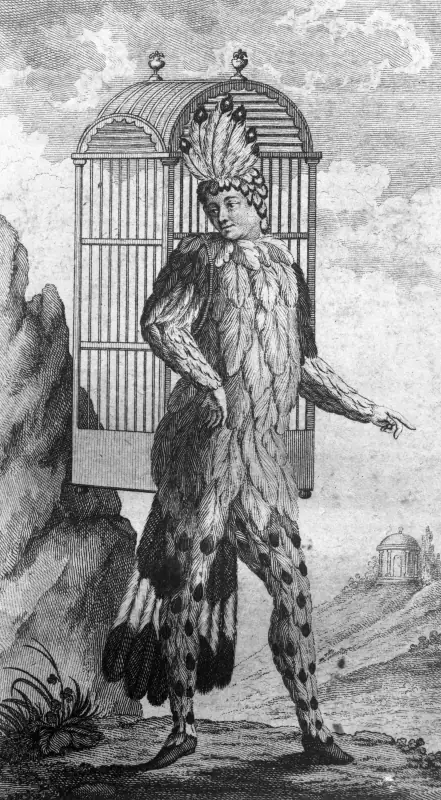

There is a duet I never tire of, “Bei Männern, welche Liebe fühlen,” sung by Pamina and Papageno. It is an ode to the love between woman and man, and it closes with a line I take to be Mozart’s own belief more than a Masonic one. In Mozart’s score, as given in the Digitale Mozart-Edition, they sing:
Mann und Weib und Weib und Mann
reichen an die Gottheit an.Man and wife, and wife and man,
— Emanuel Schikaneder, Die Zauberflöte, Mozart’s score
reach up to the divine.
In the first printed libretto of 1791 the last word is Götter, “the gods.” In the music itself the word is Gottheit: divinity, the Godhead. Either way, the thought is that a man and a woman, joined in love, reach toward something higher than either can touch alone.
That idea will sound familiar to readers from The Church of Jesus Christ of Latter-day Saints. In the Church’s official teaching, marriage between a man and a woman is not only for this life. As the chapter Eternal Marriage in Gospel Principles explains, eternal marriage is essential to exaltation, the highest hope held out to the faithful. I mention that with respect, and simply as a kinship of ideas. It is not a Masonic doctrine I am describing here. It is a Mozart one that other traditions have also recognized.
The tune itself found a second life in older Latter-day Saint hymnals under the title “Though in the Outward Church Below,” a text by John Newton. In The Latter-day Saints’ Psalmody of 1889 it appears as no. 330, under the tune name Elliot, and the composer is given as Mozart. It appears again in The Songs of Zion of 1918 as no. 122, once more attributed to Mozart. In From Arcadia to Elysium in The Magic Flute and Weimar Classicism, John B. Fowles identifies that melody as this very duet, “Bei Männern, welche Liebe fühlen.”
The First Queen of the Night
Mozart’s own life is written into this opera in another way, through the Weber sisters. As a young man he courted the soprano Aloysia Weber. In a letter to her of 30 July 1778, written from Paris, he called her “Dearest friend,” told her he had written a scene expressly for her, and said that the most felicitous day he could imagine would be the one on which he could see her again and embrace her with his whole heart. He did not win her. She married the actor and painter Joseph Lange in 1780.
He married her sister Constanze instead, at St. Stephen’s Cathedral in Vienna on 4 August 1782. A letter to Baroness von Waldstätten shortly before that date shows him determined to make Constanze his wife rather than expose her to her mother’s threats. The first Queen of the Night was not Aloysia, and she was not Constanze. She was another sister still, Josepha Hofer. The Polish Musical Library’s note on Weber, Josepha records that Mozart wrote the Queen of the Night’s music with her voice in mind, and that she was the first to sing the role, at the Vienna premiere on 30 September 1791.
He wrote that aria to show off what she could do. From a darker, more humorous angle, it has always sounded to me like the song to end all sopranos.
The Story That He Was Poisoned
The Magic Flute was one of Mozart’s last operas, and a rumour grew up later that Freemasons poisoned him for revealing elements of the degrees in it. I find that legend extremely unlikely. Schikaneder, who wrote the words, lived on until 1812. Mozart’s own lodge brethren, after his death, published his last Masonic cantata to benefit his widow and children. Those are not the acts of a fraternity covering up a murder.
The poisoning talk started early, in a general way. In Mozartian Conspiracy Theories, the historian Robert Greenberg notes that a Berlin paper, less than a month after Mozart died, mentioned that some people believed he had been poisoned because his body had swollen. The specifically Masonic version of the story came much later. In 1861, G. F. Daumer claimed that the Masons had killed Mozart for revealing secrets in The Magic Flute. That claim was later taken up in antisemitic, anti-Masonic writing, including by Mathilde Ludendorff in the years around the rise of the Nazi movement, and used to paint Freemasonry as a secret enemy of German genius. It belongs with the other invented charges I have written about in Anti-Masonry Through the Ages.
What the record actually shows is quieter, and sadder. Mozart fell ill on 20 November 1791, a little more than seven weeks after the premiere, and died in the early hours of 5 December, aged thirty-five. Not one of the physicians who attended him suggested that he had been poisoned. From the sources we do have, it is believed he died of an acute infectious illness. In The Death of Wolfgang Amadeus Mozart: An Epidemiologic Perspective, Richard H. C. Zegers, Andreas Weigl, and Andrew Steptoe studied Vienna’s official death registers and found a rise in edema-related deaths among younger men in the weeks around Mozart’s death, a pattern consistent with a streptococcal infection leading to an acute nephritic syndrome. That is a long way from a Masonic plot.
If You Have Never Seen It
If you have never seen The Magic Flute, I highly recommend it. You will enjoy the music and the story, and you will notice, if you listen for them, the Masonic undertones and the life Mozart poured in around them. A good short introduction is the TED-Ed lesson The secrets of Mozart’s “Magic Flute”, written by Joshua Borths, which walks through the opera’s symbolism and Mozart’s involvement with Freemasonry.
When you next sit down to The Magic Flute, will you listen only for a fairy tale, or for the man Mozart believed every one of us is?