
Wolfgang Amadeus Mozart
Born January 27, 1756 · Died December 5, 1791 · Zur Wohltätigkeit, Vienna
As death, when we come to consider it closely, is the true goal of our existence, I have formed during the last few years such close relationships with this best and truest friend of mankind that his image is not only no longer terrifying to me, but is indeed very soothing and consoling.
From prodigy to master
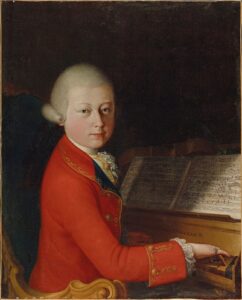
Wolfgang Amadeus Mozart was born in Salzburg on January 27, 1756. His father, Leopold, was a court musician and the author of a well-known violin method published in the year of his son’s birth. The boy’s gift showed almost at once. At three he was picking out chords on the harpsichord, at four he was playing short pieces, and at five he was composing. Leopold called him “the miracle which God let be born in Salzburg.” He felt bound, as Britannica’s biographer puts it, to show that miracle to the world, and, incidentally, to profit from doing so.
Before he was six, Wolfgang and his gifted sister Nannerl had played at the Bavarian court and the imperial court in Vienna. In mid-1763 the family set out on a tour of Europe’s musical capitals that lasted more than three years, taking in Munich, Paris, London, The Hague and more. In London he met Johann Christian Bach and wrote his first symphonies. At 13 he was appointed honorary Konzertmeister at the Salzburg court.
The child prodigy grew into a working composer who wrote in every musical genre of his day and excelled in all of them. Britannica’s summary is apt: he did not set out to overturn the forms he inherited. He perfected them, and raised the symphony, the concerto and opera to new heights. His operas The Marriage of Figaro (1786), Don Giovanni (1787) and The Magic Flute (1791), the Jupiter Symphony of 1788 and the unfinished Requiem are among the works by which Western music measures itself. He died in Vienna on December 5, 1791, at 35.
Music that crosses every border
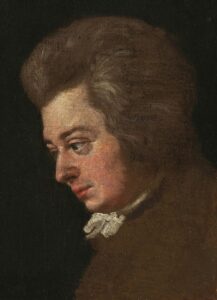
Mozart’s music is still played everywhere, more than two centuries on, because it speaks across class, language and time. That fits something the Austrian State Archives note about him. Many documents show his conviction that a person’s worth does not come from his social origin. He was a servant of the archbishop of Salzburg who became one of the first great freelance composers in Vienna, and he lived that conviction.
His life was short and not always well managed. Popular legend has also wrapped it in myth. The State Archives warn that after his death, his Masonic activity was repeatedly used for wild speculation, up to the claim that The Magic Flute “betrayed” Masonic secrets. A careful reader should set those stories aside and look at the record.
A Brother in the lodges of Vienna
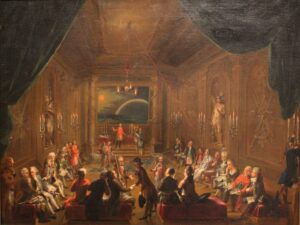
Mozart was proposed for membership in the Viennese lodge Zur Wohltätigkeit (“Beneficence”) on December 5, 1784, and initiated on December 14. The lodge’s Master was Otto von Gemmingen-Hornberg, whom Mozart already knew from Mannheim. Freemasonry was then in fashion in Vienna, even though papal bulls of 1738 and 1751 forbade it. Members had included Emperor Franz I Stephan, husband of Maria Theresa, along with leading figures in science, the arts and government such as Gerard van Swieten and Joseph von Sonnenfels. The chaplain Wenzel Summer was initiated in the same ceremony as Mozart. At the request of his own lodge, he was passed to the second degree on January 7, 1785, in the lodge Zur wahren Eintracht (“True Concord”). Its Master was the scientist Ignaz von Born. The date of his raising is debated. Some writers give April 22, 1785, reading it from True Concord’s attendance register for that day, while others hold that the exact date is unknown. That register, preserved in the Austrian State Archives, lists both Wolfgang and his father Leopold as visitors “from Beneficence” in April 1785.
Viennese lodges of the time drew members from almost every social class, including writers, soldiers, officials, clergy and nobles. The State Archives say that this equal footing was “without doubt of great importance” to Mozart. He brought both his father and his friend Joseph Haydn into the Craft. After Joseph II’s decree of December 1785 reduced Vienna’s lodges to three, he carried on, above all in the lodge Zur neugekrönten Hoffnung (“New Crowned Hope”). The lodge records describe him as a diligent member.
He also wrote for his brethren. His Masonic works include the cantata Die Maurerfreude, K. 471 (1785), in honor of Ignaz von Born; the Masonic Funeral Music, K. 477; and the Little Masonic Cantata, K. 623. He finished K. 623 on November 15, 1791, for the dedication of his lodge’s new temple, and it was his last completed work. After his death the brethren published it to benefit his widow and children. That was relief in its most practical form. The Magic Flute, written with his brother Mason Emanuel Schikaneder and first performed on September 30, 1791, is widely read as a Masonic opera of trials, light and wisdom. How far its symbolism goes depends on the interpreter.
Mozart’s brethren published his last cantata to support his widow and children. What is the most meaningful act of relief you have seen a lodge carry out for a brother’s family?
Sources
- Encyclopaedia Britannica, Wolfgang Amadeus Mozart (Stanley Sadie)
- Austrian State Archives, Mozart und die Loge (Christian Glanz)
- The Square Magazine, Mozart and Freemasonry
- King’s College London, Mozart & Material Culture: True Concord
Life & Masonic Timeline

Wolfgang Amadeus Mozart, 1819. Barbara Krafft. Public domain, via Wikimedia Commons. · Public domain