In the summer of 1961, months after his Green Bay Packers lost the championship in the final minutes, Vince Lombardi started over from scratch. As David Maraniss tells it in When Pride Still Mattered, Lombardi opened training camp holding a ball in his right hand and saying, “Gentlemen, this is a football.” The wording shifts a little in the retelling, but the lesson doesn’t: he took nothing for granted, drilled the fundamentals with veterans as if they were rookies, and six months later the Packers were champions.
Lodges work the same way. Great lodges win on the basics. If you are an officer or a Master who wants to improve your lodge, here are the five I keep coming back to, and the good that comes from each one.
Finances
A lodge is a fraternity, but it is also an organization and a business of sorts. With good resources, human and financial, a lodge has the freedom to do the things that make Masonry memorable.
The lodges that came before us show what that looks like. Capable businessmen joined, and members gave their time and their money to build great buildings and monuments, because Masonry meant something to them and to the society around them. Every one of us has inherited something from those brothers, and we have the same chance to build something for the brothers who come after us.

A simple place to start is the two numbers every lodge controls: annual dues and degree fees. Check whether yours have kept pace. Look up what your lodge charged in the past and adjust it for inflation. When I did that, I found that degree fees were substantial, about two weeks’ pay for the men who petitioned. What made men glad to give that much? Answering that question for your own lodge is a real opportunity, and when our fees match what we offer, we give ourselves the means to offer even more.
I wrote more about what a degree is worth, and what the fee says to a candidate, in What Our Degree Fees Say About the Night We Give a Candidate.
Reaching Out
When a brother stops attending, reach out to him. Call him. Let him know that he was noticed and that he was missed. Make him feel wanted, and find out what is going on in his life.
We all know the Golden Rule: treat others the way you want to be treated. So picture yourself as that brother. You have been away for a few months, and one evening the phone rings, and it is someone from your lodge who noticed the empty chair and wanted to know how you are. Imagine how it feels to know that someone noticed and cared. Every one of our brothers deserves that call, and any of us can make it.
You don’t have to wait for a brother to drift away, either. Send every brother a card on his Masonic anniversary. It costs a stamp and a few minutes, and it tells him his lodge remembers him. Getting something real in the mail is rare now, and it is nice. An email gets lost in a flooded inbox; a card in his own mailbox, with a brother’s handwriting on it, gets read.
This is what it means to be our brother’s keeper, and it is one of the most rewarding parts of being a Mason.
Committees
Masonry attracts smart, well-intended, capable men who are looking for a way to contribute. Put them to work!
Start by getting to know your members and their whys: why they joined, what they are good at and what interests them. A brother who joined for the history belongs on the education committee. A brother who builds websites for a living belongs on the one that handles your online presence. Match each man to a role that fits his capabilities, give him the room to run with it, and watch what he builds.
It is natural to lean on the same trusted few, and our Past Masters and Past Grand Masters bring experience we all value. But I have never understood keeping the same circle in every seat, at the lodge level or at the Grand Lodge level, where it can feel as if every committee is filled with Past Grand Masters. Too much of that starts to feel like a good ole boys club to the brothers on the outside of it. Any Master Mason can serve on a committee and do a fine job, and the leaders who see that and open the door to him get more talent, more energy and more brothers who feel the lodge is theirs.
Awareness
Can people find you? Try this: open up Google and search for your lodge, and see what comes up. People are already searching, whether or not you are there to be found.
As a Mason who loves to travel and visit other lodges, I often find it extremely difficult to find or contact a lodge, even though I know exactly what I am looking for. We should ask ourselves: if I can’t find you, how do we expect others to find you? Every lodge that makes itself easy to find is opening its door to visiting brothers and to the men who are curious, or looking to join, but don’t yet know where to look.
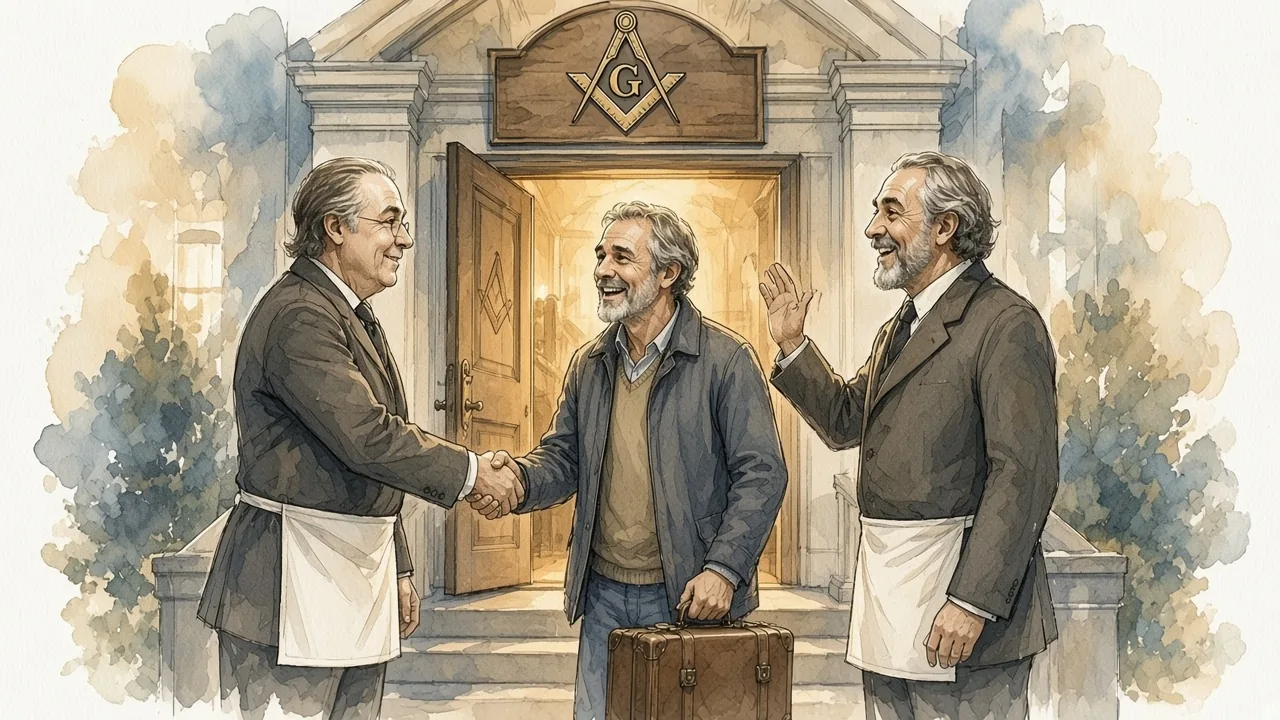
Build an online presence: a website or page that is current, says where and when you meet, and gives a real way to get in touch. Then hold regular social events where interested people can meet you and ask questions. I have seen this work: my own lodge grew exponentially.
If your lodge is working on this, reach out to me through Contact Us and tell me where you’re starting from.
Practicing Masonry
Masonry has something to offer that no other organization does. Why would a man join a lodge instead of the Elks, Rotary or a more active role at his church? Know your answer to that question, and tell that story with pride.
Every lodge has its own emphasis and culture. I didn’t join for community service or for fellowship, though both are wonderful byproducts of what Masonry teaches and how it teaches it. Masonry is for self-improvement, taught in an initiatic format, and it is rich in symbols, meaning and history. It is not a gentleman’s whiskey-and-cigar club, and it is not a community service organization. Fellowship and service will always be part of lodge life, and they flourish best when the work of Masonry itself sits at the center. I explored what it means to be initiated, and why the experience matters, in What It Means to Be Made: A History of Initiation. It is also why I am against one-day classes, as I wrote in One Day Masons.
So ask your lodge: what is our priority? Singular, on purpose. In Essentialism: The Disciplined Pursuit of Less, Greg McKeown points out that the word “priority” came into English in the 1400s as a singular word meaning “the very first or prior thing,” and stayed singular for some five hundred years before we began talking about “priorities.” The Online Etymology Dictionary’s entry for “priority” traces it to the Latin prior, and notes that its sense shifted only in the twentieth century toward “coming first in importance.” Decide together which one comes first, and let everything else serve it. Nothing will improve your lodge more.
If your lodge could name only one priority, what would you choose, and what would it look like a year from now?
One response to “Five Simple Things You Can Do to Improve Your Lodge”
[…] same reasoning applies inside the lodge. Our post 5 Simple things you can do to Improve your Lodge puts finances first on the list for a reason. A lodge that undercharges for its degrees often ends […]