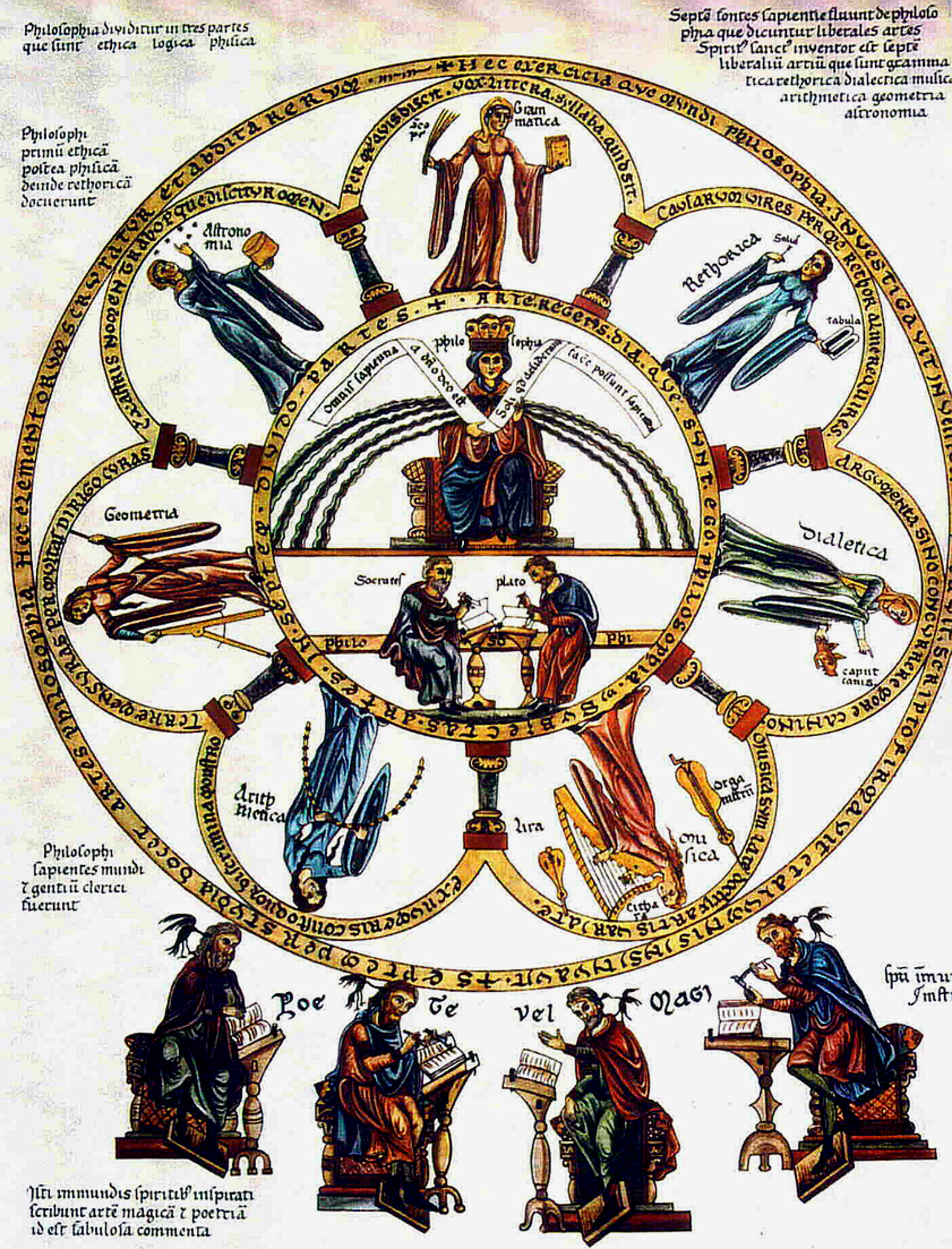
Few ideas run as deep in Masonic education as the seven liberal arts and sciences. A Fellowcraft is urged to study them, and Freemasonry’s oldest documents list them by name. But where did the seven come from, and did the ancient Greeks really teach them? Here is the story, from Athens to the lodge room, and why it still matters.
What the Seven Are
The seven liberal arts fall into two groups. The trivium covers the arts of language: grammar, logic and rhetoric. The quadrivium, Boethius’s word for a “fourfold way,” covers the arts of number: arithmetic, geometry, music and astronomy. In the medieval European university, these seven made up the liberal arts curriculum. As Dorothy L. Sayers put it, the trivium “preceded the Quadrivium” and was meant “to teach the pupil the proper use of the tools of learning.”
Below, each art is described in the words of Webb’s Freemason’s Monitor, a textbook its 1867 publisher called “the first Masonic text-book ever published in any country in the English language.”
Grammar
Grammar, says the monitor, “teaches the proper arrangement of words” and the ability “to speak or write a language with accuracy, agreeably to reason and correct usage.” It is the root of the other arts. You can’t reason or persuade until you can say clearly what you mean.
Rhetoric
Rhetoric teaches us “to speak copiously and fluently on any subject,” joining “strength of argument and beauty of expression.” Aristotle defined it as “the faculty of observing in any given case the available means of persuasion.”
Logic
Logic, sometimes called dialectic, “directs our inquiries after truth.” It is the craft of building sound arguments and spotting false ones, following “a regular train of argument, whence we infer, deduce, and conclude.”
Arithmetic
Arithmetic “teaches the powers and properties of numbers.” Every other mathematical art depends on it.
Geometry
Geometry “treats of the powers and properties of magnitudes,” moving from a point to a line, to a surface, to a solid. The monitor calls it “the foundation of architecture, and the root of the mathematics.” For Masons it holds pride of place, as we’ll see.
Music
Music in this tradition meant less performance than proportion. The monitor says it teaches “the art of forming concords” by “a mathematical and proportional arrangement” of sounds. It inquires “into the nature of concords and discords” and finds “the proportion between them by numbers.”
Astronomy
Astronomy, in the monitor’s words, is “that Divine art by which we are taught to read the wisdom, strength, and beauty of the Almighty Creator, in those sacred pages, the celestial hemisphere.” It joins measurement to wonder.
Did the Greeks Teach It?
Yes and no. The Greeks taught every one of these subjects, but they never fixed them as a set of seven.
The language arts owe much to the Sophists, professional teachers who toured the Greek world “with particular emphasis on skill in public speaking and the successful conduct of life,” as the Stanford Encyclopedia of Philosophy puts it. They also contributed to “the study of language and grammar,” to logic and to rhetoric. Aristotle then gave rhetoric its classic treatment in his Rhetoric.
The mathematical arts have Pythagorean roots. The Pythagorean Archytas identified a set of four sciences, astronomy, geometry, “logistic” (arithmetic) and music, and called them sisters. Plato took up these studies in Book VII of the Republic as training for the future rulers of his ideal city. There geometry “will draw the soul towards truth.” Plato actually counted five, adding solid geometry, which shows how unsettled the list still was.
“As the eyes are designed to look up at the stars, so are the ears to hear harmonious motions; and these are sister sciences—as the Pythagoreans say.”
Plato, Republic, Book VII (trans. Benjamin Jowett)
Rome and the Middle Ages
The Romans carried Greek learning into Latin. Marcus Terentius Varro (116–27 BC), whom Britannica calls “Rome’s greatest scholar,” wrote on astronomy, geography and education, among many other subjects.
The set of seven took its lasting shape with Martianus Capella, a North African advocate at Carthage who wrote perhaps about AD 400. In his allegory De nuptiis Philologiae et Mercurii (“On the Marriage of Philology and Mercury”), Mercury gives his bride seven maidens, “and each declaims on that one of the seven liberal arts that she represents.” The remaining books are titled for grammar, dialectic, rhetoric, geometry, arithmetic, astronomy and harmony.
Boethius named the four mathematical arts. In his De institutione arithmetica he wrote that no one reaches the summit of philosophy unless it is sought “quodam quasi quadruvio,” “by a kind of fourfold way.” A generation later, Cassiodorus founded the monastery of Vivarium. The second part of his Institutiones gives “a brief exposition of the seven liberal arts” and was widely used in the Middle Ages.
In the Carolingian Renaissance, Alcuin of York headed Charlemagne’s palace school, where he “systematized the curriculum” and “encouraged the study of liberal arts for the better understanding of spiritual doctrine.” By the time the medieval universities arose, the trivium and quadrivium were their liberal arts curriculum.
How Freemasonry Adopted Them
The seven arts reached Freemasonry through the Old Charges, the manuscript histories and rules of the medieval stonemasons.
The oldest of these is the Regius Poem, or Halliwell Manuscript. It was once dated to about 1390, but the British Library now catalogs it as first half of the fifteenth century (1400–1449), and the historian Andrew Prescott places it in the second quarter of that century. In rhyming Middle English it names “the sciences seven,” one by one, and gives geometry the last and highest word:
“Geometry the seventh science it is, / That can separate falsehood from truth, I know. / These be the sciences seven, / Who useth them well he may have heaven.”
The Regius Poem (Halliwell Manuscript), modern English rendering
The Cooke Manuscript, dated by the Masonic scholar W. J. Hughan to “1450 or thereabouts,” is a prose version of the Old Charges. It tells the reader “that there be 7 liberal sciences,” gives each a short definition and singles out geometry as “causer of all,” equating it with masonry itself. It then goes on to a legendary history of the craft, which is tradition rather than documented history.
In the eighteenth century, William Preston‘s Illustrations of Masonry set out the lectures of the degrees for English Freemasons. Its charge to the Fellowcraft already recommends “the study of the liberal arts,” “especially the science of Geometry, which is established as the basis of our Art.” In America, Thomas Smith Webb’s Freemason’s Monitor, or Illustrations of Masonry carried the same material, nearly word for word.
In the published monitor, the seven arts belong to the second degree, the Fellowcraft. They are “next illustrated” in the lecture’s second section, alongside the orders of architecture and the senses of human nature. The 1867 edition notes that the brother whose duty it is “to moralize upon the Winding Stairway” is expected “to draw upon his intellectual resources to their fullest extent.” The winding stair, in other words, is a figure of steady intellectual climbing. The Fellowcraft’s charge then recommends “the study of the liberal arts, that valuable branch of education, which tends so effectually to polish and adorn the mind,” especially geometry, “established as the basis of our art.” The monitor calls geometry “the first and noblest of sciences” and the basis “on which the superstructure of Masonry is erected.”
Why It Matters Today
It would be easy to treat all this as a museum piece. But look at what the seven arts actually train.
Critical thinking. Logic is the art of telling a sound argument from a slick one. In an age of headlines, feeds and confident claims, the Regius Poem’s ideal of separating “falsehood from truth” is a daily need.
Communication. Grammar and rhetoric teach us to say what we mean and to say it well, whether we are giving a toast at a lodge dinner, writing an email at work or settling a family disagreement.
Numeracy. Arithmetic and geometry give us the habits of measuring before we cut and checking the figures before we decide. They are the practical side of the Mason’s working tools.
Wonder. Music and astronomy remind us that the world has order and beauty worth noticing. The monitor says geometry lets us “view with delight the proportions which connect this vast machine.” Stepping outside on a clear night to find a constellation is a very old Masonic exercise.
The idea has a modern following too. Dorothy L. Sayers’s 1947 Oxford essay “The Lost Tools of Learning” argued that the trivium taught “the proper use of the tools of learning” before any subject. Anyone who takes up that idea today is reaching for the same tools that the monitor commends to every Fellowcraft.
For a Mason, the lesson is simple. The seven liberal arts are not a course you finish. They are a lifelong invitation to keep learning, one step at a time.
Sources
- Plato, The Republic, Book VII, trans. Benjamin Jowett. Project Gutenberg, gutenberg.org/ebooks/1497
- Aristotle, Rhetoric I.2, trans. W. Rhys Roberts. MIT Internet Classics Archive, classics.mit.edu/Aristotle/rhetoric.1.i.html
- Boethius, De institutione arithmetica, ed. G. Friedlein (Leipzig: Teubner, 1867), Book I preface. Internet Archive, archive.org
- Carl Huffman, “Archytas,” Stanford Encyclopedia of Philosophy, plato.stanford.edu/entries/archytas
- C. C. W. Taylor and Mi-Kyoung Lee, “The Sophists,” Stanford Encyclopedia of Philosophy, plato.stanford.edu/entries/sophists
- Encyclopaedia Britannica: “Liberal arts,” “Martianus Minneus Felix Capella,” “Marcus Terentius Varro,” “Cassiodorus,” “Alcuin,” britannica.com
- William Preston, Illustrations of Masonry, in Universal Masonic Library, vol. III (New York, 1855). Internet Archive, archive.org/details/illustrationsof00pres
- Thomas Smith Webb, The Freemason’s Monitor, or Illustrations of Masonry, ed. John Sherer (Cincinnati, 1867). Internet Archive, archive.org/details/freemasonsmonito00webb
- Webb’s Freemason’s Monitor, comp. James Fenton (Cincinnati, 1865). Internet Archive, archive.org/details/webbsfreemasonsm00webb
- The Regius Poem (Halliwell Manuscript) and the Matthew Cooke Manuscript, texts with translation. Grand Lodge of British Columbia and Yukon, regius.html and cooke.html
- British Library, Royal MS 17 A I, “Poem on the craft of masonry (‘The Regius Manuscript’),” catalogue record, searcharchives.bl.uk
- “A new approach to the Old Charges: Continuum Theory” (summarizing Andrew Prescott’s dating of the Regius), old-charges.org, old-charges.org
- Dorothy L. Sayers, “The Lost Tools of Learning” (1947), gbt.org/text/sayers.html
Which of the seven liberal arts do you wish you’d been taught better in school, and what are you doing to learn it now?