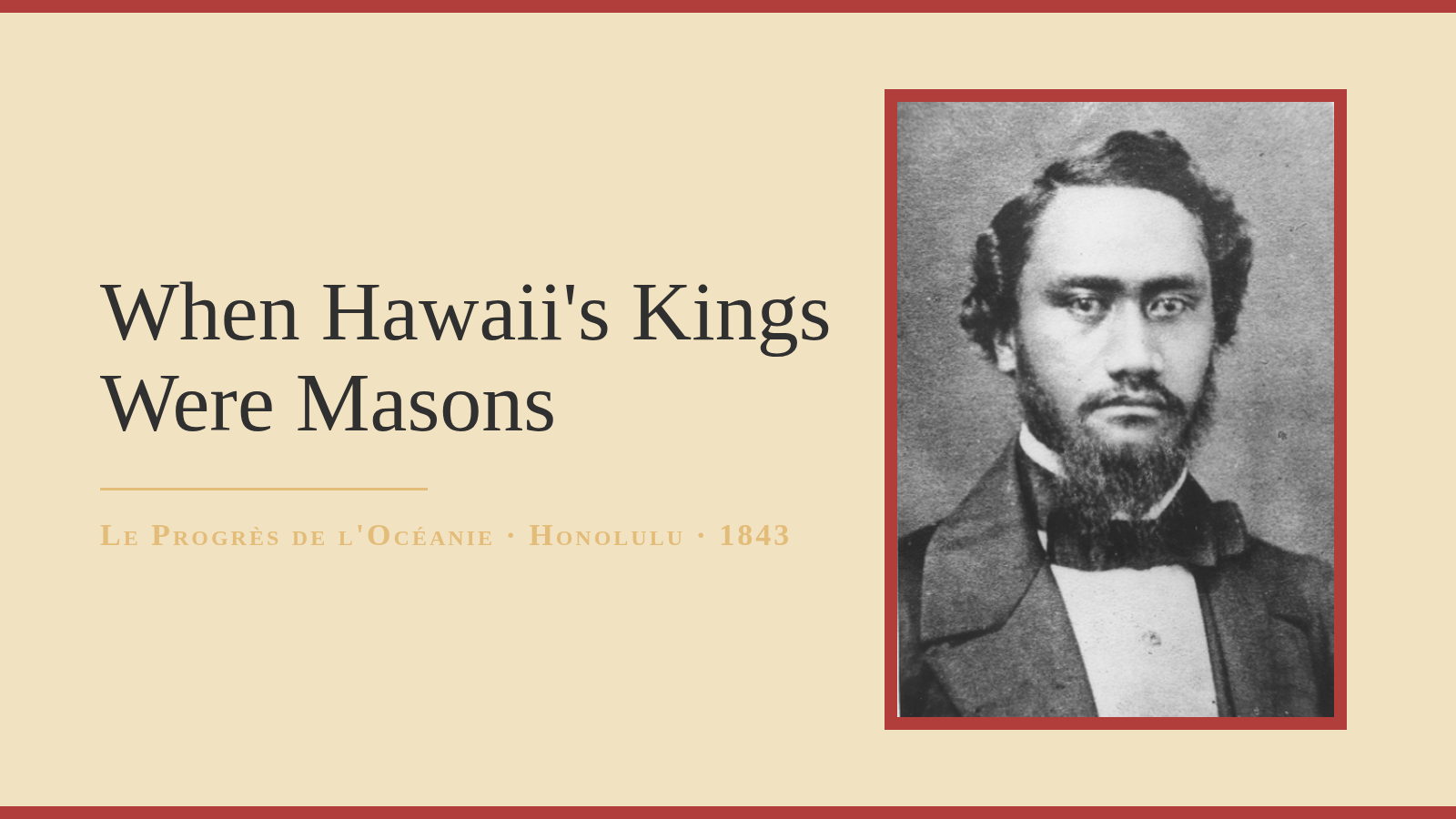
In the spring of 1843 the British flag flew over Honolulu, and a damaged French whaler limped into the harbor for repairs. Its captain carried more than a cargo of oil. He carried a commission to found Masonic lodges, and within days the Pacific had its first one. Over the next half century, three Hawaiian kings and a crown prince would wear the apron.
A Whaler, a Merchant and a Lodge
The Ajax reached Honolulu on 30 March 1843. Her captain, Joseph-Marie Le Tellier, needed the port’s repair yards after a collision in the Indian Ocean. According to historian Frank Karpiel, writing in The Hawaiian Journal of History, Le Tellier had also been named a “Special Inspector” by the Supreme Council of France and was “specially authorized to create new Masonic lodges.”
The timing was unusual. Lord George Paulet of HMS Carysfort had taken possession of the islands for Britain, and the Union Jack flew over the kingdom from 25 February to 31 July 1843. During that uneasy summer, on 8 April 1843, Le Tellier constituted Lodge Le Progrès de l’Océanie under the Supreme Council of France. The lodge’s own history says it was done in the store of Jules Dudoit, the French consul, and not aboard the ship, as older accounts claimed. Karpiel notes that the brothers met at first both aboard the Ajax and at Dudoit’s store, before moving to an adobe house owned by the American seafarer John Meek.
The charter members were a mixed crew of American and English mariners, merchants, a physician, a sugar planter and an auctioneer. Oddly enough, the lodge’s historian notes that Le Tellier himself never became a member of the lodge he founded.
A Second Lodge from California
By the end of the 1840s the French lodge had gone quiet. The Gold Rush changed Honolulu, bringing hundreds of newcomers from the United States. In late 1851 several of them, joined by seven members of the dormant Le Progrès, decided to form a new lodge under the Grand Lodge of California, which was barely a year old. Hawaiian Lodge No. 21 received its charter from California on 5 May 1852. It was the first lodge in Hawaii descended from an American Grand Lodge, and it has worked without interruption ever since.
Its early membership included Alexander Cartwright, a young New York merchant better remembered today for his part in the early rules of baseball. Carpenter Charles Vincent, who built many of Honolulu’s waterfront buildings, was its first Master.
The Royal Brothers
A word first about the founder of the dynasty. Kamehameha I, who united the islands, died long before the first lodge met in Honolulu. He was not a Mason. His son Kamehameha III did ask to join. In July 1853 the foreign minister, Robert Crichton Wyllie, sent Hawaiian Lodge a request that the king be initiated “into our ancient and benevolent order.” Karpiel writes that the lodge, strangely, never acted on it, and the records give no reason why.
His successors did join, and for a time the Craft and the crown were closely bound together.
Prince Lot, later Kamehameha V
Prince Lot Kamehameha, a grandson of Kamehameha I, joined Hawaiian Lodge in 1853 at the age of twenty-three. He was the first Native Hawaiian to become a Freemason. The sources differ on the exact month. Karpiel places his first degree in June 1853, while the lodge historian Herbert Gardiner dates his raising to May 1853. Lot later went on into the York Rite and became a Royal Arch Mason. He succeeded his brother on the throne as Kamehameha V and reigned until his death in 1872.
Alexander Liholiho, Kamehameha IV
Lot’s younger brother took a different path. Alexander Liholiho, already reigning as Kamehameha IV, was made a Mason in Le Progrès de l’Océanie, which had begun accepting new members again in 1855. Gardiner dates his raising to December 1856, and Karpiel describes his initiation in January 1857, attended by Lot and several other members of Hawaiian Lodge.
He went on to serve as Worshipful Master of Le Progrès in 1859, 1861 and 1862. The lodge counts itself one of only two in the world to have had a reigning monarch in the Master’s chair. Under Kamehameha IV, Karpiel notes, “every member of the cabinet was a Mason, as was the king himself.”
David Kalākaua
Kalākaua was also a member of Le Progrès. Gardiner records that he became a Master Mason there in January 1859, years before anyone expected him to rule. He served as Master of the lodge in 1876, shortly after he was elected king. Karpiel describes his interest in “exploring the metaphysical knowledge contained in traditional Hawaiian as well as Masonic sources,” and notes that he appointed dozens of brethren to public office.
Others close to the throne
The circle widened from there. The Le Progrès history of its “prominent brethren” lists Prince William Pitt Leleiohoku, Kalākaua’s brother and heir, raised in Hawaiian Lodge in June 1874. It also lists John Owen Dominis, husband of the future Queen Liliʻuokalani, raised in Le Progrès in April 1858 and Master in 1863, 1864 and 1868. Archibald Cleghorn, father of Princess Kaʻiulani, was raised in Hawaiian Lodge in December 1873, and Prince David Kawānanakoa in Le Progrès in August 1900.
Two Lodges, One Kingdom
Royal favor brought rivalry. In the 1850s, Karpiel writes, the dispute between the two lodges “revolved around royal patronage and the question of which lodge would benefit by association with the Hawaiian monarchs.” Friends of the princes moved from Hawaiian Lodge to Le Progrès. When Kamehameha IV was made a Mason in the French lodge, which California did not recognize, several Hawaiian Lodge members who attended were judged guilty of “un-Masonic behavior” for visiting it. Lot was excused.
The quarrel did “moral and material injury” to local Freemasonry for two years, in the words of Abraham Fornander, the Hawaiian Lodge secretary who worked to end it. In time the two lodges made peace.
Cornerstones of a Capital
The most public face of the Craft in the kingdom was the laying of cornerstones. Karpiel counts “dozens of buildings in Hawai’i inaugurated with Masonic ceremonies from the 1860s to the 1920s.”
The first great example was a hospital. Kamehameha IV championed the islands’ first hospital for Native Hawaiians, and the king raised money for it himself, going door to door through the city. In July 1860 the groundbreaking for Queen’s Hospital included “a traditional Masonic cornerstone-laying ceremony attended by thousands and presided over by the young monarch.”
Kalākaua carried the custom further. In January 1879, wearing Masonic regalia and accompanied by Queen Kapiʻolani and Princess Liliʻuokalani, he laid the cornerstone of Hawaiian Lodge’s new temple. Eleven months later he led “an even grander Masonic ceremony” at the site of the new ʻIolani Palace, using silver working tools made for the occasion. Le Progrès also counts Aliʻiolani Hale, St. Andrew’s Cathedral and Honolulu Hale (City Hall) among the landmarks whose cornerstones its brethren helped lay.
Fornander once explained the custom to a puzzled friend in Sweden. In England and America, he wrote, “you will hardly find a public secular building, bridge, or monument of any note, whose cornerstone was not laid with Masonic ceremonies.” Honolulu, with its Masons in the cabinet, simply followed suit.
After the Monarchy
The kingdom ended in 1893, when Queen Liliʻuokalani was deposed, and the United States annexed the islands in 1898. Gardiner’s history is careful on this point. Neither lodge, nor the Scottish Rite bodies, took part as bodies in the politics of those years, though individual brethren were active on both sides.
Freemasonry in the islands kept growing all the same. A Scottish lodge, Pacific Lodge No. 822, was chartered in 1895, and Lodge Maui No. 984 followed in 1905. Both later moved to the Grand Lodge of California. Le Progrès itself transferred from its French charter to California in 1905. By then, Karpiel notes, Hawaiian Lodge and Le Progrès together had more than four hundred members.
For most of the twentieth century, then, Hawaii’s lodges worked under California. That changed in 1989. With California’s full support, the Hawaiian lodges formed a Grand Lodge of their own. The Grand Lodge of Hawaii gives its charter date as 19 May 1989, and Gardiner dates the lodges’ constitution of the new Grand Lodge to 20 July 1989. Le Progrès de l’Océanie and Hawaiian Lodge both sit on its roll today.
Why the Story Still Matters
It’s easy to treat royal Masons as trivia. The Hawaiian story is richer than that. A small lodge founded by foreign sailors became a place where Hawaiian kings, American merchants, British officials and French residents sat together as brothers. That happened in a kingdom being pulled in several directions at once.
The brothers argued, sometimes bitterly, over charters and recognition. They also built a hospital, laid the stones of a palace and a capital, and kept their lodges open through the fall of the kingdom itself. For a Mason today, that’s a reminder that the lodge is not a refuge from history. It is one of the places where history gets made, one stone at a time.
Is there a building in your town whose cornerstone was laid by Masons? What’s the story behind it, and does anyone still remember the day?
Sources
- Frank J. Karpiel, “A Multinational Fraternity: Freemasonry in Hawai’i, 1843–1905,” The Hawaiian Journal of History 34 (2000). https://evols.library.manoa.hawaii.edu/server/api/core/bitstreams/6f61d5e0-f760-46e3-a5e5-b5d1f76df3ca/content
- Lodge Le Progrès de l’Océanie, “History.” https://leprogresfreemasons.org/history/
- Herbert G. Gardiner, PGS, Grand Historian, “Our History in Brief,” Lodge Le Progrès de l’Océanie (2003). http://www.mastermason.com/lodgeleprogres/heritage-frame.htm
- Grand Lodge of Free and Accepted Masons of Hawaii, home page (“Our History”). https://hawaiifreemason.org/