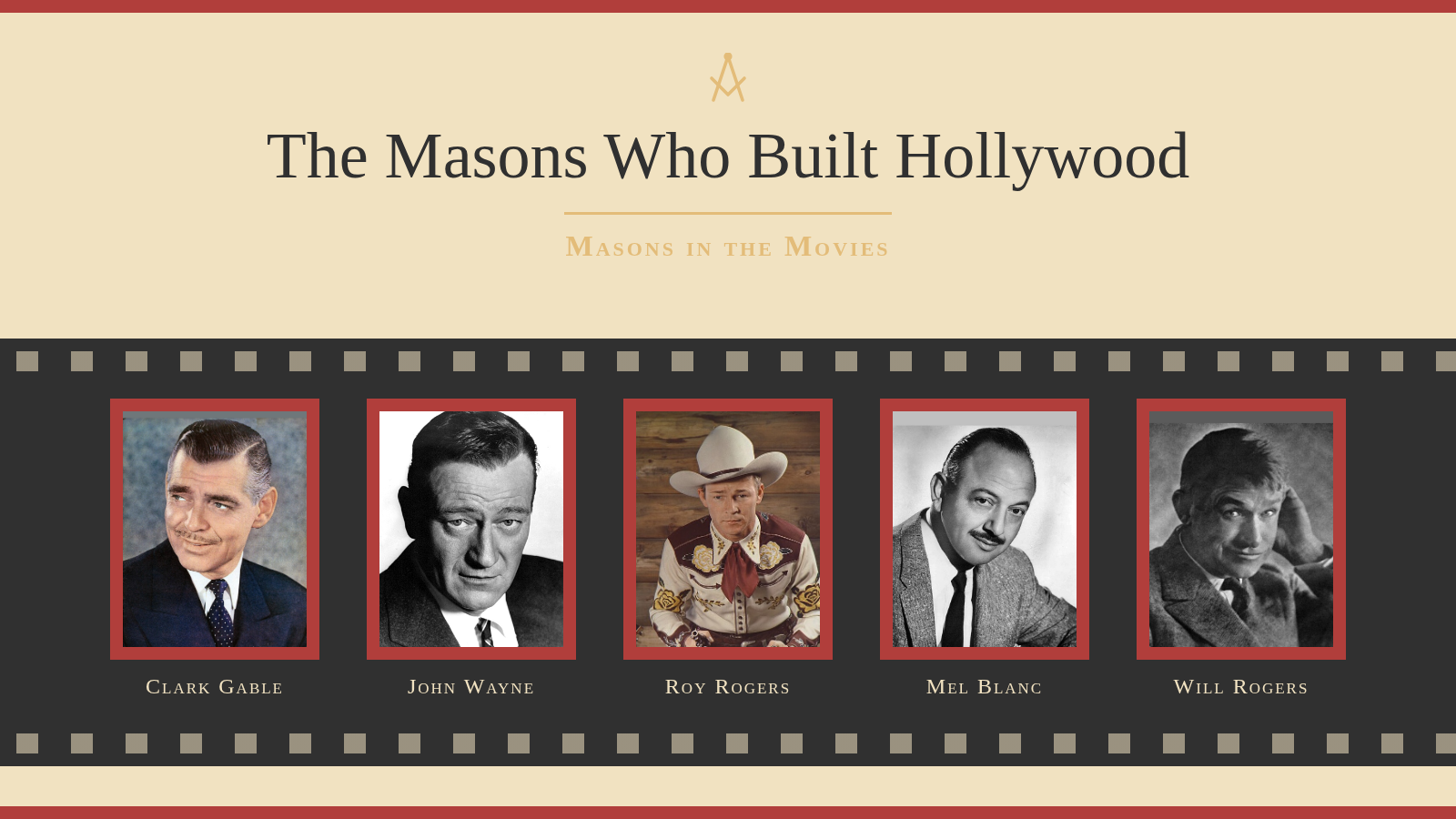
Hollywood sells glamour, but the men in this story kept another commitment, often far from the cameras, in a lodge room where fame earned them nothing. This is a short tour of film-era Freemasons whose membership is on the record, and of one famous name that isn’t.
The Builders Behind the Camera
If the title of this piece claims that Masons built Hollywood, the studio founders and directors had better be in it. They are. The Grand Lodge of California’s magazine records that Harry and Jack Warner, two of the brothers behind Warner Bros., were members of Mount Olive Lodge No. 506 in Los Angeles. It notes that Cecil B. DeMille, the director of The Ten Commandments, was raised in 1921 in Prince of Orange Lodge No. 16 in New York. D. W. Griffith, whose editing and close-ups shaped the grammar of film, was an initiated member of St. Cecile Lodge No. 568 in New York, though his The Birth of a Nation remains deeply troubling. Douglas Fairbanks, the first great action star, belonged to Beverly Hills Lodge No. 528 and helped found the Academy of Motion Picture Arts and Sciences.
That’s the industry’s foundation. Now to five men who stood in front of the camera.
Will Rogers, the Cowboy Philosopher
Long before talking pictures, there was Will Rogers. Born on 4 November 1879 in the Cherokee Nation, he toured as a trick roper, starred in the Ziegfeld Follies, wrote a newspaper column read around the world and became one of Hollywood’s biggest box-office stars. The Grand Lodge of British Columbia and Yukon, citing Denslow’s 10,000 Famous Freemasons, records that he was initiated on 18 February 1905, passed on 10 March 1906 and raised on 13 March 1906 in Claremore Lodge No. 53, Oklahoma.
The same biography remembers him as “a humanitarian, often using his popularity and position to raise money for those in need.” He died on 15 August 1935 in a plane crash in Alaska. A Mason learns early that what a man does with his influence matters more than how much of it he has. Rogers used his for others.
Clark Gable, the King Who Enlisted
William Clark Gable was born on 1 February 1901 in Cadiz, Ohio. His mother died when he was ten months old. According to the Scottish Rite, Northern Masonic Jurisdiction, he received the first degree on 19 September 1933, the second on 17 October, and was raised a Master Mason in Beverly Hills Lodge No. 528 on 31 October 1933, just as his fame took off. The Grand Lodge of California adds that he was known to slip away from celebrity life to enjoy the quiet fellowship of the lodge.
The measure of the man came in 1942. His wife, Carole Lombard, was killed in a plane crash. On 12 August 1942, at forty-one and at the top of his profession, Gable enlisted in the Army Air Forces. He flew five combat missions as an observer-gunner in B-17 bombers in 1943, earning the Air Medal and the Distinguished Flying Cross. He could have sat the war out. He didn’t. Gable died on 16 November 1960.
John Wayne, a Mason Late in Life
John Wayne, born Marion Morrison, came to the Craft through family. The Grand Lodge of British Columbia and Yukon notes that his father was a Mason and that young Marion was a member of the Glendale chapter of DeMolay, the Masonic youth order. Yet he didn’t petition a lodge until he was in his sixties. Citing lodge records, the same source gives his degree dates as 9, 10 and 11 July 1970, in Marion McDaniel Lodge No. 56, Tucson, Arizona. That December he joined the York Rite in California and became a Shriner.
The Grand Lodge of California notes that fellow Masons often remembered him as “surprisingly reserved away from the cameras.” There’s a lesson in his timing. The door of the lodge isn’t only for young men. A man who has spent decades being famous can still choose, at sixty-three, to come in as a candidate like anyone else. Wayne died on 11 June 1979.
Roy Rogers, a Hero Who Lived It
Leonard Franklin Slye was born on 5 November 1911 in Cincinnati, Ohio, and became Roy Rogers, the King of the Cowboys. The Henry Wilson Coil Library and Museum of Freemasonry, which now holds his Masonic regalia, records that he was made a Mason in Hollywood Lodge No. 355 on 15 April 1946 and raised on 27 June 1946. The Grand Lodge of California confirms his membership in Hollywood No. 355 and his later Scottish Rite honors.
The museum’s account notes that his love of children, and his own experience of their sometimes hard circumstances, drew him to the Shrine, which he joined in 1950. It quotes his biographer Laurence Zwisohn: “Roy lived his life off camera with the same decency and humility that he projected on television and on the silver screen.” For a generation of children he was the straight-shooting good guy. The point, for a Mason, is that he tried to be that man when no one was filming.
Mel Blanc, the Man of a Thousand Voices
Mel Blanc was born on 30 May 1908 and grew up in Portland, Oregon. He gave voice to Bugs Bunny, Daffy Duck, Porky Pig and hundreds more. The Grand Lodge of British Columbia and Yukon records him as a member of Mid-Day Lodge No. 188, Oregon, and the Grand Lodge of California notes that he belonged to DeMolay as a boy and was later raised in Mid-Day No. 188, joining the Scottish Rite and the Shrine in Los Angeles. One of his favorite charities was the Shriners’ children’s burn center.
In 1961 a car crash left him in a coma. In his autobiography, That’s Not All, Folks! (1988), he recalled that he first responded when a doctor spoke not to Mel Blanc but to Bugs Bunny. “I may have been on the verge of death,” he wrote, “but they were very much alive inside me.” The characters he had given life to, he said, returned the favor. Blanc died on 10 July 1989.
A Name We Can’t Claim
Charlie Chaplin appears on many lists of Masonic film stars. We haven’t found a lodge or Grand Lodge record of his membership. The German broadcaster Deutsche Welle, citing the Freimaurer-Wiki, reports that his son Eugene Chaplin, interviewed in Zurich, said his father was not a Freemason. Chaplin’s closing speech in The Great Dictator is often called Masonic in spirit, and readers can judge that for themselves. But speaking like a Mason isn’t the same as being one. We put Chaplin on our list of disputed names, alongside others such as Abraham Lincoln, whose Masonic membership is often assumed but not documented.
What the Lodge Gave Them, and What They Gave Back
Fame didn’t make these men Masons, and Masonry didn’t make them famous. What the record shows is quieter. A star enlisted when he didn’t have to. An aging icon knocked at the door at sixty-three. A cowboy hero tried to live up to the boys who copied him. A voice actor gave his time to children with burns. A humorist raised money for strangers. None of them was perfect, and some of the industry’s founders left legacies we still argue about. But on the level of the lodge floor, each was simply a brother, and that is how we remember them.
Is there a public figure whose character you came to respect more once you learned how he lived away from the spotlight? What changed your mind?
Sources
- Jeanette Yu, “Lights, Camera, Lodge,” California Freemason, Grand Lodge of California. https://freemason.org/magazine/lights-camera-lodge/
- Scottish Rite, NMJ, “The King of Hollywood: Brother William Clark Gable.” https://scottishritenmj.org/blog/clark-gable-freemason
- Grand Lodge of British Columbia and Yukon, “John Wayne” (citing lodge records). https://freemasonry.bcy.ca/biography/wayne_j/wayne_j.html
- Grand Lodge of British Columbia and Yukon, “Will Rogers” (citing Denslow). https://freemasonry.bcy.ca/biography/rogers_w/rogers_w.html
- Grand Lodge of British Columbia and Yukon, “Mel Blanc” (citing Philatelic Freemason, May–June 2001). https://freemasonry.bcy.ca/biography/blanc_m/blanc_m.html
- Henry Wilson Coil Library and Museum of Freemasonry, “Roy Rogers, ‘The King of the Cowboys,’” as reproduced by ShowBizShriners (11 February 2013). http://showbizshriners.blogspot.com/2013/02/leonard-slye-king-of-cowboys.html
- Mel Blanc with Philip Bashe, That’s Not All, Folks! (Warner Books, 1988), p. 2, excerpted at Deuce of Clubs. https://deuceofclubs.com/books/252blanc.htm
- Deutsche Welle, “The mysterious world of Freemasons.” https://www.dw.com/en/the-mysterious-world-of-freemasons/g-40314942