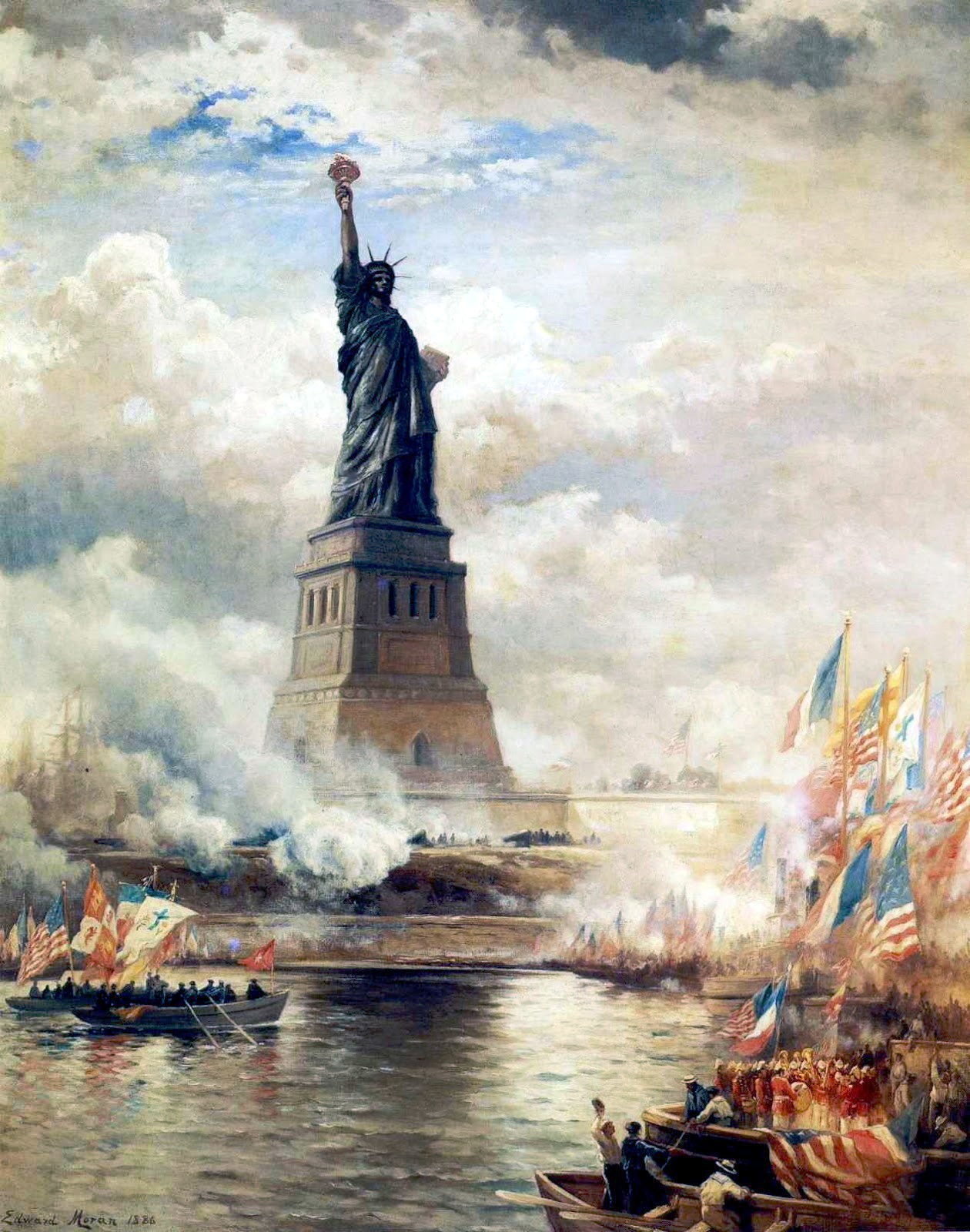
On a foggy, rain-soaked 28 October 1886, a French tricolor veil fell from the face of a copper giant in New York Harbor. It had taken twenty-one years since the idea was first spoken aloud. The story of how it got there is a lesson in what it takes to turn a vision into something that stands.
The Day the Veil Fell
The National Park Service records that New York held its first ticker-tape parade that day, in honor of the dedication of “Liberty Enlightening the World.” More than a million people attended. About 300 vessels passed the statue in a water parade, though fog and rain kept visibility under a quarter of a mile. On Bedloe’s Island, 2,000 to 2,500 men watched the formal unveiling, and the Library of Congress notes that President Grover Cleveland dedicated the statue “before thousands of spectators.” The fireworks were rained out and held over until 1 November.
It would be easy to tell this as the story of a sculptor’s masterpiece. The film at Liberty Island tells it another way, as a story of vision, planning, fundraising and teamwork. That is the story worth telling to anyone building something today, in a lodge or anywhere else.
1. A Vision Bigger Than One Man
The idea did not start with Bartholdi. According to the NPS, in 1865 Édouard de Laboulaye, a French political thinker, authority on the U.S. Constitution and president of the French Anti-Slavery Society, proposed that France give the United States a monument. The Union had just won the Civil War, and the Thirteenth Amendment had abolished slavery. To Laboulaye this proved “that justice and liberty for all was possible.” Honoring America, he argued, would also strengthen the cause of democracy in France, then under Napoleon III.
Frédéric Auguste Bartholdi, a young sculptor from Colmar in Alsace, took that idea and gave it a form. The Musée Bartholdi in Colmar dates his first voyage to the United States, and the start of the Liberty project, to 1871. That was the same year his home province was annexed by the German Empire. Liberty was not an abstraction to him.
The lesson: the best visions serve something larger than the person who holds them. Laboulaye supplied the purpose and Bartholdi supplied the picture. Neither alone would have been enough.
2. A Plan Measured in Stages
A 151-foot copper figure had to survive an ocean crossing and the salt winds of New York Harbor. The NPS Historical Handbook describes how Bartholdi solved this in measured steps. He began with a study model 1.25 meters high, then made one of 2.85 meters, then a figure of 11 meters (36 feet) corrected “down to the most minute detail.” The figure was then divided into sections, and each section was enlarged four times. Each section took “about 9,000 separate measurements.” More than 300 sheets of copper, each only 3/32 of an inch thick, were hammered by hand over wooden molds.
Then the plan lost a key man. In 1879 the project’s engineer, Eugène Viollet-le-Duc, died. Bartholdi brought in Gustave Eiffel, who in 1880 devised a 98-foot inner iron framework (NPS). In the Handbook’s description, four great iron posts form a pylon that carries the weight, and each copper sheet is “supported independently,” so no plate “hangs from the one above it or bears upon the one below.”
The lesson: a large work is finished in stages, one checked measurement at a time. When the plan breaks, a good leader brings in the right partner rather than starting over.
3. Raising the Purse, One Gift at a Time
From the start the builders insisted the monument be a joint gift. In September 1875, the NPS records, Laboulaye announced the project and the Franco-American Union as its fundraising arm. The French people would pay for the statue and the American people for the pedestal.
The French response was quick. The Handbook lists public fêtes and entertainments, and a song to the statue that the composer Gounod presented at the Paris Opera. In the spring of 1878 the Union organized a lottery, which French law allowed for charitable and artistic causes. That same year the finished head and shoulders went on display at the Paris Universal Exposition (NPS chronology). Visitors could see the dream taking shape, and that helped sell it. The cost rose to about $250,000, and not until July 1882 was the full amount subscribed. Every penny came from the French people, not the French government.
The American side was harder. By March 1885 the pedestal committee had spent all but $3,000 of its funds and needed $100,000 more. Other cities offered to take the statue instead. Then Joseph Pulitzer stepped in. On 16 March 1885 his New York World renewed its campaign “in grim earnest.” He scolded the rich for not paying and ordinary citizens for leaving it to the rich. Schoolchildren sent coins, and gifts came from as far as California and Louisiana. On 11 August 1885, less than five months later, the World announced that the pedestal fund was complete (NPS Handbook). The NPS chronology puts the total at over $100,000.
The lesson: people give to what they can see and what they feel is theirs. A lottery ticket, a glimpse of the head at the fair and a child’s coin each made someone an owner of the project.
4. Many Hands, One Work
Look at the roll of builders. Laboulaye supplied the idea. Bartholdi was the designer and tireless promoter. Viollet-le-Duc and then Eiffel engineered the frame. Richard Morris Hunt designed the pedestal, and General Charles P. Stone was its chief engineer. Ferdinand de Lesseps succeeded Laboulaye after his death in 1883. Pulitzer and countless small donors paid for the pedestal. Bartholdi’s great skill was keeping all of them pointed at the same goal for more than a decade.
On 4 July 1884, in Paris, de Lesseps formally presented the finished statue to U.S. Minister Levi P. Morton:
“It is great in its conception, great in its execution, great in its proportions; let us hope that it will add, by its moral value, to the memories and sympathies that it is intended to perpetuate.”
— Ferdinand de Lesseps, Paris, 4 July 1884 (NPS Historical Handbook)
The Masonic Thread
Bartholdi was a Freemason. The Musée Bartholdi records that in 1875, the year construction began, he joined the “patriotic” Lodge Alsace-Lorraine in Paris, founded in 1872 for men of the lost provinces. As with Mucha, readers should note that the lodge worked under the Grand Orient de France, which mainstream American Grand Lodges do not recognize.
We make no claim that Laboulaye or Eiffel were Masons. We found no documentary evidence that either was.
American Masons had their own part. The NPS Handbook records that the pedestal’s cornerstone was laid “by William A. Brodie, Grand Master of the Grand Lodge of New York State, with impressive Masonic ceremony on August 5, 1884.” The London Freemason’s Chronicle reported it that month, with a twenty-one-gun salute from old Fort Wood. Grand Master Brodie explained why the fraternity had been asked:
“No institution has done more to promote liberty and to free men from the trammels and chains of ignorance and tyranny than Freemasonry, and we as a Fraternity take an honest pride in depositing the Corner-stone of the pedestal of this statue which, we pray God, may deserve to prosper by becoming a beacon light of liberty to all men.”
— M.W. William A. Brodie, Bedloe’s Island, 5 August 1884 (The Freemason’s Chronicle, 30 Aug 1884)
Laying a cornerstone is the oldest public duty of the Craft, and it is fitting that the Craft helped begin a monument to liberty.
Working Tools for Today
Every Mason is taught to build, and Liberty shows the whole job:
- Vision: know why the work matters to more than yourself.
- Plan: work from a small model to the full scale, measuring as you go.
- Purse: let many people own a piece of the dream, and show them progress.
- People: recruit the right partners and keep them aligned for as long as it takes.
The lodge project you are planning, whether a scholarship fund, a building repair or a new degree team, will not take twenty-one years. It will take the same four things.
Sources
- National Park Service, “Liberty Island Chronology,” Statue of Liberty National Monument. https://www.nps.gov/stli/learn/historyculture/liberty-island-a-chronology.htm
- National Park Service, “Édouard de Laboulaye.” https://www.nps.gov/stli/learn/historyculture/edouard-de-laboulaye.htm
- Benjamin Levine and Isabelle F. Story, Statue of Liberty, NPS Historical Handbook No. 11 (Washington, 1954), sections “Plan Approved and Fund Raising Undertaken,” “Construction of the Statue,” “Construction of the Pedestal,” and “Completion and Presentation of the Statue.” https://www.npshistory.com/handbooks/historical/11/hh11c.htm · hh11d.htm · hh11e.htm · hh11g.htm · hh11h.htm
- Library of Congress, “Grover Cleveland: A Resource Guide — Related Online Resources.” https://guides.loc.gov/grover-cleveland/related-online-resources
- “The Bartholdi Statue,” The Freemason’s Chronicle, 30 Aug 1884, p. 5 (reprinted from the Keystone), via Masonic Periodicals Online. https://masonicperiodicals.org/periodicals/fcn/issues/fcn_30081884/page/5/articles/ar00500/
- Musée Bartholdi, Colmar, “Repères chronologiques.” https://www.musee-bartholdi.fr/decouvrir-bartholdi/reperes-chronologiques/
- For the Grand Orient de France recognition note, see the sources in our Alfons Mucha entry (UGLE 1878 report; UGLE Basic Principles, 1929; Bessel, Heredom 5, 1996).
Have you ever seen a big idea through from vision to reality, the way Bartholdi did? What kept you going when the money or the help ran short?