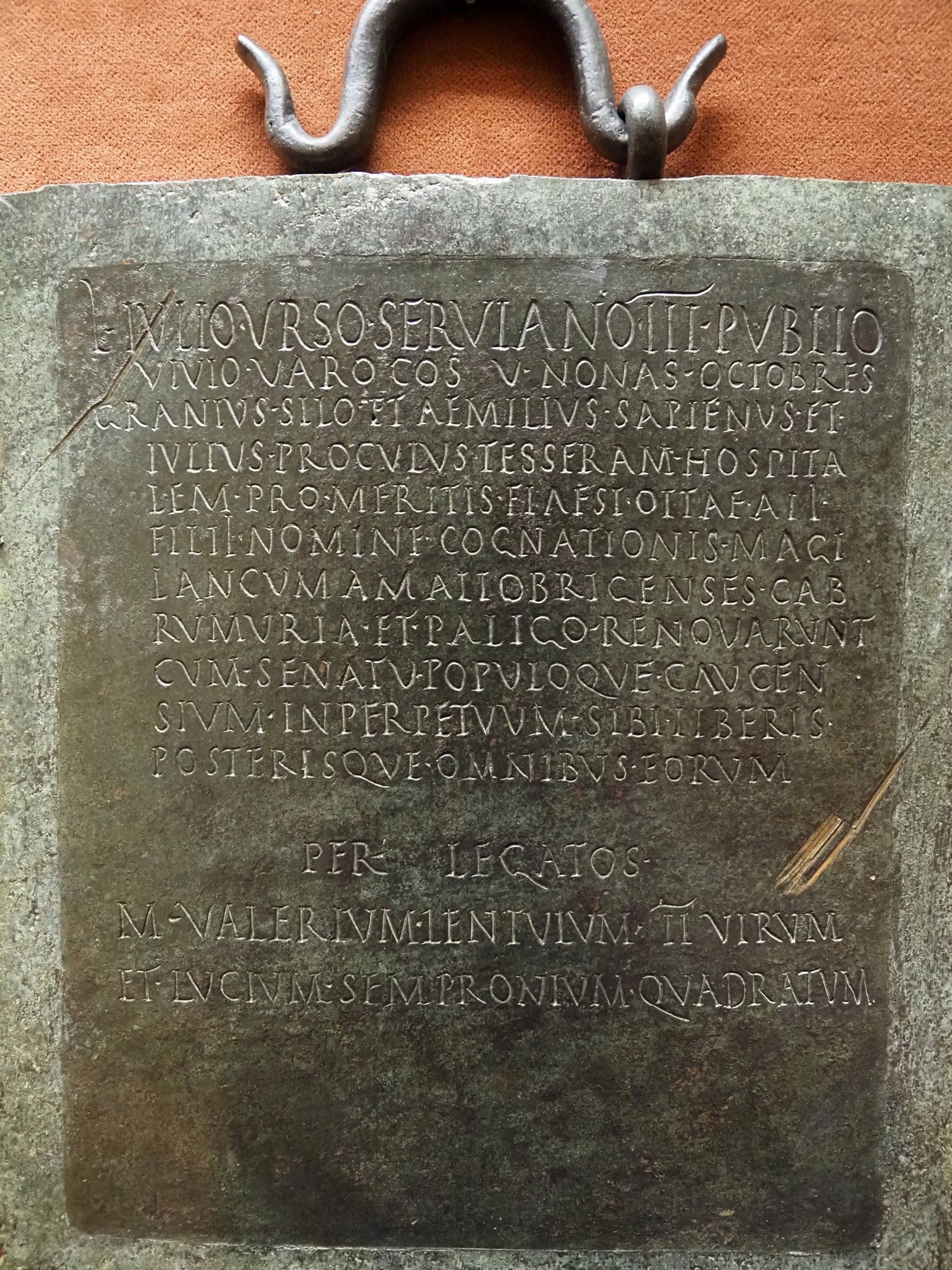
Before “symbol” meant a sign on a page, it meant half of something broken: a token you kept so that one day someone could match it.
A Token Thrown Together
The English word “symbol” comes from the Greek symbolon. According to Etymonline, it is built from syn-, “together,” and bolē, “a throwing, a casting,” from ballein, “to throw.” Put simply, a symbolon is “that which is thrown or cast together.”
The Liddell-Scott-Jones Greek lexicon (LSJ) tells us what that meant in practice. Its first definition is “a tally, i.e. each of two halves or corresponding pieces of an ἀστράγαλος or other object.” An astragalos was a knucklebone. LSJ explains that “two ξένοι [guest-friends], or any two contracting parties, broke between them” such a token, “each party keeping one piece, in order to have proof of the identity of the presenter of the other.” The shorter Middle Liddell says much the same: the halves “of a bone or coin, which two persons broke between them, each keeping one piece.” The lexicon also gives the Latin equivalent, tesserae hospitales, or tokens of hospitality.
That last phrase matters. In Greek life, xenia, the bond between host and guest, could last for generations. A broken token let a friend’s son, years later and far from home, prove that he was owed a welcome. In Euripides’ Medea (around line 613), Jason offers Medea money for her exile and promises “to send tokens to my friends, who will treat you well” (English translation on the Perseus Digital Library). Herodotus (6.86) tells of a man from Miletus who left half his wealth with Glaucus of Sparta and asked him to “take and keep these tallies; and whosoever shall ask for the money back having the tokens answering to these, to him do thou restore it.” Years later the man’s sons came “producing the tokens,” and Glaucus replied, “I do not remember the matter” (G. C. Macaulay translation). So a symbolon could stand for identity, hospitality, a debt or a promise.
The word kept growing. LSJ records that Athenian jurors were handed a symbolon on entering the courts and turned it in to collect their pay. It also lists “passport,” “receipt,” “contract between individuals” and, in the plural, treaties between cities protecting one another’s citizens. In every case, one thing vouches for another, and its worth depends on a match.
Plato’s Two Halves
The best-known use of the word comes from Plato’s Symposium. The comic poet Aristophanes is speaking, and he tells a playful myth: the first humans were double beings, and Zeus split them in two. Ever since, each of us has been looking for our missing half.
“Each of us, then, is but a tally of a man … and each is ever searching for the tally that will fit him.”
Plato, Symposium 191d, trans. H. N. Fowler (1925), via the Perseus Digital Library
Fowler’s footnote explains his choice of word. “A tally, or notched stick matching another, is the nearest English equivalent for σύμβολον, which was a half of a broken die given and kept as a token of friendship.” Plato’s readers did not need that explained. They knew the image of a person as half a token, incomplete until the matching piece turns up.
From Token to Creed: Latin Symbolum
The word came into Latin as symbolum and took on a new meaning in the early Church. Etymonline notes that around 250 AD Cyprian of Carthage applied the Greek word to the Apostles’ Creed, “on the notion of the ‘mark’ or ‘outward sign’ that distinguishes Christians from pagans.” The Catholic Encyclopedia (1907) agrees that the word symbolum, used alone for the Creed, “meets us first about the middle of the third century in the correspondence of St. Cyprian and St. Firmilian.” The oldest known use of Symbolum Apostolorum, “Creed of the Apostles,” is in a letter from the Council of Milan, written around 390.
Around 400, the writer Rufinus said the word had two meanings at once. It was an indicium, a token by which believers recognized each other, and a collatio, a whole made up of separate contributions. That is why churches still speak of a creed as a “symbol of faith.” In English, Etymonline records that the earliest sense of “symbol” (mid-15th century) was “creed, formal summary of religious belief.”
A Sign That Points Beyond Itself
LSJ shows that the wider meaning was already present in Greek. A symbolon could be a beacon signal, an omen, an emblem of a god or of royal power, or even coined money, which Plato calls “a token for the purpose of exchange.” Aristotle wrote that spoken words are symbola of experiences in the soul, and written words are symbols of spoken ones. LSJ even lists “allegory” among the meanings.
Etymonline sums up the path: from “throwing things together” to “contrasting,” to “comparing,” to a “token used in comparisons to determine if something is genuine.” From there, in English, it came to mean “something which stands for something else,” and by the 1580s “especially [an] object standing for or representing something sacred, moral, or intellectual.” By the 1610s it also meant a written mark, like those used in mathematics.
The old idea is still there. A symbol is still half of something. The visible half is the object or the mark. The other half is the meaning, and it has to be supplied by the person who understands it.
Symbols in Freemasonry
Freemasonry has made this idea central to how it teaches. English Masonry has long described itself as “a peculiar system of morality, veiled in allegory and illustrated by symbols.” George Boys-Stones traces that definition to William Preston (1742–1818). His study A Peculiar System of Morality (2021) revises his 2020 Prestonian Lecture and adds material from the 2021 lecture. In the publisher’s description, it “shows how Preston used Aristotle as his starting-point to argue that Freemasonry teaches a philosophical approach to virtue, which it expresses allegorically through the story of the building of King Solomon’s Temple.”
The best-known example is the square and compasses. Both are real tools of the stonemason. The Museum of Freemasonry in London explains that a stonemason used the square to make sure stones had perfect right angles, so they would fit together on the building site.
“For a freemason the square means treating people equally and fairly. The phrase ‘on the square’ means to treat people in an upright and proper fashion.”
Museum of Freemasonry, London, “What does the freemason symbol mean?”
The compasses, the Museum says, “represent the boundary of our day-to-day lives,” a reminder “never to go beyond the boundary, to stray into bad or excessive behaviour.” The Grand Lodge of Pennsylvania puts it the same way: the square asks a man to “act squarely,” and the compasses remind him “to keep himself in check.” Customs also vary by jurisdiction. The Grand Lodge of Pennsylvania notes that the letter “G” often seen in the center is common in America but is usually left out elsewhere.
Here the old symbolon comes back. A square is just a piece of metal until someone matches it with its meaning and lives that meaning out. Masonic symbols are not codes to crack. They are moral reminders, and each one is complete only when a person brings the other half: an honest effort to live by it.
Why It Matters Today: Keeping Your Half
We still live by symbola, though we seldom call them that. We have ticket stubs and claim checks, receipts in duplicate, passports, and keys that fit only one lock. LSJ lists almost every one of these among the meanings of the Greek word. The modern world runs on matching halves.
The ancient token, though, held something a receipt does not. It was a promise. Breaking the knucklebone meant: whoever brings the other half will find me true to my word. The token itself was worth almost nothing. Its value lay in the trust between the two people, which could outlast them both.
Herodotus tells the story of Glaucus as a warning for exactly this reason. The sons brought the matching tokens, and the man holding the other half claimed he could not remember the deal.
That is a useful question for any of us, Mason or not. When someone holds the other half of a promise I have made, a word given to a friend, a commitment to a family, a duty taken on at work or in a lodge, will it still fit when they bring it back? A symbol, as the Greeks understood it, is fulfilled by faithfulness. Keep your half.
A Note on Popular Myths
- “A symbolon was always a knucklebone.” Not quite. LSJ says an astragalos “or other object.” The lexicons also mention coins and dice, and the tokens could take other forms, such as seal impressions.
- “The Apostles wrote the Creed and called it the Symbol.” This was a medieval legend. The Catholic Encyclopedia notes that the word symbolum for the Creed does not appear in the first two centuries. It concludes that Rufinus’ account of the Apostles choosing the term is unhistorical.
- “Plato taught that we each have one destined soulmate.” The halves myth is a speech Plato gives to the comic poet Aristophanes in a dialogue full of competing views. It is not presented as Plato’s own doctrine.
Is there an object you keep because it stands for a promise or a friendship? What’s the story behind it?
Sources
- Liddell, Scott, Jones, A Greek-English Lexicon, s.v. σύμβολον, with Middle Liddell. https://lsj.gr/wiki/σύμβολον
- Etymonline, “symbol (n.).” https://www.etymonline.com/word/symbol
- Plato, Symposium 191d, trans. H. N. Fowler (Harvard/Heinemann, 1925), Perseus Digital Library. https://www.perseus.tufts.edu/hopper/text?doc=Perseus:text:1999.01.0174:text=Sym.:section=191d
- Herodotus, Histories 6.86, trans. G. C. Macaulay, The History of Herodotus, vol. 2, Project Gutenberg. https://www.gutenberg.org/cache/epub/2456/pg2456.txt
- Euripides, Medea 610–615, English translation, Perseus Digital Library. https://www.perseus.tufts.edu/hopper/text?doc=Perseus:text:1999.01.0114:line=610
- Catholic Encyclopedia (1907), “Apostles’ Creed,” New Advent. https://www.newadvent.org/cathen/01629a.htm
- G. R. Boys-Stones, A Peculiar System of Morality: William Preston and the Definition of English Freemasonry (2021). https://books.google.com/books/about/A_Peculiar_System_of_Morality.html?id=xxdfzgEACAAJ
- Museum of Freemasonry, London, “Learn about freemasonry: What does the freemason symbol mean?” https://museumfreemasonry.org.uk/blog/learn-about-freemasonry-what-does-freemason-symbol-mean
- Grand Lodge of Pennsylvania, “The Square and Compass.” https://pagrandlodge.org/the-square-and-compass/