
Before there were voting machines, there were pebbles, bronze discs and little balls of wood or ivory. The story of the “blackball” runs from the law courts of Athens to the gentlemen’s clubs of London and into the Masonic lodge. It is really a story about how communities protect the honest judgment of each member.
Pebbles and the Language of Democracy
The Greeks voted so often with small stones that the stone itself became the word for a vote. The Greek psēphos means “pebble,” and psēphizein, “to vote,” originally meant to vote with pebbles. That is where we get psephology, the modern study of elections, a word coined in 1952. Etymonline notes that the usual method in Greek cities was to drop pebbles into marked urns. As a result, “pebble” shows up throughout the Greek vocabulary of democracy: isopsēphos, for example, means “having an equal vote.”
The Athenian juror’s bronze ballot
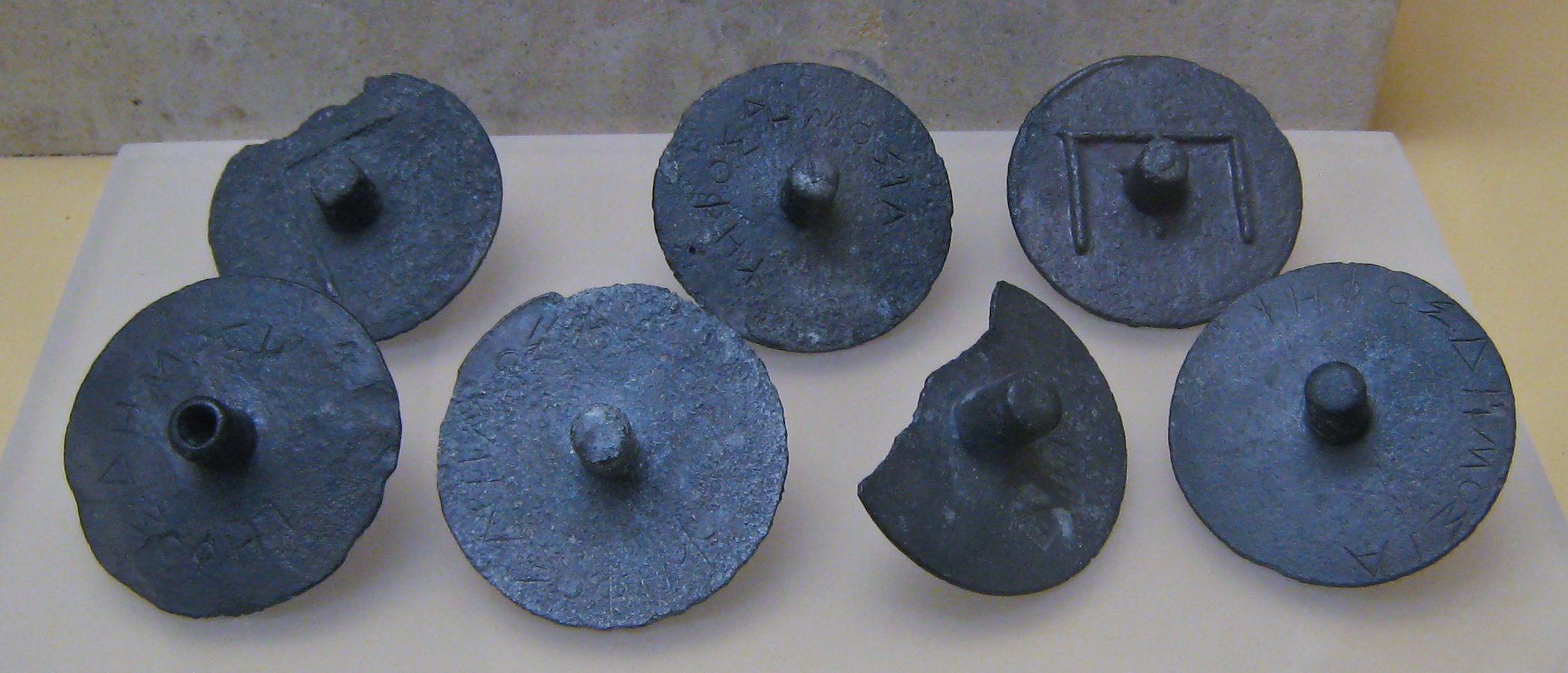
By the fourth century BC, Athenian juries had a more ingenious tool. Aristotle’s Constitution of the Athenians (chapters 68–69) describes bronze ballots, each with a small tube through the middle. Half had a pierced tube and half a solid one. Each juror received one of each. A herald announced that the pierced ballot counted for the side that spoke first (the accuser) and the solid one for the side that spoke second (the defendant). The juror pinched the tube between his fingers so no one could see which ballot was which. He dropped the ballot that counted into a bronze urn and discarded the other into a wooden one. A tie went to the defendant.
These are not legends. The excavations in the Athenian Agora have recovered examples of both kinds, such as object B 728 (pierced) and B 1055 (solid, inscribed ΨΗΦΟΣ ΔΗΜΟΣΙΑ, “public ballot”). The Canellopoulos Museum in Athens holds another and explains it simply: the solid peg stood for innocence and the pierced one for condemnation. Even then, Athenians understood that a free vote needs a hidden vote.
Myth and fact: the “white and black stone”
The popular picture has every Greek citizen choosing between a white stone and a black one. That is a simplification. The clearest classical telling of white and black pebbles is a poem, not a law code. In Book XV of Ovid’s Metamorphoses, the Greek Myscelus is put on trial for leaving his homeland, and Ovid writes that “it was an ancient custom of that land to vote with chosen pebbles, white and black. The white absolved, the black condemned the man.” In the poem, Hercules turns every black pebble white. It is also a Roman poet’s myth about the founding of Croton, not an eyewitness description of Athenian democracy.
A second common confusion involves ostracism. When Athenians voted to exile a powerful citizen for ten years, they did not use stones at all. Plutarch (Aristides 7) describes the procedure: each voter took an ostrakon, a potsherd, wrote on it the name of the man he wanted removed, and brought it to a fenced-off area of the agora. The archons first counted the total. If fewer than 6,000 had voted, the ostracism was void. Then they sorted the names, and the man named most often was banished for ten years, though he kept the income from his property. Plutarch also tells of a voter who, not recognizing Aristides, asked him to write “Aristides” on his sherd because he was “tired of hearing him everywhere called ‘The Just.’” The Athenian Agora excavations of the American School of Classical Studies have recovered real ostraka bearing his name, such as object P 9973, inscribed for “Aristeides, son of Lysimachos.”
Rome, Venice and the Word “Ballot”
Rome adopted the secret ballot through what Cicero calls the four leges tabellariae, or “tablet laws” (De Legibus III.35–36). Before them, Romans voted by voice. The first, the Gabinian law, covered the election of magistrates. The Cassian law, passed two years later, covered trials before the people. Carbo’s law covered the passing and rejecting of laws, and Coelius finally extended the written ballot to trials for treason. Later laws barred anyone from inspecting a voter’s tablet or accosting him (III.38). Cicero, an aristocrat, preferred open voting, but he conceded that the people might keep the tablet as a vindex libertatis, a “champion of liberty” (III.39).
Our English word comes later, from Italy. According to Etymonline, “ballot” first appears in the 1540s, from the Italian pallotte, “little balls,” the counters used in secret voting. The earliest references are to Venice. A ballot was a small ball long before it was a sheet of paper; the paper sense is recorded by 1776.
Clubs, Societies and the Birth of “To Blackball”
In eighteenth-century clubs and societies, members dropped a white ball to admit a candidate or a blackball to reject him, out of sight in a covered box. The rules often let one or two objections, rather than a majority, defeat an election. That way, every new member was acceptable to (nearly) all the existing ones. Etymonline dates the verb to blackball, “to exclude from a club by adverse votes,” to 1770, from the image of “black balls of wood or ivory that were dropped into an urn as adverse votes during secret ballots.”
Clubs adjusted the rule to their size. Charles Dickens Jr.’s Dictionary of London (1879) records the Travellers’ Club rule: “When 12 and under 18 members ballot, one black ball, if repeated, shall exclude; if 18 and upwards ballot, two black balls exclude, and the ballot cannot be repeated.” The principle was the same everywhere: keep the fellowship harmonious, and keep each member’s judgment private.
The Blackball in Freemasonry
Freemasonry took up this tradition early and with conviction. What follows is public, published Masonic law and commentary, not anything from the ritual.
The General Regulations published by the premier Grand Lodge in 1723 required a unanimous vote to admit a new member. They also gave the reason:
“…because the Members of a particular Lodge are the best Judges of it; and if a fractious Member should be impos’d on them, it might spoil their Harmony, or hinder their Freedom; or even break and disperse the Lodge.”
General Regulations, Art. VI (1723), as quoted in the Macoy Masonic Encyclopedia
The debate started almost at once. By 1738, James Anderson’s revised Constitutions admitted that “it was found inconvenient to insist upon unanimity in several cases,” and allowed lodges to admit a man “if not above three Ballots are against him.” Jurisdictions still differ today. The United Grand Lodge of England’s rule (historically Rule 190) is that three blackballs exclude, though a lodge’s by-laws may set that at one or two. Scotland’s constitution sets three. American Grand Lodges long held to the strict rule that a single blackball or cube rejects. Even so, Macoy’s encyclopedia notes that since the 1980s many U.S. jurisdictions have relaxed it, requiring two, three or more negative votes. (Some lodges use a black cube rather than a ball, so it cannot be mistaken for a white one.)
Why it protects harmony
The Masonic Service Association’s 1929 Short Talk Bulletin “The Black Cube” calls the secrecy and the unanimity of the ballot “two of the greatest bulwarks of the Fraternity.” A lodge is a family, it argues, and no man should be admitted “to the Masonic home of any brother against his will.” Secrecy protects the brother who holds private knowledge he does not wish to make public. No officer, “not even the Grand Master,” may ask how a brother voted.
The duty to vote by conscience, not by grudge
That much power, held by one person and answerable to no one, puts a heavy duty on the voter. The same Bulletin insists that a negative vote cast for “little reasons, small reasons, mean reasons” is a wrong, and that “turning the Masonic black cube into a secret dagger for personal revenge is indefensible.” It tells of a rough, self-made man kept out four times by one well-meaning brother, who, once elected, became one of the finest Masters his lodge ever had.
“A well used black cube goes into the ballot. Ill used, it drops into the heart and blackens it.”
“The Black Cube,” Short Talk Bulletin, Masonic Service Association, Vol. VII, No. 11 (November 1929)
The ongoing debate
Masons have argued about the ballot in good faith for three centuries. Supporters see it as a defense of harmony. Critics worry that one person can block a worthy man in secret. Macoy’s encyclopedia points out an irony: there are decisions declaring it a Masonic offense to blackball out of spite, yet such a case is nearly impossible to prove when revealing the vote is itself forbidden.
Why Lodges Still Ballot This Way
Three centuries after Anderson’s Constitutions, lodges could easily switch to a show of hands or a simple majority. Most have not. The rules have been adjusted (one blackball here, three there), but the method itself, a hidden ballot in which a small minority can say no, has survived every revision. Masons keep it because the reasons given above still hold, and because the ballot box is one of the few places where every brother, newest or oldest, carries exactly the same weight.
Why It Still Matters
You may never hold a blackball, but you live with its legacy. The secret ballot you use at a polling place rests on the same idea as the Athenian juror’s hidden thumb and the Roman wax tablet: a person votes most honestly when no one can punish or reward the choice. Every club, board, congregation or team that works by consensus faces the same question as the lodge. How do we protect the group’s harmony without letting one grudge decide a person’s future?
The blackball also shows how much weight one voice can carry. In many lodges, a single vote can close the door. That is a responsibility before it is a power. The lesson reaches well beyond the lodge room: when your vote counts most and no one is watching, vote by conscience. Do it for the good of the community and in fairness to the person in front of you, never to settle a score.
Have you ever had to cast a vote, in a lodge or anywhere else, where your one voice could decide the outcome? How did you make up your mind?
Sources
- Etymonline, “psephology”: https://www.etymonline.com/word/psephology
- Etymonline, “ballot”: https://www.etymonline.com/word/ballot
- Etymonline, “blackball”: https://www.etymonline.com/word/blackball
- Aristotle, Constitution of the Athenians 68–69, trans. H. Rackham (Loeb, 1952), Perseus Digital Library: https://www.perseus.tufts.edu/hopper/text?doc=Aristot.+Ath.+Pol.+68
- Athenian Agora Excavations, objects B 728 and B 1055: https://www.agathe.gr/id/agora/object/b%20728 and https://www.agathe.gr/id/agora/object/b%201055
- Canellopoulos Museum, “Bronze juridical ballot”: https://camu.gr/en/item/chalkini-dikastiki-psifos/
- Ovid, Metamorphoses XV (Myscelus), trans. Brookes More, Theoi Classical Texts Library: https://www.theoi.com/Text/OvidMetamorphoses15.html
- Plutarch, Aristides 7, trans. B. Perrin (Loeb, 1914), Perseus Digital Library: https://www.perseus.tufts.edu/hopper/text?doc=Plut.+Arist.+7
- American School of Classical Studies at Athens, Athenian Agora Excavations, ostrakon P 9973 (Aristeides Lysimachou): https://www.agathe.gr/id/agora/object/p%209973 (the same record lives at agora.ascsa.net, which timed out when I tried to fetch it)
- Cicero, De Legibus III.33–39 (Latin text): https://www.thelatinlibrary.com/cicero/leg3.shtml; also Perseus (ed. de Plinval, 1959): https://www.perseus.tufts.edu/hopper/text?doc=Cic.+Leg.+3.33
- Charles Dickens Jr., Dickens’s Dictionary of London (1879), entries “Travellers’ Club” and “Turf Club,” via Victorian London: http://www.victorianlondon.org/dickens/dickens-tyb.htm
- Macoy Masonic Encyclopedia, “Ballot”: https://www.macoy.com/Ballot
- “The Black Cube,” Short Talk Bulletin VII:11 (MSA, Nov. 1929): https://www.skirret.com/archive/stb/stb1929-11.html