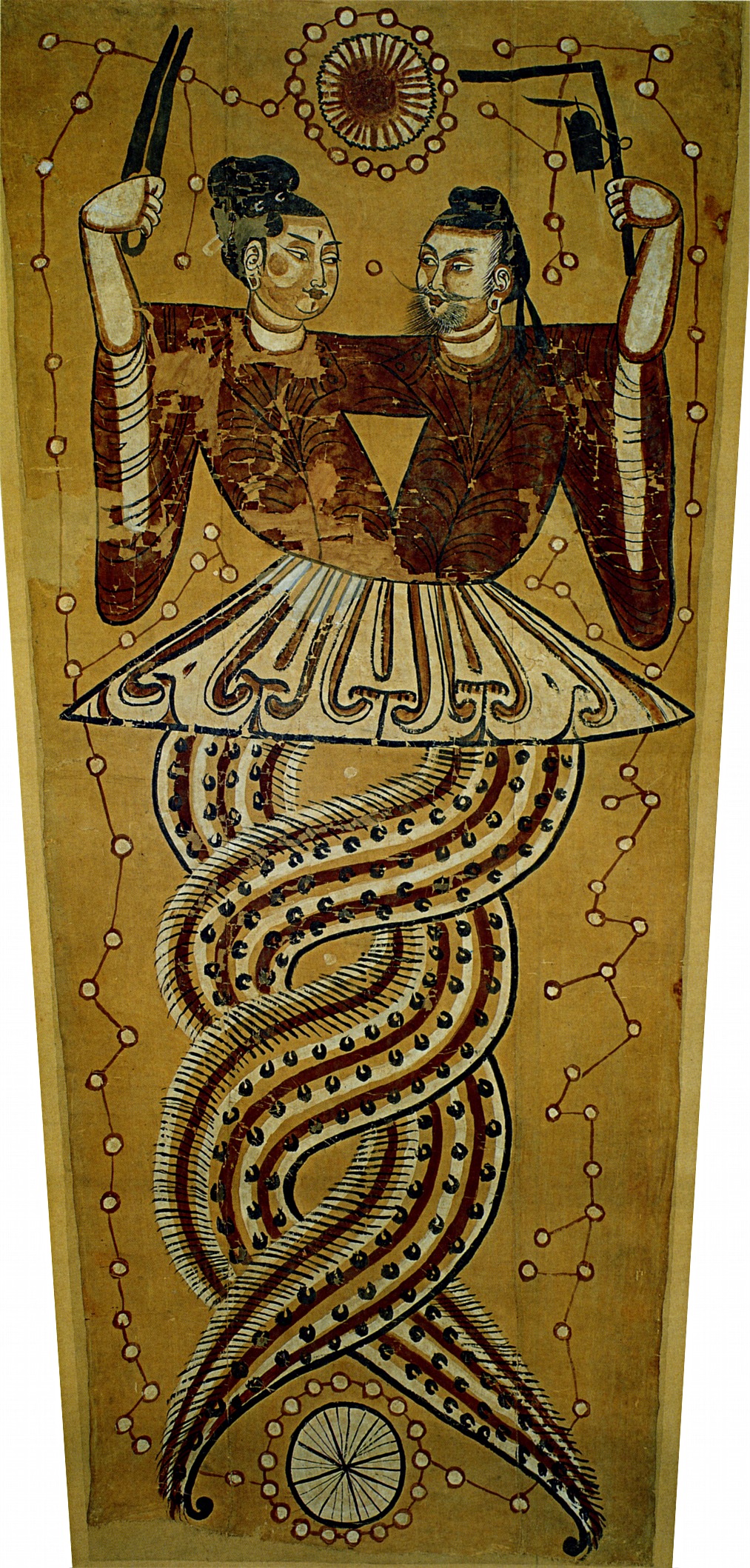
Long before the first Grand Lodge met in London, a painter in the desert oasis of Turpan laid out two figures on silk. One held a carpenter’s square and the other a compass.
Who Were Fuxi and Nüwa?
In Chinese tradition, Fuxi (伏羲, Fúxī) and Nüwa (女媧, Nǚwā) belong to the age before recorded history. They are founding figures, remembered less as gods to be worshipped than as the first ordering powers of the human world. The British Museum’s catalogue calls them “the mythical ancestors of the human race.” The Philadelphia Museum of Art describes them as “creators of the human race and civilization.” Princeton University Art Museum adds that “Fuxi established kingly rule, social order, and marriage,” and that “Nüwa is known both as Fuxi’s sister and as his wife.”
The word that keeps coming up is order. That is why the tools they hold matter so much.
The Images: Serpent Tails, Square and Compass
Han-dynasty stone: the Wu family shrines
One of the best-known depictions comes from the Wu family shrines (often called the Wu Liang Shrine) in Jiaxiang, Shandong province, carved in the 2nd century AD under the Eastern Han dynasty. The Philadelphia Museum of Art, which holds rubbings from Stone Chamber 2 (stone dated 147), notes that the carvings mix history and myth. On its stone, the bottom band shows “Fuxi (holding a set square) and Nüwa (holding a compass).”
Princeton University Art Museum’s guide to another Wu shrine stone describes the same pair: “The primeval rulers Fuxi and Nüwa are shown with their snake-like tails intertwined. Fuxi holds a square and his female counterpart Nüwa holds a compass.”
Silk in the desert: the Astana banners
Some five centuries later, the same pair turned up far to the west, at the Astana cemetery near Turpan in today’s Xinjiang. The British Museum holds a painted silk banner from there (museum number 1928,1022,0.203), dated about the 6th to 7th century and collected by Sir Aurel Stein. The museum’s curator’s note, drawn from Roderick Whitfield’s 1985 catalogue, explains that banners like it “are a characteristic feature of the furnishings of the tombs from the early sixth to the mid-seventh century in the cemetery at Astana, and have been found in some numbers.”
The design is striking. Above, a sun ringed with stars; below, the moon. Between them the two figures share a coat, each with an arm around the other’s neck, and below the waist their serpent bodies twist together, “here three times, but in other cases only once or twice.” The Xinjiang Uygur Autonomous Region Museum holds another Tang-dynasty example, unearthed at Astana in 1965, in which, as China Daily reports, “Fuxi holds a square and Nüwa holds a compass, representing the balance of heaven and earth.”
Who holds which tool?
The usual rule is that Fuxi holds the square and Nüwa the compass, and every source cited here agrees on that. The position of the figures, however, is not fixed. Whitfield notes that the British Museum banner “is unusual in that Nu Wa is on the right, in the place usually taken by Fu Xi. She holds what appears to be a compass, and he the set-square ruled with divisions in white.” So the safest way to read any single image is to look at the tools, not at which side each figure stands on.
The Characters: 規, 矩 and 規矩
The two tools have their own characters, and those characters became moral words.
- 規 (guī) is the compass, the tool for drawing circles. The Unicode Consortium’s Unihan database gives its meanings as “rules, regulations, customs, law.”
- 矩 (jǔ) is the carpenter’s square. Unihan defines it as “carpenter’s square, ruler, rule.”
- 規矩 (guījǔ) (simplified 规矩) puts the two together. Literally “compass and square,” it means rules, norms and proper conduct. To say someone is 規矩 is to say he behaves properly and keeps within bounds.
A gentle correction is needed here, because a popular claim says the Chinese word for “virtue” is made of the square and compass. It isn’t. The usual word for virtue is 德 (dé), which Unihan glosses as “ethics, morality, virtue,” and it has nothing to do with either tool. What 規矩 names is something slightly different, and in some ways closer to Masonic thinking: not virtue as an inner quality, but the standard of upright behavior, the measure that conduct is tested against. That is very near what a Mason means by “square conduct.”
The philosopher Mencius (4th century BC) made the image famous. The first passage of the book “Li Lou I” (4A:1) opens:
「離婁之明,公輸子之巧,不以規矩,不能成方圓。」
“Even with the keen sight of Li Lou and the skill of Gongshu Zi, without the compass and square one cannot form squares and circles.”
Mencius 4A:1 (Chinese text via Wikisource; our translation)
Li Lou was a legendary man with perfect eyesight, and Gongshu Zi a legendary master craftsman. Mencius’s point is that talent is not enough. Even the most gifted worker needs a true standard.
方 and 圓: square earth, round heaven
The two shapes the tools make are 方 (fāng), square, and 圓 (yuán), round. In early Chinese thought they stood for earth and heaven. The idea is often summed up as “round heaven, square earth” (天圓地方, tiān yuán dì fāng).
Even in antiquity, thoughtful people read this as symbol rather than geography. In the Da Dai Liji, a student asks Zengzi, a disciple of Confucius, whether heaven really is round and earth square. Zengzi points out that if it were literally so, “the four corners would not be covered,” and then quotes his master: 「天道曰圓,地道曰方」, “the way of heaven is called round; the way of earth is called square.” It is the way, the pattern of conduct, that is round or square, not the shape. Seen that way, Fuxi and Nüwa holding square and compass beneath the sun and moon are holding the measures of earth and heaven together.
Older Than Freemasonry?
Yes, and plainly so. The Wu shrine carvings were made about sixteen centuries before the Grand Lodge of England, the first Grand Lodge, was founded in 1717. Even organized lodges are older than that date: on 28 December 1598 William Schaw, the King’s Master of Work in Scotland, issued the Schaw Statutes for “all the master masons within this realm,” ordering wardens to be elected for every lodge and a copy sent “to every particular lodge” (text as given by the Masonic High Council). Yet the Astana banners are older still, and the Wu carvings older by some fourteen centuries. The square and compass, and the idea that they teach a moral lesson, long predate the first Grand Lodge and the earliest documented Masonic lodges alike.
Freemasons themselves say as much. The Museum of Freemasonry in London explains that for a Freemason “the square means treating people equally and fairly,” and that the compasses “represent the boundary of our day-to-day lives,” a reminder “never to go beyond the boundary, to stray into bad or excessive behaviour.” Then it adds:
“These are both symbols that go back before organised freemasonry but combined together they are recognised the world over as the emblem of the organisation.”
Museum of Freemasonry, London, “What does the freemason symbol mean?”
The Grand Lodge of Pennsylvania puts it in similar terms: the square is thought to enjoin a man to “act squarely,” and the compass “to keep himself in check and not to overindulge in life’s vices.”
What we should not say is that Freemasonry descends from Fuxi and Nüwa, or that Chinese imagery somehow travelled to the stonemasons of Britain. There is no documented historical link between the two. Masonic symbolism grew from the working tools of the European building trades, the same tools the Museum of Freemasonry describes stonemasons using to cut stone true.
That is what makes the parallel worth noticing. Two traditions, with no known contact, looked at the builder’s square and compass and drew nearly the same lesson: a good life, like a good building, is made by working to a true standard and within proper bounds. That is not evidence of a secret lineage. It is evidence of a shared human intuition.
Why It Matters Today
規矩 is still an everyday word in Chinese. A parent might tell a child to 守規矩 (shǒu guījǔ), “keep to the rules,” or to behave properly. Behind that ordinary phrase is Mencius’s point: skill and good intentions are not enough on their own. We need a standard outside ourselves to measure our work against, and the humility to use it.
For Masons this is familiar ground. It is encouraging that a painter at Turpan and a Han-dynasty stone carver would have understood those lessons at once. The tools are simple, the measure is old, and the work of living up to it belongs to every generation.
Freemasonry in China Today
The square and compasses on the Astana banners are ancient Chinese images. Freemasonry itself reached China much later, with European traders. The Grand Lodge of China’s own history records an English lodge, Amity No. 407, sanctioned for Canton (Guangzhou) in 1767. Through the nineteenth and early twentieth centuries, English, Scottish, Irish, American and Philippine lodges met in Shanghai, Hong Kong and the treaty ports.
Mainland China
That chapter closed in the early 1950s. The Grand Lodge of China says that “by 1951 the Grand Lodge of China had ceased to function in Shanghai.” A history of the Scottish District of the Far East, written in 1961, records that “political considerations compelled” the Scottish District of North China “to cease work in 1952.” Shanghai lodges such as Lodge St. Andrew in the Far East and the Irish Lodge Erin moved to Hong Kong, where they still meet. There are no known, recognized lodges in Mainland China.
Hong Kong and Macau
Hong Kong is a different story. Its first Masonic hall was built in 1853 by Zetland Lodge No. 525 of the English Constitution and named Zetland Hall. The second hall was destroyed in 1944, during the Japanese occupation. The present Zetland Hall at 1 Kennedy Road was dedicated on 30 January 1950. It is shared by all three “home” Grand Lodges of the British Isles: lodges of the District Grand Lodge of Hong Kong and the Far East (England), the District Grand Lodge of the Far East (Scotland), and the Provincial Grand Lodge of the Far East (Ireland) all meet there. The Irish province includes Sino Lusitano Lodge of Macau No. 897, warranted in 1988 to meet in either Hong Kong or Macau.
Taiwan
The Grand Lodge of China was consecrated at the Masonic Hall in Shanghai on 18 March 1949. Its founding lodges had been chartered by the Grand Lodge of the Philippines; the first, Amity Lodge, was chartered in 1931 to bring the Craft to Chinese members. After it went dark in Shanghai, the Grand Lodge moved briefly to Hong Kong and then to Taiwan. There it consecrated Liberty Lodge No. 7 in 1952 and was reactivated in 1955. It still works in Taipei today. Han Lodge No. 8, chartered in 1972, was the first of its lodges to conduct all its business in Chinese.
So the old emblem of the square and compasses still has a home in the Chinese-speaking world, in Taipei, at Zetland Hall and in Macau, under several Grand Lodges.
A Note on Popular Myths
- “The Chinese word for virtue is square plus compass.” No. Virtue is usually 德 (dé). 規矩 (guījǔ) means rules, norms and proper conduct, the standard of upright behavior.
- “Freemasonry is descended from ancient China.” There is no documented historical link. The parallel is real; the descent is not.
- “Fuxi is always on the left and Nüwa on the right.” Positions vary. The tools are the reliable guide: in the sources cited here Fuxi holds the square and Nüwa the compass.
Have you come across the square and compasses, or a similar idea of living “by the square,” in another culture or in your travels? Where was it?
Sources
- British Museum, funerary banner depicting Fu Xi and Nu Wa, Astana, museum no. 1928,1022,0.203 (curator’s comments from Whitfield 1985). https://www.britishmuseum.org/collection/object/A_1928-1022-0-203
- Philadelphia Museum of Art, “Rubbing from carved stone from the Wu Family Shrines, Stone Chamber 2.” https://www.philamuseum.org/objects/41129
- Princeton University Art Museum, “Wu Family Shrines Pictorial Stones.” https://static.artmuseum.princeton.edu/asian-art/china/viewers/wu-shrine-viewer
- China Daily, “Ancient silk painting depicts Fuxi and Nüwa with intertwined snake tails” (Xinjiang Uygur Autonomous Region Museum), Feb. 2025. https://govt.chinadaily.com.cn/s/202502/06/WS67a411c4498eec7e1f72e84f/ancient-silk-painting-depicts-fuxi-and-nuwa-with-intertwined-snake-tails.html
- Mencius, “Li Lou I” (離婁上) 4A:1, Chinese text, Wikisource. https://zh.wikisource.org/wiki/孟子/離婁上
- Da Dai Liji, “Zengzi Tian Yuan” (曾子天圓), Chinese text, Wikisource. https://zh.wikisource.org/wiki/大戴禮記/曾子天圓
- Unicode Consortium, Unihan Database entries for 規 (U+898F), 矩 (U+77E9), 德 (U+5FB7), 方 (U+65B9), 圓 (U+5713). https://www.unicode.org/charts/unihan.html
- Museum of Freemasonry, London, “Learn about freemasonry: What does the freemason symbol mean?” https://museumfreemasonry.org.uk/blog/learn-about-freemasonry-what-does-freemason-symbol-mean
- Grand Lodge of Pennsylvania, “The Square and Compass.” https://pagrandlodge.org/the-square-and-compass/
- United Grand Lodge of England (foundation of the Grand Lodge of England, 1717). https://www.ugle.org.uk/
- Masonic High Council, “The Schaw Statutes (Scotland) 1598 & 1599” (modern-English text and transcript). https://www.rgle.org.uk/RGLE_1598.htm
- Grand Lodge of China (Taiwan), “GLOC History.” https://freemason.org.tw/about-gloc/gloc-history/
- Zetland Hall, Hong Kong, “History” and “Hong Kong Lodges.” https://www.zetlandhall.com/history ; https://www.zetlandhall.com/hong-kong-lodges
- Provincial Grand Lodge of the Far East (Irish Constitution), lodge list. https://pglfe.org/
- District Grand Lodge of the Far East (Scottish Constitution), “Outline History” (1961). https://www.skirret.com/papers/dgl/outline_history.html