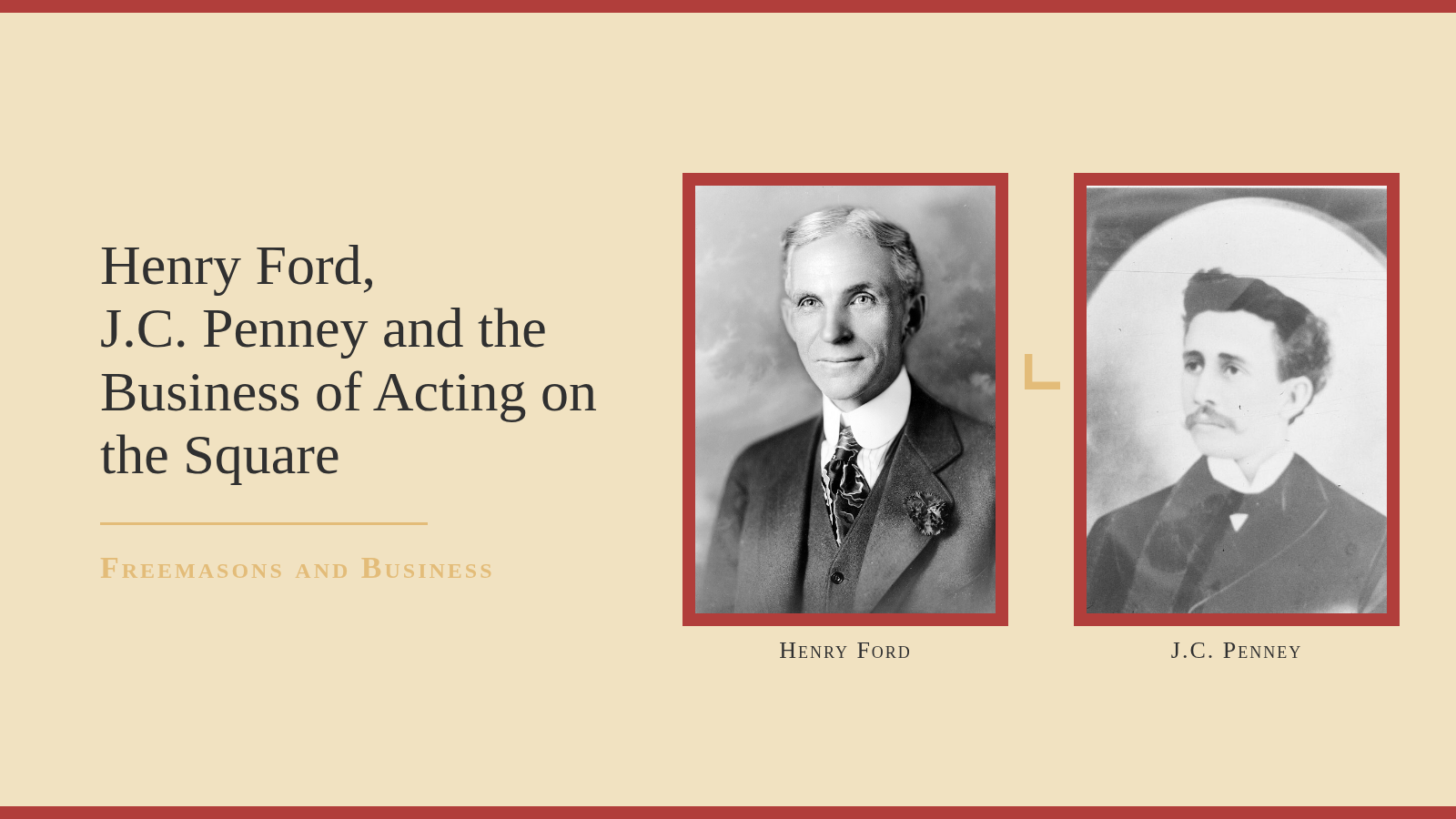
Two of the men who shaped how Americans work and shop were Freemasons. One changed the way things are made, and the other changed the way they’re sold. Their stories are worth telling honestly, with the admirable parts and the parts that aren’t.
Henry Ford and the Moving Line
Henry Ford was born on 30 July 1863 on a farm in what is now Dearborn, Michigan. The Grand Lodge of British Columbia and Yukon’s biography records that he was raised on 28 November 1894 in Palestine Lodge No. 357, Detroit, and was later a member of Zion Lodge No. 1. We haven’t found documented dates for his first two degrees.
His great achievement was in production. On 1 December 1913 his Highland Park plant put the first moving assembly line into operation. The Henry Ford museum’s curator of transportation, Matt Anderson, writes that experiments through 1913 and into 1914 cut the time needed to build a Model T “from 12½ hours to a mere 93 minutes.” Cheaper production meant lower prices, and lower prices meant that ordinary families could buy a car.
The Five-Dollar Day, With Its Strings
On 5 January 1914, Ford and his vice president James Couzens announced that the company would pay its workers five dollars a day. It made headlines around the world. Nobody had paid that much for unskilled factory work before.
The fuller story is more complicated, and The Henry Ford museum tells it plainly. First, it wasn’t a straightforward raise. Ford called it profit sharing. A man earning $2.30 a day kept that wage, and if he met the company’s requirements he received a bonus of $2.70 on top of it.
Second, those requirements reached into workers’ homes. Ford set up a Sociological Department to make sure the money was used “properly.” To qualify, a worker had to stay off alcohol, not abuse his family, not take in boarders, keep a clean home and save regularly. Inspectors made unannounced home visits, checked bank deposits and asked whether the children were attending school. When inspectors found “violations,” they offered advice and pointed families to company resources, and the full bonus was held back until the problems were put right. But workers came to resent the intrusion, and by 1921 the department was largely dissolved.
Third, nobody quite agrees on why Ford did it. Turnover on the new assembly line had reached about 370 percent, because the work was so monotonous. Over the past century the wage has been explained as a way to keep men on the line, as a publicity stunt, and, by Ford’s admirers, as pure philanthropy. The familiar story that he paid workers enough “so they could afford the cars they built” is part of the picture, but only part. Anderson notes that Ford himself “slyly observed” that better pay created new customers for the Model T, and he concludes that “the truth lay somewhere in the middle.” What isn’t in doubt is the result. Other employers raised their wages to keep up, and the Five-Dollar Day helped bring factory workers into the middle class.
The Part We Can’t Leave Out
Any honest account of Henry Ford must include his antisemitism. The United States Holocaust Memorial Museum records that from 1920 his newspaper, The Dearborn Independent, ran a series called “The International Jew.” The series spread conspiracy theories drawn from the forged Protocols of the Elders of Zion, and it was reprinted as books and translated into many languages, including German. In 1927, facing a libel suit, Ford signed a public apology, but the books went on circulating for years. Freemasonry teaches that we meet on the level, whatever a man’s faith. On this, Ford fell badly short of what the Craft asks of its members, and we say so plainly.
J.C. Penney and the Golden Rule
James Cash Penney was born on 16 September 1875 on a farm near Hamilton, Missouri. According to the National Park Service’s National Register nomination for his Kemmerer, Wyoming, landmarks, he was clerking in a Hamilton store when poor health sent him west in 1897. In Longmont, Colorado, he bought a butcher shop, and he lost its main customer, a local hotel, because he refused to supply the hotel’s chef with free liquor. He went back to clerking, and his employers soon made him a partner in a new store.
Penney opened that store in Kemmerer on 14 April 1902 and called it the Golden Rule. Mining towns of the time were dominated by company stores that ran on credit and often kept miners in debt. Penney sold for cash, at fair, fixed prices. His first day’s takings were $466.59. Asked about the name, he said that
“our idea was to make money and build business through serving the community with fair dealing and honest value.”
J.C. Penney, Fifty Years with the Golden Rule (1950), p. 55, as quoted in the National Register of Historic Places nomination for the J.C. Penney Historic District, Kemmerer, Wyoming
The Golden Rule stores became the J.C. Penney Company. The Grand Lodge of British Columbia and Yukon’s biography notes that when the company went public in 1927, Penney gave shares to his store managers and later brought employees into profit sharing.
A Salt Lake City Mason
In 1909 Penney left Kemmerer and moved his headquarters to the Kearns Building in Salt Lake City, according to the National Register nomination. It was there that he became a Mason. The Grand Lodge of British Columbia and Yukon and the Minnesota Masonic Heritage Center both record that he was made a Mason in Wasatch Lodge No. 1, Salt Lake City, and Jeptha Lodge No. 121 gives his initiation as 18 April 1911. When the company moved east to New York a few years later, its first temporary offices were in the Masonic Lodge Building at 71 West 23rd Street.
His link with the Craft shows up in an unexpected place. The Minnesota Masonic Heritage Center describes the old idea of “J.C. Penney lodges,” Masonic buildings with a Penney store on the ground floor. In Hibbing and Wadena, Minnesota, Penney stores were the lodges’ main tenants for more than sixty years. Penney didn’t build Masonic temples, as some legends claim. But as the Heritage Center puts it, “Masons could be counted on as fair and upright landlords, acting on the square and living by the Golden Rule.”
Acting on the Square
Every Mason knows the square as the emblem of honest dealing. Penney’s Golden Rule store was that idea put into practice: a fair price, the same for everyone, paid in cash rather than run up on a tab the customer could never clear. The Golden Rule is far older than Freemasonry, and Penney was a devout Christian who wrote a whole book about living by it. We shouldn’t claim the lodge taught it to him. He was already running Golden Rule stores nine years before he was initiated. Perhaps it’s truer to say he found in the lodge men who already lived by the rule he cared about.
What We Can Learn From Both
It would be easy to make both men into Masonic saints, or to dismiss them. Neither is honest. Ford’s genius for production helped bring factory workers into the middle class, yet he paired his famous wage with surveillance of workers’ homes, and he used his wealth to spread hatred. Penney built an empire on fair dealing, and his convictions came from his faith before he ever entered a lodge.
The lesson for us is not that Freemasonry makes men rich. It’s that the tools we’re given, the square above all, can be used in a factory or behind a shop counter as well as anywhere else. They also measure us when we fall short.
Where have you seen “acting on the square” make a real difference at work, whether in a deal, a hire, or a hard decision? And where is it hardest to live up to?
Sources
- Grand Lodge of British Columbia and Yukon, “Henry Ford.” https://freemasonry.bcy.ca/biography/ford_h/ford_h.html
- Matt Anderson, “Ford’s Five-Dollar Day,” The Henry Ford (3 January 2014). https://www.thehenryford.org/collections/explore/articles/fords-five-dollar-day
- United States Holocaust Memorial Museum, “Antisemitism and Henry Ford’s ‘The International Jew,’” Holocaust Encyclopedia. https://encyclopedia.ushmm.org/content/en/article/antisemitism-and-henry-fords-international-jew
- National Park Service, National Register of Historic Places nomination, J.C. Penney Historic District, Kemmerer, Wyoming (NRHP 78002830). https://npgallery.nps.gov/NRHP/GetAsset/NRHP/78002830_text
- Grand Lodge of British Columbia and Yukon, “James Cash Penney.” https://freemasonry.bcy.ca/biography/penney_j/penney_j.html
- Mark Anderson, “‘J.C. Penney’ lodges,” Minnesota Masonic Heritage Center (29 June 2022). https://masonicheritagecenter.org/2022/06/j-c-penney-lodges/
- Jeptha Lodge No. 121, “James Cash (JC) Penney” (education program, 3 June 2025). https://jepthalodge.org/Voices/NOTABLE-JCPenney.html