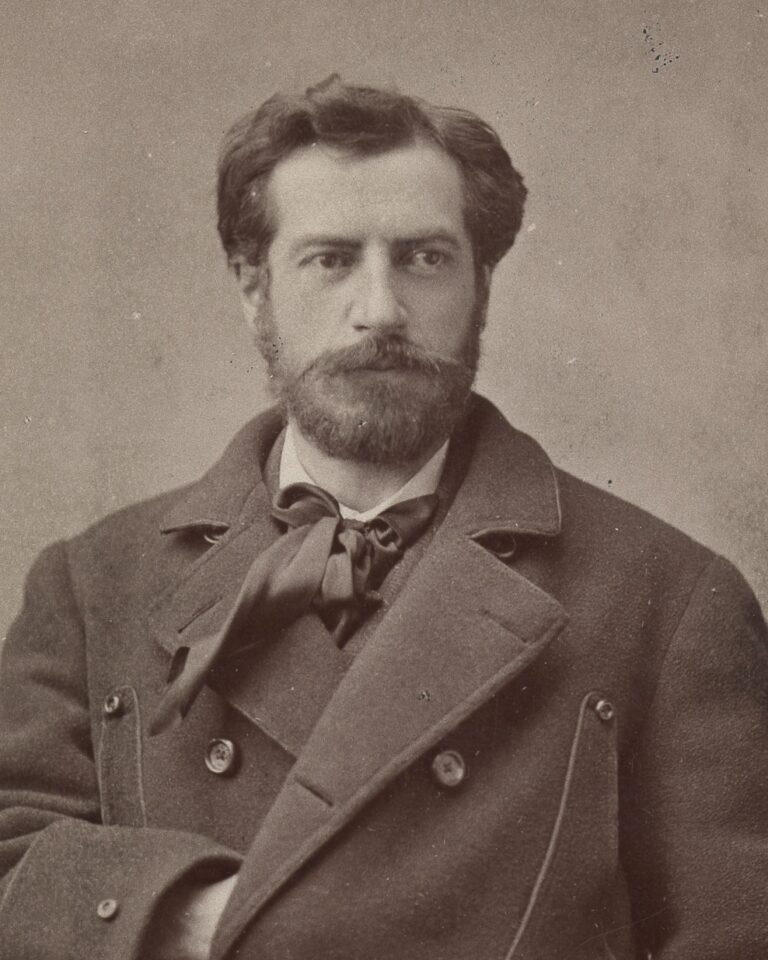
Frédéric Auguste Bartholdi
Born August 2, 1834, Colmar, Alsace · Died October 4, 1904, Paris · Lodge Alsace-Lorraine, Paris
Frédéric Auguste Bartholdi designed the Statue of Liberty, the monumental French gift to the United States that became an enduring symbol of freedom.
A Colmar Sculptor Who Learned His Scale in Egypt
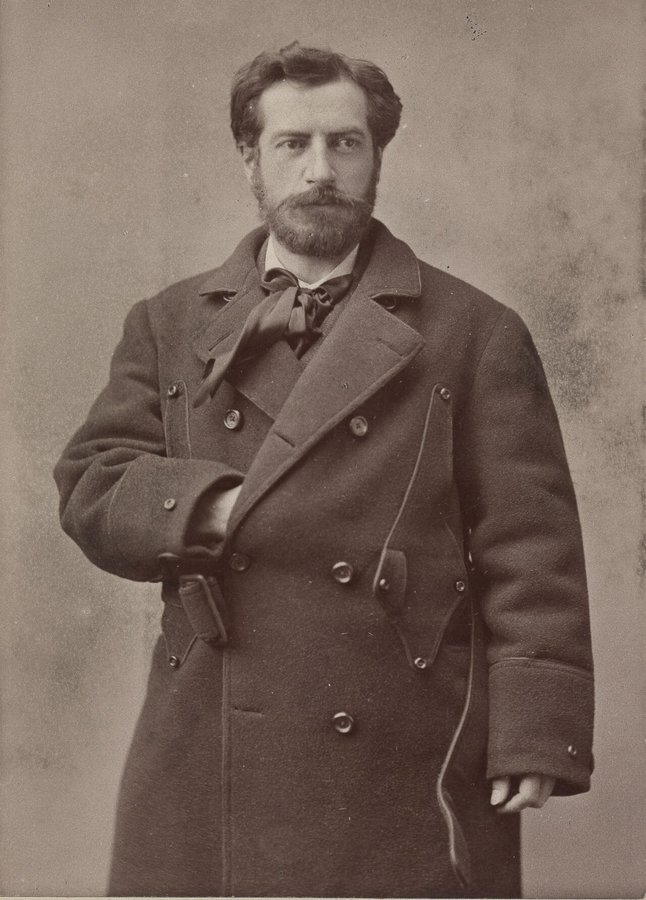
Frédéric Auguste Bartholdi was born in Colmar, in Alsace, on August 2, 1834. When he was nine, his mother, Charlotte, moved with her children to Paris so that they could attend the Lycée Louis-le-Grand and study under accomplished artists. At twenty he received a commission for a large bronze statue of General Jean Rapp, a Napoleonic officer. A later journey to Egypt, to photograph works of antiquity, left a lasting impression. In the desert he found ruined cities and colossal statues still standing, and he wrote that those “granite beings, in their imperturbable majesty, seem to be still listening to the most remote antiquity.” He proposed to the khedive of Egypt, then overseeing the French work on the Suez Canal, a lighthouse in the form of an Egyptian woman carrying a light, to be called “Egypt (or Progress) Carrying the Light to Asia.” The khedive rejected the design.
A Gift Proposed at a Dinner, Delayed by a War
A different commission grew from his friendship with Édouard de Laboulaye, an abolitionist, president of the French Anti-Slavery Society, a scholar of American democracy and a leading French expert on the United States Constitution. Laboulaye believed in what he called “the common law of free peoples,” the idea that every person was born with a right to freedom, and he spent much of his career arguing for the return of democracy in France. In 1865, after the Union victory in the American Civil War and the adoption of the Thirteenth Amendment, which abolished slavery, he proposed a monument that would honor the American centennial and the Franco-American friendship, and would, he hoped, give the French a living example of those ideals. The Franco-Prussian War interrupted the plan. Bartholdi led a local regiment in the defense of Colmar, then surrendered with the rest of France. Germany annexed his birthplace, and Paris was again in upheaval. In 1871 he sailed to the United States with letters of introduction from Laboulaye, seeking support and a site. In less than three months he chose Bedloe’s Island in New York Harbor, which he saw as the “gateway to America,” secured a commission for a frieze at the Brattle Square Church in Boston, and explored a display at Philadelphia’s coming Centennial Exposition. For the statue itself he received, at first, little more than encouragement.
An Arm in Philadelphia, a Head in Paris, and a Pylon by Eiffel
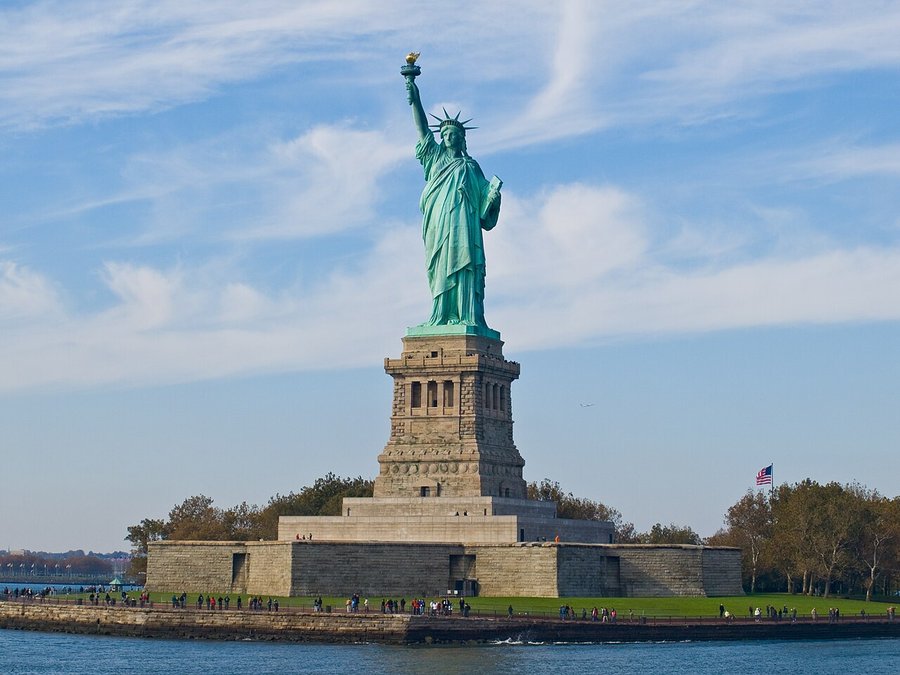
In September 1875 Laboulaye announced the project and the Franco-American Union that would raise money for it. The statue received its name, Liberty Enlightening the World: the French would pay for the statue, the Americans for the pedestal. Bartholdi began the design in 1870 and oversaw fabrication at the Paris workshop of Gaget, Gauthier & Company. The arm and torch were finished in 1876 and shown at the Centennial Exposition in Philadelphia and then in New York; the head and shoulders were completed in 1878 and displayed at the Paris Universal Exposition. Admission fees and the sale of miniatures helped the fund. After Eugène Viollet-le-Duc, who had first designed the statue’s interior, died in 1879, the committee hired Alexandre-Gustave Eiffel. Eiffel kept Viollet-le-Duc’s method of forming the copper skin, known as repoussé, but designed a new iron pylon, ninety-two feet high, with a lightweight truss and flexible bars that acted like springs, so that the statue could settle and withstand the harbor winds and changes of temperature. He supervised that inner construction until late 1883. The complete statue was assembled in Paris between 1881 and 1884.
Liberty’s arm was not the only Bartholdi work at the Philadelphia Centennial. He also sent a cast-iron fountain, cast in Paris by A. Durenne, thirty feet high and weighing more than fifteen tons, with three sea nymphs eleven feet tall appearing to hold up its great basin and three tritons beneath a crown shaped like a walled city. He meant it as an allegory of light and water, and he thought its mix of iron, gas light and water suited a modern city. At the suggestion of the landscape architect Frederick Law Olmsted, Congress bought it for $6,000 and moved it to Washington in 1877, where it stood at the foot of Capitol Hill. Its gas lamps were lit by battery in 1881, making it a popular sight after dark, and it was fully electrified in 1915. Moved once, in 1932, and restored from 2008 to 2011, the Bartholdi Fountain still runs beside the United States Botanic Garden and turned 150 in 2026.
On July 4, 1884, the finished statue was presented in Paris to Levi P. Morton, the United States minister to France, then taken apart and shipped aboard the French Navy vessel Isère, arriving in New York Harbor on June 17, 1885, to a welcome the pedestal was not yet ready to match. The newspaper publisher Joseph Pulitzer pressed the American campaign for the base. Once the pedestal was finished, inside the star-shaped walls of old Fort Wood on Bedloe’s Island, a construction crew—many of them new immigrants—reassembled the statue with steam-driven cranes and derricks and no exterior scaffolding. On October 28, 1886, in wet, foggy weather, some one million New Yorkers turned out for the dedication. Parades moved on land and water, and the official ceremony took place beneath the statue “glistening with rain.” When Bartholdi released the French tricolor that veiled Liberty’s face, guns, whistles and applause answered. He told a reporter, “My dream has been realized. I can only say that I am enchanted. This thing will live to eternity, when we shall have passed away.” He died on October 4, 1904.
Lodge Alsace-Lorraine, and a Cornerstone Laid in the Rain
Bartholdi belonged to Lodge Alsace-Lorraine in Paris, a lodge whose name recalled the provinces lost in the war he had fought. William R. Denslow, following John Hamill, places his initiation in 1874; other accounts give 1875, the year the Franco-American Union was announced and fundraising for the statue began in earnest. The dates of his later degrees are not known.
Lodge Alsace-Lorraine drew intellectuals, writers and public officials. Bartholdi is reported to have invited his brothers there to see the finished statue before it left France, to have given the lodge a lecture in November 1884 on its history and the methods used to build it, and in 1887 to have told them of the welcome he had received in New York.
On the American side, the Masonic link was public. William M. Evarts, chairman of the American Committee, asked the Grand Lodge of Free and Accepted Masons of the State of New York to lay the pedestal’s cornerstone, as Masons had done for the United States Capitol and the Washington Monument. On August 5, 1884, in pouring rain, about a hundred members of the Grand Lodge and visiting Grand Officers crossed to Bedloe’s Island aboard the steamer Bay Ridge. The pedestal’s architect, Richard Morris Hunt, presented the working tools to Grand Master William A. Brodie. A copper box placed in the stone held a copy of the Constitution, Washington’s Farewell Address, New York newspapers, and a portrait of Bartholdi. Brodie asked why the fraternity had been called on for such a structure, and answered, “No institution has done more to promote liberty and to free men from the trammels and chains of ignorance and tyranny than has Freemasonry.”
Which part of Liberty’s story best shows the cooperation Bartholdi needed beyond his own sculpture?
Sources
- National Park Service — Frédéric-Auguste Bartholdi
- National Park Service — Creating the Statue of Liberty
- National Park Service — Édouard de Laboulaye
- National Park Service — Alexandre-Gustave Eiffel
- Grand Lodge of British Columbia and Yukon — Frédéric Bartholdi
- On this site — The Masonic History of the Statue of Liberty
- United States Botanic Garden — Bartholdi Fountain (Fountain of Light and Water)
- Grand Lodge of New Jersey — Freemasonry and the Statue of Liberty, by Robert C. Singer
- National Park Service Historical Handbook — Statue of Liberty: Building the Pedestal
Life & Masonic Timeline
Frédéric Auguste Bartholdi, 1880. Napoleon Sarony. via Wikimedia Commons, cropped · Public domain · Source