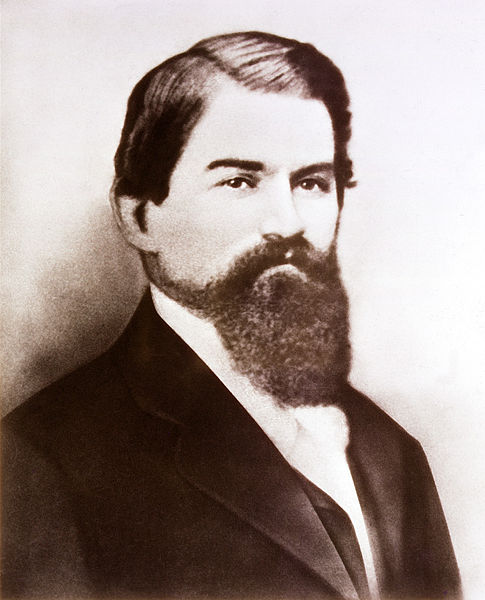
On 8 May 1886, an Atlanta pharmacist carried a jug of dark syrup down the street to Jacobs’ Pharmacy. It sold for five cents a glass, and in its first year it averaged about nine drinks a day. The man who made it would not live to see what it became. He was Dr. John Stith Pemberton, a veteran, a chemist and a member of Columbian Lodge No. 7 in Columbus, Georgia.
A Georgia Druggist
Pemberton was born on 8 January 1831 in Knoxville, Crawford County, Georgia, and grew up in Rome. He trained at the Reform Medical College of Georgia in Macon. In 1850, at nineteen, he was licensed to practice on Thomsonian, or botanic, principles, a school of medicine built on herbal remedies. He practiced first around Rome and then in Columbus. There, in 1855, he opened a wholesale and retail drug business.
His real gift, as the New Georgia Encyclopedia puts it, “was for medical chemistry rather than regular medicine.” His Columbus laboratories were unusual in the South, and an Atlanta reporter later called them “one of the most splendid Chemical Laboratories that there is in the country.” Those labs outlived him. They were turned into the state’s first testing laboratories and became part of the Georgia Department of Agriculture, where they helped stop the sale of fraudulent farm chemicals.
A Brother of Columbian Lodge No. 7
Columbian Lodge No. 7 is the oldest lodge in western Georgia. It was organized on 9 October 1828 and chartered by the Grand Lodge of Georgia that December, two months before the city of Columbus was incorporated. The lodge’s own published history names “Dr John Stith Pemberton, American pharmacist, inventor of Coca-Cola” among its notable brothers. The Masonic biographies kept by freemasonry.bcy.ca list him as a member of Columbian Lodge No. 7. They cite the records of the Grand Lodge of Georgia and his grave marker in Linwood Cemetery, Columbus, as their references.
We should be honest about the limits of what we know. We found no published date for his initiation, passing or raising, and no record of any office he held. What we can say is that he was a member of the lodge in the town where he built his career, served in the war and nearly died. That lodge did not escape the war either. Its history records that in April 1865 Federal troops broke into the lodge room and carried off its charter, furniture and about ten years of records. That was the same month and the same fight in which Pemberton was wounded.
The Wound
When war came, Pemberton enlisted in May 1862 as a first lieutenant. He organized the Third Georgia Cavalry Battalion for the defense of Columbus and rose to lieutenant colonel. On Easter Sunday 1865, Union troops under General James Wilson attacked Columbus. Pemberton was directly in the line of fire. He suffered gunshot and sword wounds, and the New Georgia Encyclopedia says he was “almost killed.”
Like many veterans of that war, he lived the rest of his life with the pain.
A Quiet Struggle
Here we should tread carefully, as a brother would. Biographers believe that Pemberton, “like many other Civil War veterans,” became addicted to morphine after using it to manage the pain of his wounds. That’s how Encyclopedia.com’s biography phrases it, and it’s fair to keep the word “thought.” Morphine was widely prescribed in those years, and many wounded soldiers came home to a second battle that had no surrender terms.
His work bears the marks of that struggle. One of his best-selling products, Pemberton’s French Wine Coca, was advertised among other things as a cure for morphine addiction. It’s hard not to read something personal in that. A man who knew the weight of dependence spent years in his laboratory looking for relief. He didn’t find a cure. But the search led him somewhere no one could have predicted.
From French Wine Coca to Coca-Cola
By the mid-1880s Pemberton had moved to Atlanta, where he became a trustee of the Atlanta Medical College (later Emory University School of Medicine). From 1881 to 1887 he served on the first state board that licensed Georgia’s pharmacists. In 1885 he told an Atlanta Journal reporter what was in his popular French Wine Coca: “an extract from the leaf of Peruvian Coca, the purest wine, and the Kola nut.” He openly admitted it was modeled on Vin Mariani, a French coca wine.
Then, in 1886, Atlanta voted for prohibition, and wine became a problem. Pemberton went back to his home laboratory, often working through the night. He replaced the wine with sugar syrup and added citric acid to balance the sweetness. He tested the new syrup on local pharmacies, with his nephews sent to report on what customers thought.
The result went on sale at Jacobs’ Pharmacy on 8 May 1886. According to the Coca-Cola Company, his partner and bookkeeper Frank M. Robinson suggested the name, “thinking that ‘the two Cs would look well in advertising,’” and wrote it out in the flowing script still in use. Some accounts, including the New Georgia Encyclopedia, say Pemberton coined the name himself. We’ve followed the company’s own record.
Yes, there was coca in it
The two Cs in the name stood for real ingredients. The early drink was made with extract of the coca leaf, the plant from which cocaine is derived, and with the kola nut, a source of caffeine. This was neither secret nor scandalous by the standards of the day, when coca tonics were sold openly. Encyclopedia.com notes that fresh coca leaves had been removed from the formula by 1905. It adds that the drink still uses spent coca leaves, the part of the plant left after the cocaine is extracted.
He Sold It Before It Was Famous
The first year was no triumph. Sales came to about $50, against some $70 spent on supplies. Pemberton was also ill. Encyclopedia.com records that he was suffering from stomach cancer. To keep going, he sold off his interest in the business piece by piece. The Coca-Cola Company’s own history says that he “gradually sold portions of his business to various partners and, just prior to his death in 1888, sold his remaining interest in Coca-Cola to Asa G. Candler.” It was Candler and those who followed who built the drink into a national, and then global, brand.
Even in his last months, Encyclopedia.com says, Pemberton kept going back to the laboratory to try to improve the formula.
He died at his home in Atlanta on 16 August 1888. He was fifty-seven. The New Georgia Encyclopedia records a remarkable tribute. On the day of his funeral, Atlanta’s druggists closed their stores and attended the service together, and “not one drop of Coca-Cola was dispensed in the entire city.” The next morning a train carried his body home to Columbus, where he was buried in Linwood Cemetery.
What a Mason Might Take from His Life
It’s tempting to tell Pemberton’s story as a tale of bad luck, the man who sold a fortune for very little. That misses what he actually built. He trained young, worked hard, and became one of Georgia’s most respected chemists. He served his state on its first pharmacy board and as a trustee of a medical college. His laboratories went on protecting Georgia farmers long after he was gone.
He also carried a wound, in body and in habit, that he did not choose and could not shake. Freemasonry teaches us to meet a brother’s failings with charity, and to judge a life by the whole of its work rather than its worst hour. Pemberton kept working, kept experimenting and kept trying to make something good out of pain. In the end he left the world a small, ordinary pleasure that countless people have shared. Not every legacy needs to be grand to be real.
Do you know of a brother from your own lodge’s past who built something that outlived him, even if the world never connected it to his name? Tell us his story.
Sources
- Monroe Martin King, “John Stith Pemberton (1831–1888),” New Georgia Encyclopedia (2004, last edited 2020). https://www.georgiaencyclopedia.org/articles/business-economy/john-stith-pemberton-1831-1888/
- “Pemberton, John Stith,” Encyclopedia.com (Encyclopedia of World Biography). https://www.encyclopedia.com/history/encyclopedias-almanacs-transcripts-and-maps/pemberton-john-stith
- The Coca-Cola Company, “The Birth of a Refreshing Idea.” https://www.coca-colacompany.com/about-us/history/the-birth-of-a-refreshing-idea
- Columbian Lodge No. 7, F. & A.M., Columbus, Georgia, “Our Rich History.” https://columbianlodgeno7.com/history/
- “Dr. John Stith Pemberton,” freemasonry.bcy.ca (citing Grand Lodge of Georgia records and his Linwood Cemetery grave marker). https://freemasonry.bcy.ca/biography/pemberton_j/pemberton_j.html