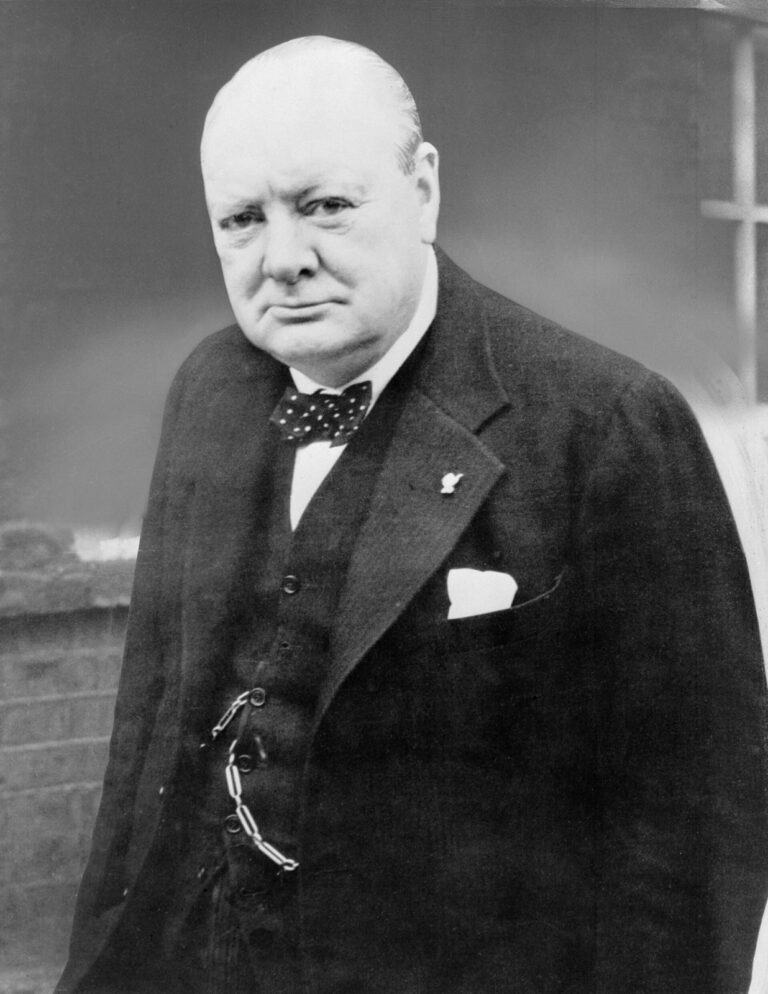
Winston Churchill
Born November 30, 1874 · Died January 24, 1965 · Studholme Lodge No. 1591, London
Never give in, never give in, never, never, never, never—in nothing, great or small, large or petty—never give in except to convictions of honour and good sense.
A temperament that cut both ways
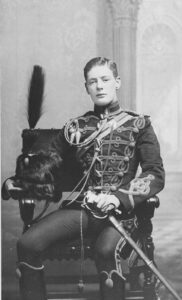
Winston Leonard Spencer Churchill was born on 30 November 1874 at Blenheim Palace. His father, Lord Randolph Churchill, was the second son of the 7th Duke of Marlborough. His mother, Jennie Jerome, was an American from Brooklyn. He was educated at Harrow, graduated from Sandhurst as a cavalry cadet in December 1894, and was commissioned into the 4th Queen’s Own Hussars in February 1895.
He did not wait for his career to come to him. He served on the North-West Frontier of India and published his first book about it in 1898. In 1899, while reporting on the war in South Africa, he was taken prisoner by the Boers and escaped on 2 December. The escape made him famous around the world. He took his seat in the House of Commons in February 1901 and stayed in Parliament for more than sixty years. Over the next three decades he held many high offices in both Liberal and Conservative governments.
A temperament that cut both ways
One of his biographers, Robert Rhodes James, described him as “politician, sportsman, artist, orator, historian, parliamentarian, journalist, essayist, gambler, soldier, war correspondent, adventurer, patriot, internationalist, dreamer, pragmatist, strategist, Zionist, imperialist, monarchist, democrat, egocentric, hedonist, romantic.” The International Churchill Society, which is far from hostile to him, calls him “always a risk-taker” whose “enthusiasm swept aside any anxieties others may have felt.”
That temperament brought him his worst failure. As First Lord of the Admiralty in the First World War, he pushed for the attack on the Dardanelles. In April 1915 he wrote to his brother: “the vital thing is not to break off because of losses but to persevere.” The Gallipoli campaign turned into a disaster with an enormous loss of life. Churchill’s term at the Admiralty ended on 24 May 1915. He was given a token post, found he could not influence policy from it, and resigned from the government in November 1915. He then went to command troops on the Western Front, and in 1916 he led the 6th Battalion, Royal Scots Fusiliers.
He returned to high office, but by the early 1930s he held no government post again. He opposed greater self-government for India and seemed out of touch, and many people thought his political career was over. From Chartwell, his home in Kent, he wrote books and newspaper articles. He also warned, again and again, about Hitler’s new regime and the need for Britain to rearm. In the ICS’s words, it was “a message that few wanted to hear.”
The man Britain needed in 1940
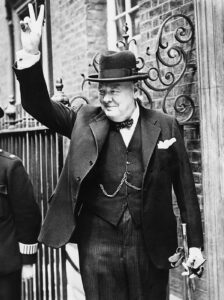
The man many found difficult in peacetime turned out to be the man Britain needed in 1940. That is our reading of his life, and the record supports it. The stubbornness that would not let go of the Dardanelles was the same stubbornness that would not let go of his warnings about Germany. After the Munich Crisis of 1938 and the German occupation of Czechoslovakia, people increasingly agreed that he had been right. When war came in September 1939, Neville Chamberlain made him First Lord of the Admiralty again. On 10 May 1940 he became Prime Minister and Minister of Defence.
He led Britain from the Battle of Britain to Victory in Europe. The ICS says he “brought a new vitality to the war effort,” and that his speeches and his constant presence among the public “helped galvanise the British spirit in the fight against Nazi tyranny.” His “Finest Hour” speech in June 1940 is still quoted around the world.
His contribution did not end with the war. On 5 March 1946, at Fulton, Missouri, he gave the “Iron Curtain” speech, which is often seen as marking the start of the Cold War. He was Prime Minister again from 1951 to 1955. In 1953 he received the Nobel Prize in Literature “for his mastery of historical and biographical description as well as for brilliant oratory in defending exalted human values.” The Nobel committee counted his wartime speeches among his most important writings. In 1963 he was made an honorary citizen of the United States. He died on 24 January 1965 and was given a state funeral.
The lesson is not that a hard personality is a virtue. Churchill’s faults were real, and they cost lives as well as careers. The lesson is that courage, persistence and a refusal to look away from an unwelcome truth can make the difference when the moment calls for them.
A short apprenticeship in Studholme Lodge
According to the United Grand Lodge of England, Churchill was initiated into Studholme Lodge No. 1591 (now United Studholme Alliance Lodge) on 24 May 1901. He “completed his Second Degree nearly two months later on 19 July and was then made a Master Mason on 25 March 1902.” His apron and apron pouch are on display in the Museum at Freemasons’ Hall in London. Some older accounts say he was raised in Rosemary Lodge No. 2851. Masonic researchers describe that as an error, traced to a 1955 letter from the Grand Lodge librarian and to entries next to Churchill’s name in the lodge register. All three of his degrees were conferred in Studholme Lodge.
His active Masonic life was short, and we should say so plainly. Research published by the International Churchill Society records that he “was apparently a regular attender, but took no office in the Lodge and resigned in July 1912, probably due to his political commitments and office.” In 1918 he petitioned for a new lodge for the Ministry of Munitions. The petition did not succeed in that form, and he does not appear to have been involved when a later version was granted. His only other recorded Masonic contact was a visit to Royal Naval Lodge No. 59 on 10 December 1928. The Grand Lodge of British Columbia and Yukon adds that there is no documentation that he ever publicly renounced Freemasonry.
So we should not claim that the Craft made Churchill. It is fair to see in his life some of the qualities a Mason is taught to value. One is fortitude when the cause seems lost. Another is persistence in speaking the truth when it is unpopular. A third is devotion to the defence of liberty. Every brother is free to take that lesson to heart.
Churchill’s stubbornness cost him dearly in 1915 and served the world in 1940. Have you seen a trait that made someone hard to work with turn out to be exactly what a lodge, a family or a team needed?
Sources
- United Grand Lodge of England, Winston Churchill
- International Churchill Society, Who was Churchill?
- International Churchill Society, The First World War
- International Churchill Society, Wilderness Years
- International Churchill Society, Finest Hour 107, “Masonic Career” (Laurence Geller)
- NobelPrize.org, Winston Churchill, Facts
- Freemasons New Zealand, Sir Winston Churchill (on the Rosemary Lodge error)
- Grand Lodge of British Columbia and Yukon, Winston Churchill
- Portrait image: Churchill portrait NYP 45063, British Government photograph, Public domain

Life & Masonic Timeline
Winston Churchill. British Government photograph. Via Wikimedia Commons. · Public domain · Source