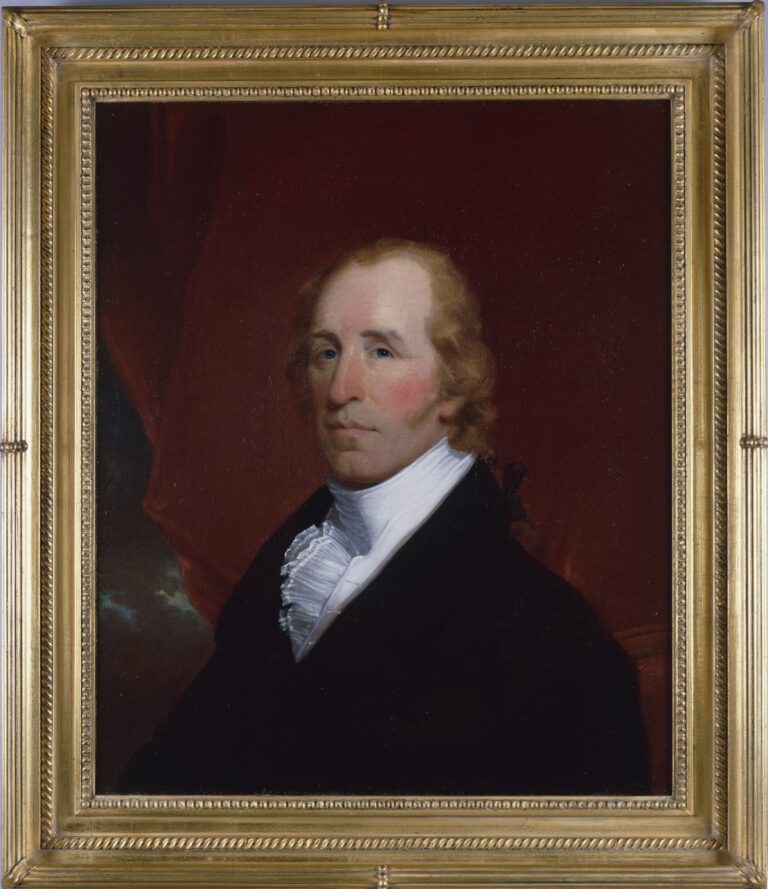
William Clark
Born August 1, 1770, Ladysmith, Virginia · Died September 1, 1838, St. Louis, Missouri · St. Louis Lodge No. 111 (traveling certificate as Master Mason, Sept. 18, 1809)
William Clark co-led the Corps of Discovery to the Pacific, mapped its route and later served as governor of the Missouri Territory.
The Younger Brother Who Chose the River
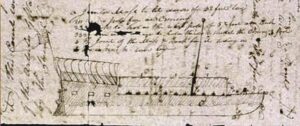
William Clark was born on August 1, 1770, at Ladysmith, Virginia, the ninth of ten children of John and Ann Clark. His older brother George Rogers Clark was a well-known Revolutionary War commander. Twenty years before the later expedition, Thomas Jefferson asked that elder Clark to lead an overland journey to the Pacific; he declined. When William was fourteen the family moved to Kentucky, near present-day Louisville. His education was informal and practical. “Learning does not consist in the knowledge of Languages,” he wrote in the 1790s, “but in the knowledge of things to which language gives names.”
He joined the Kentucky militia in 1789, secured a lieutenant’s commission in 1792, and served in campaigns in the Ohio Valley under General Anthony Wayne. In the mid-1790s, in the Army in Ohio, he was Meriwether Lewis’s commanding officer; the two men became friends. In 1796 he left the army to manage the family’s plantation. On his father’s death in 1799 he inherited more than 3,300 acres, a distillery, a gristmill, and twenty-three enslaved people, among them York. Family financial trouble forced him to sell the farm in 1802, leaving his future uncertain.
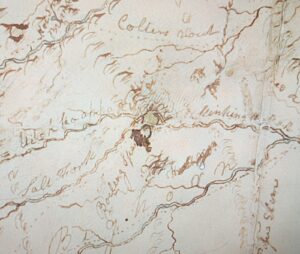
On June 19, 1803, Lewis invited him to share command of a western expedition. “The enterprise &c. is Such as I have long anticipated,” Clark replied. “I will cheerfully join you … and partake of the dangers difficulties, and fatigues, and I anticipate the honors & rewards of the result.” He studied astronomy and mapmaking, assembled and trained the Corps of Discovery, and brought York with him. Although the two men believed they would share the captaincy, word arrived shortly before they left St. Louis that Clark would remain a lieutenant. The men, who had spent a winter addressing “Captain Clark,” were not told of the difference. In 2001, President Clinton promoted him to captain. From 1804 to 1806 the two led the Corps from Wood River, Illinois, to the Pacific and back, sharing the work as equals. Clark’s maps were then the most accurate charts of the trans-Missouri West, and when Lewis’s pen fell silent for months, Clark’s daily journals — straightforward, and creatively spelled — became the record.
Clark, York, and the Expedition’s Unequal Rewards
York hunted — notable, because enslaved people were not generally allowed to handle guns — cared for the sick, and once risked his life to help Clark, Sacagawea, and her infant son when they were caught in a flash flood. In November 1805, he and Sacagawea took part in the expedition’s vote about where to spend the winter. Clark, however, had also separated York from York’s wife in Louisville for the long journey, treating him as personal property. On the return east, the other members of the Corps received double pay and 320 acres of land; York remained enslaved. Clark rejected his initial requests for freedom. In an 1808 letter, Clark wrote that he had wished “to do well by him,” but would not accept York’s “emence Services” as grounds for emancipation. York was finally freed sometime after 1815 and began a hauling business with a wagon and team of horses provided by Clark. In 1832, Clark told the writer Washington Irving that the business had failed and that York had died of cholera in Tennessee; the place of York’s burial is unknown.
A Name on the Rock, and a Long Watch on the Frontier
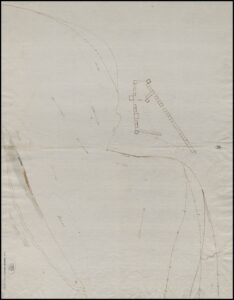
On the trek west in 1805, and again on the return in 1806, Clark treated ailments among the Nez Perce, who came to consider him a healer. Twisted Hair guided the expedition down the Clearwater and Columbia Rivers, and his nine-year-old son, who later became Chief Lawyer, a signer of the 1855 Nez Perce Treaty and an advocate of friendship with the United States, was among those on whom Clark made a lasting impression. On November 7, 1805, Clark recorded that he had seen the Pacific; what he had actually seen was the Columbia River’s wide, rough estuary. He went on to chart the coast and the lower river. On the return in 1806 he led a detachment, including York, Sacagawea, her husband Toussaint Charbonneau, and their son Jean Baptiste, to explore the lower Yellowstone. On July 25, about twenty-five miles upriver from present-day Billings, Montana, he carved his name and the date into a sandstone formation he called Pompey’s Tower, after a nickname he had given the child — Pomp. In 1814 Nicholas Biddle, preparing the journals, renamed it Pompey’s Pillar. The signature can still be seen at the site, now Pompeys Pillar, and is believed to be the only remaining on-site physical evidence of the expedition. His party rejoined the expedition on the Missouri on August 12, and they reached St. Louis on September 21, 1806. Two days later Clark wrote his brother Jonathan a letter outlining the journey; it was printed in the Frankfort, Kentucky, Palladium on October 9. After Lewis’s death, Clark helped prepare the journals for publication, and in 1810 completed a master map of the North American West that later explorers relied on. For a time he also cared for Sacagawea’s son.
In 1807 he resigned from the Army. President Jefferson named him principal Indian agent for the Louisiana Territory, and he was appointed a brigadier general for the territory of Upper Louisiana. In 1813 he became governor of the Missouri Territory. In 1808, at thirty-seven, he married sixteen-year-old Julia Hancock. She died suddenly in 1820, and he married her cousin Harriet Radford, who died in 1831. He lost the 1820 race for governor of the new state of Missouri, then in 1822 was appointed Superintendent of Indian Affairs in St. Louis, a post he held until shortly before his death. His fair dealings with American Indians in those years earned him the esteem of his peers. In 1831 the Christian Advocate reported that four Nez Perce men, called “Flatheads” in the article, had visited Clark in St. Louis asking for teachers of Christianity; Clark never noted the visit in his journals, but his fame gave the story weight, and it launched missionary efforts across the Pacific Northwest, including the first missionaries to reach Oregon in the 1830s.
A Traveling Certificate from Saint Louis Lodge No. 111
In 1808 Lewis and several acquaintances petitioned the Grand Lodge of Pennsylvania for a lodge in St. Louis. A warrant for Saint Louis Lodge No. 111 was issued on September 16, 1808, with Lewis recommended as its first Master. Clark petitioned the new lodge and was accepted; no minutes of his initiation survive. On September 18, 1809 — about a month before Lewis’s death — the lodge issued Clark a traveling certificate naming him a Master Mason. The Missouri Historical Society holds the certificate, signed by Frederick Bates, Thomas Riddick and John Coons. Because the lodge held a Pennsylvania warrant, the certificate made him technically a Pennsylvania Mason.
When Saint Louis Lodge No. 111 returned its warrant in 1815, Clark’s membership transferred to Missouri Lodge No. 12, which for several years met on the second floor of a house he had built. He died in St. Louis on September 1, 1838, and was buried with Masonic honors. He lies at Bellefontaine Cemetery, where a Masonic monument marks his grave.
How should York’s unequal treatment after the expedition change the way we remember Clark’s leadership?
Sources
- National Park Service — William Clark
- National Park Service, Lewis and Clark National Historic Trail — William Clark
- National Park Service — York
- Oregon Encyclopedia — William Clark (1770–1838)
- National Park Service, Lewis and Clark National Historic Trail — Meriwether Lewis
- Grand Lodge of Pennsylvania, The Pennsylvania Freemason — “Treasures of the Temple: Brothers Lewis and Clark,” Laura Libert (May 2003, archived)
- Missouri Historical Society — Masonic certificate of William Clark, Master Mason, St. Louis Lodge, September 18, 1809
Life & Masonic Timeline
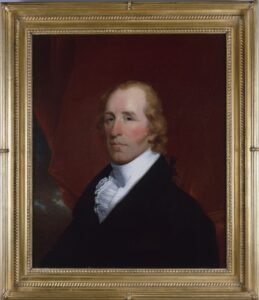
Attributed to John Wesley Jarvis, via Wikimedia Commons / Missouri Historical Society · Public domain · Source