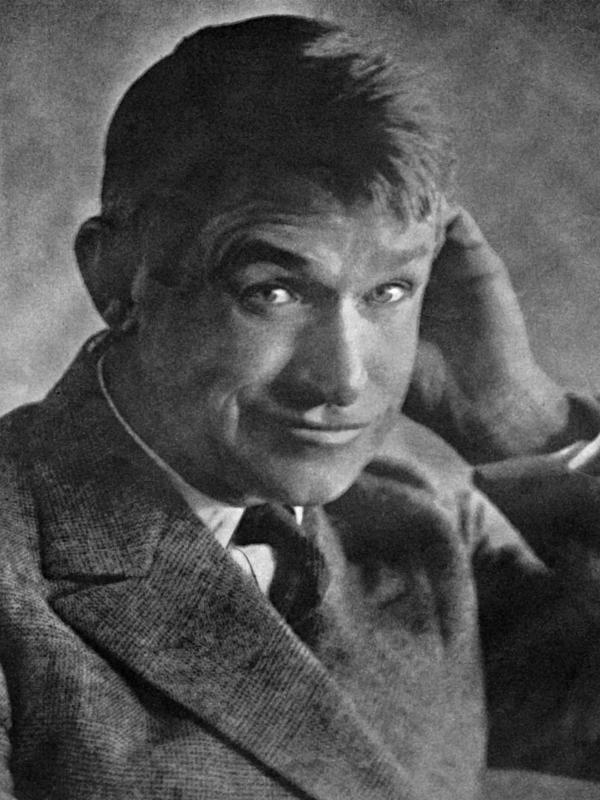
Will Rogers
Born November 4, 1879, Oologah, Cherokee Nation (Indian Territory) · Died August 15, 1935, Point Barrow, Alaska (plane crash) · Claremore Lodge No. 53, Oklahoma
Cherokee humorist, columnist and film star, a member of the Claremore lodge in Oklahoma.
Everybody is ignorant, only on different subjects.
The Cherokee Kid finds his voice
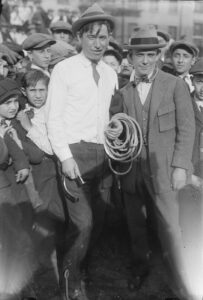
William Penn Adair Rogers was born on November 4, 1879, near Oologah in the Cooweescoowee District of the Cherokee Nation, in Indian Territory. Both of his parents were part Cherokee. His father, Clement Vann Rogers, had built a ranch on tribal land before the Civil War. Will was the eighth child and the only boy to survive to adulthood. His mother died when he was ten. He loved horses and hated classrooms, and after more than a year at Kemper Military Institute he “quit the entire school business for life” and went west to work on ranches in the Texas Panhandle.
Back home, he ran cattle for his father under his own Dog Iron brand, but his heart was in roping contests. In 1901 he and a friend set out for South America looking for ranch work. They found none. A job on a cattle boat took him on to South Africa, where he began performing as “The Cherokee Kid,” spinning ropes in Texas Jack’s Wild West Show and later with the Wirth Brothers circus. By the time he came home in 1904, show business had him.
He worked with Zack Mulhall’s Wild West cowboys in St. Louis and New York, then built a vaudeville act of trick roping that toured the United States and Europe. In 1908 he married Betty Blake of Rogers, Arkansas, after a long courtship in which, the Oklahoma Historical Society suggests, she may have hesitated partly from prejudice toward an Indian cowboy. He called the marriage the star performance of his life. They had four children. Their youngest, Fred, died of diphtheria in 1922.
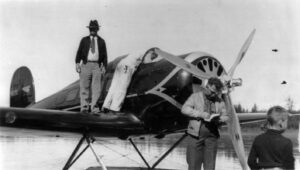
His association with Florenz Ziegfeld began in 1915, and along the way the silent roper started talking. His jokes about the news of the day became the act. From 1922 he wrote a weekly newspaper column, and from 1926 a short daily “telegram” as well, eventually carried by more than five hundred papers. He spoke on radio and at dinners, traveled the world and appeared in seventy-one films, including State Fair (1933). On August 15, 1935, he and the aviator Wiley Post were killed when their plane crashed near Barrow, Alaska. The country went into mourning.
Wit without cruelty
Rogers was a part-Cherokee cowboy from Indian Territory who became, for a time, the most popular movie star in America. He did it as himself, a cowboy from Indian Territory who read the papers and said what he thought about them, and audiences loved him for it.
His humor still teaches something. He said he aimed to tell the truth, that he poked fun only at the “big men,” and that he never meant to hurt anyone with his “little gags.” He joked about presidents to millions of readers and stayed friends with several of them. A few professionals resented a vaudeville roper offering diplomatic advice, but most Americans felt he was speaking for them, especially when hard times came in the 1930s.
In an age when public talk so often turns cruel, Rogers is a reminder that you can be sharp without being mean. Asked by the historian Will Durant for his philosophy, he advised people to “get a few laughs” and “do the best you can.” He wrote his own epitaph, too: he had joked about every prominent man of his time, but never met a man he didn’t like.
A Brother of Claremore Lodge
Rogers joined Freemasonry in his hometown. He was a member of Claremore Lodge No. 53 in Oklahoma, the town where his father had moved to take up banking and tribal politics. The Claremore Progress reported on February 7, 1905, that Masonic school had been in session that week and that Will Rogers had been “initiated into the mysteries of Masonry.” He was raised a Master Mason on March 13, 1906. The gap between his degrees fits his life at the time: in the spring of 1905 he was on tour in the East with Mulhall’s show.
According to the Will Rogers Memorial Museums, he later became a 32nd degree Mason as a life member of the Indian Consistory. In October 1914 he petitioned the Akdar Shrine in Tulsa, joining on February 3, 1915, by which time his occupation in the records had changed from farmer and ranchman to “vaudeville performer.” The museum in Claremore still displays his petition to Claremore Lodge, his Akdar life membership certificate and his fez.
His Brothers did not forget him. Masons laid the cornerstone of the Will Rogers Memorial when it opened on November 4, 1938, and in 1979, the hundredth anniversary of his birth, his old lodge in Claremore renamed itself Will Rogers Lodge. For a man who claimed to like everyone he met, the lodge was a natural home: a place where a rancher, a banker and a vaudeville performer meet as equals.
Will Rogers could poke fun at the most powerful men in America and still keep their friendship. What does it take to speak plainly about others without wounding them?
Sources
- Oklahoma Historical Society, The Encyclopedia of Oklahoma History and Culture, “Rogers, William Penn Adair” (Douglas Watson): https://www.okhistory.org/publications/enc/entry?entry=RO021
- Rogers County History, Vol. 1, p. 29, quoting the Claremore Progress, Feb. 7, 1905 (The Gateway to Oklahoma History): https://gateway.okhistory.org/ark:/67531/metadc2048854/m1/29/
- Will Rogers Memorial Museums, Shrine plaque rededication notice (Collinsville News, Oct. 27, 2011): http://www.cvilleok.com/2011OctNews/MiscOct27.html
- Grand Lodge of British Columbia and Yukon, Will Rogers: https://freemasonry.bcy.ca/biography/rogers_w/rogers_w.html
Life & Masonic Timeline
Melbourne Spurr, via Wikimedia Commons · Public domain · Source