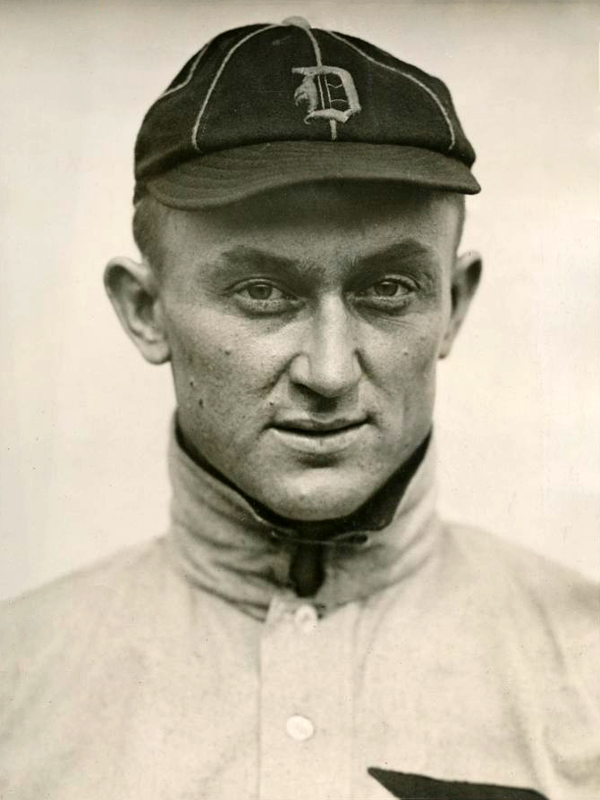
Ty Cobb
Born December 18, 1886, Narrows, Georgia · Died July 17, 1961, Atlanta, Georgia · Royston Lodge No. 426 (now No. 52), Royston, Georgia (believed membership)
Ty Cobb became one of baseball’s greatest hitters and base-runners, spending most of his twenty-four major-league seasons with the Detroit Tigers.
A Royston Boy Told Not to Come Home a Failure
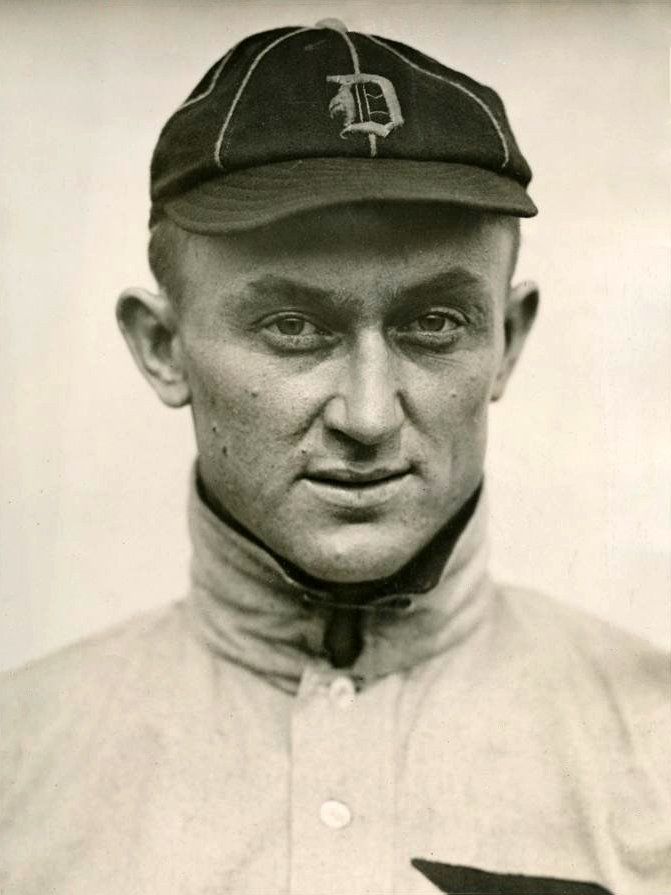
Tyrus Raymond Cobb was born on December 18, 1886, in The Narrows, in Banks County, Georgia, the first of three children of William Herschel Cobb, a schoolteacher, editor and state senator, and Amanda Chitwood Cobb. He grew up in nearby Royston, played for the Royston Rompers and the semiprofessional Royston Reds, and by his mid-teens was determined to make a living at baseball. His father, whom he later called “the greatest man I ever knew,” wanted him to study law or medicine.
In 1904 the Augusta Tourists of the new South Atlantic League invited him to spring training if he paid his own way. He was released after two games, joined a semipro club in Anniston, Alabama, and, on his father’s advice, stayed with it. “Don’t come home a failure,” William Cobb told him. Augusta called him back that August. The following summer a new manager, George Leidy, took the young outfielder in hand. Detroit, which trained in Augusta and held an option on one Tourists player, took notice.
The August Night That Changed Him, and a Debut in Detroit
On the night of August 8, 1905, Amanda Cobb shot and killed her husband as he approached a bedroom window. She said she had mistaken him for a burglar. A coroner’s inquest led to a manslaughter charge and a grand jury indictment; she was acquitted at trial in March 1906. Cobb later called the shooting “the blackest of days.” Before August was out, the Tigers purchased his contract. He made his major-league debut on August 30, 1905, and in forty-one games that season hit .240. In his grief, the customary rookie hazing—ruined hats, cut bats, open ostracism—was more than he could take. He later said the older players “turned me into a snarling wildcat.” In 1906 he won the center-field job, left the lineup for weeks in midsummer, and finished the year at .316.
Twelve Batting Titles and Three World Series That Got Away
The 1907 season made him a star. He led the American League in hits, runs batted in and batting average and helped the Tigers to their first pennant. They won the league again in 1908 and 1909, and in 1909 he also led the league in home runs, taking the batting Triple Crown. All three World Series were lost, the first two to the Chicago Cubs and the third, in seven games, to the Pittsburgh Pirates. In those seventeen Series games he hit .262. They were the only World Series of his career.
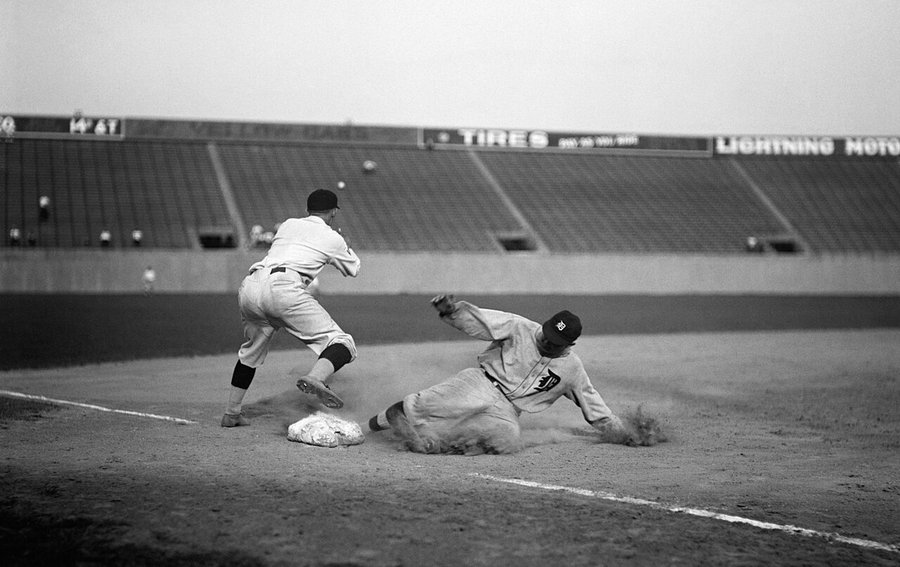
He hit to all fields and ran the bases with a fall-away slide that put constant pressure on opposing defenses. A teammate, the Hall of Fame outfielder Sam Crawford, later said, “He didn’t outhit and he didn’t outrun them, he out thought them.” Nine successive batting titles, from 1907 through 1915, were followed by three more, for a career total of twelve. His strongest offensive season was 1911, when he hit .420 and led the league in hits, runs, doubles, triples, runs batted in, slugging percentage and stolen bases, and received the American League’s Most Valuable Player award. He exceeded .400 three times and kept a batting average of at least .320 for twenty-two consecutive seasons. The Hall of Fame’s statistical record credits him with a career average of .366, 4,189 hits, 724 doubles, 295 triples, 897 stolen bases and 3,034 games, across twenty-two seasons in Detroit and two final years with the Philadelphia Athletics. At retirement he was said to hold more than ninety career or single-season records. From 1921 through 1926 he also managed the Tigers, compiling 479 wins and 444 losses and helping to develop hitters that included the future Hall of Famer Harry Heilmann.
A Scheme at Third Base, a Fight in the Stands, and a Charge That Did Not Hold
Cobb’s temper was as famous as his average. He was involved in fights on and off the field, including assaults on African-American workers. In 1909 a fight in Cleveland with a hotel night watchman led to an attempted-murder warrant, later settled with a plea to a lesser charge and a civil suit settled out of court. On May 15, 1912, after prolonged heckling in New York, he went into the stands and attacked a spectator, Claude Lueker, who had lost one hand and most of the other in a printing-press accident. American League president Ban Johnson suspended him indefinitely. Cobb’s teammates, though they disliked him, refused to play until he was reinstated, and after one game in which the Tigers fielded semiprofessional substitutes, the suspension was reduced to ten days.
The 1910 batting title produced a scandal of another kind. Cobb sat out the last two games with a narrow lead over Cleveland’s Napoleon Lajoie. In a season-ending doubleheader, the St. Louis manager ordered his rookie third baseman to play deep, and Lajoie laid down bunt after bunt for an eight-for-eight day. Official figures, later found to have counted one of Cobb’s games twice, still listed Cobb as champion, and Major League Baseball continues to recognize him as the 1910 titleholder, even though a later recount gave Lajoie the higher average.
On November 3, 1926, Cobb announced that he was leaving the Tigers as player and manager. A former Detroit pitcher, Hubert “Dutch” Leonard, soon claimed that Cobb, Tris Speaker and others had fixed a game in 1919. Leonard produced letters suggesting that bets had been placed or attempted, but he would not appear to face Cobb and Speaker, and on January 27, 1927, Commissioner Kenesaw Mountain Landis ruled that they had not been found guilty of fixing a game. Cobb then signed with Connie Mack’s Philadelphia Athletics, played two seasons, reached 4,000 career hits, and retired after 1928. In 1952 he told the Associated Press that he saw “no reason in the world why we shouldn’t compete with colored athletes as long as they conduct themselves with politeness and gentility.”
A Hospital in Royston and a First Ballot at Cooperstown
Shrewd investments, including early holdings in Coca-Cola and in United Motors, which later merged with General Motors, made him a rich man. In 1945 he donated $100,000 to establish a hospital in Royston in memory of his parents. In 1953 he gave another $100,000 to endow the Cobb Educational Fund, which still helps Georgia residents attend college.
In 1936, in the first balloting for the National Baseball Hall of Fame, Cobb received more votes than any of the other four men elected. He had two marriages, both of which ended in divorce, and a strained relationship with his five children. He died of prostate cancer on July 17, 1961, at Emory Hospital in Atlanta, and was buried in Rose Hill Cemetery in Royston, beside his parents.
Royston Lodge No. 426
From the sources we do have, it is believed that Cobb belonged to Royston Lodge No. 426 in his Georgia hometown, the lodge in which his father had served as Master. The dates of his degrees are not known. A Masonic account places his entry at the age of twenty-one and records that in 1912 he joined the Scottish Rite in the Valley of Detroit and a Shrine temple in that city.
How should Cobb’s extraordinary batting record be considered alongside the accounts of his conduct toward others?
Sources
- New Georgia Encyclopedia — Ty Cobb
- National Baseball Hall of Fame — Ty Cobb
- Society for American Baseball Research — Ty Cobb
- Scottish Rite, Valley of Boston — Famous Freemason: Ty Cobb
Life & Masonic Timeline
International Film Service, via Wikimedia Commons · Public domain · Source