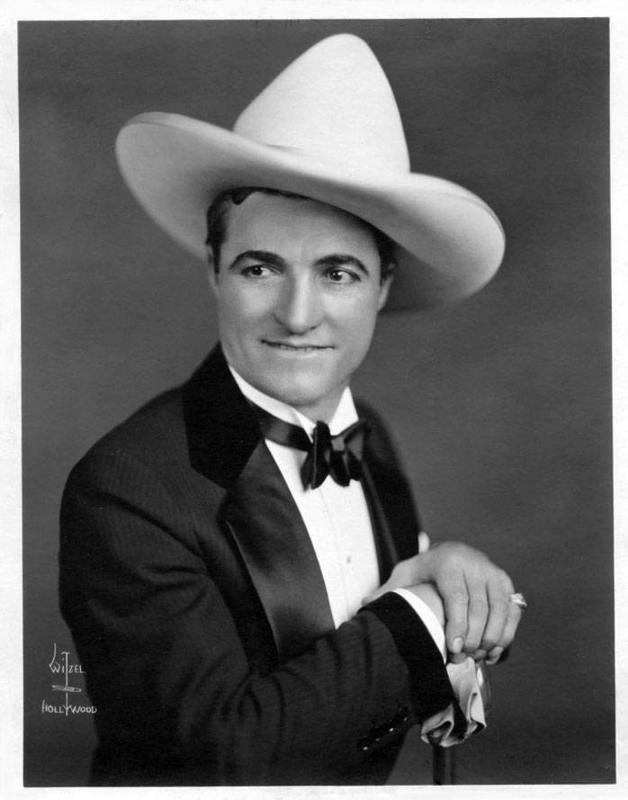
Tom Mix
Born January 6, 1880, Mix Run, Pennsylvania · Died October 12, 1940, Near Florence, Arizona (car accident) · Utopia Lodge No. 537, California
Tom Mix made the silent Western a star vehicle, riding his horse Tony through hundreds of films and becoming Hollywood’s first great cowboy hero.
From Mix Run to the 101 Ranch
Thomas Edwin Mix was born on January 6, 1880, in Mix Run, Pennsylvania, to Edwin and Elizabeth Mix. His father, a stable master for a wealthy lumber merchant, taught the boy to love horses long before a camera needed a cowboy silhouette. At eighteen Mix left home for the United States Army. In 1902 he married Grace Allin, went absent without leave, and headed west to Guthrie in Oklahoma Territory. He tended bar at Guthrie’s Blue Belle Saloon, wrangled horses, and in 1904 served as drum major for the Oklahoma Cavalry Band at the St. Louis Exposition. That exposure carried him to the Miller Brothers’ 101 Ranch Wild West show near Ponca City, where from 1905 to 1908 he rode as a bronc buster for thirty-five dollars a week.
His first marriage was annulled, and a second, to Jewell “Kitty” Perrine of Oklahoma City, was short-lived. In 1908 he married the Oklahoma cowgirl Olive Stokes, and they toured the Wild West circuit together. Their daughter, Ruth, was born on July 13, 1912, at Olive’s family ranch near Dewey, Oklahoma. While he was staying with his in-laws, the mayor of Dewey, a family friend, appointed him night marshal; the Oklahoma Historical Society’s museum page records that he served as marshal there for a short time in 1911. Publicists later created a heroic past for him, and stories multiplied until the truth became hard to find. The record that can be documented is already eventful enough.
Selig, Fox, and Tony the Wonder Horse
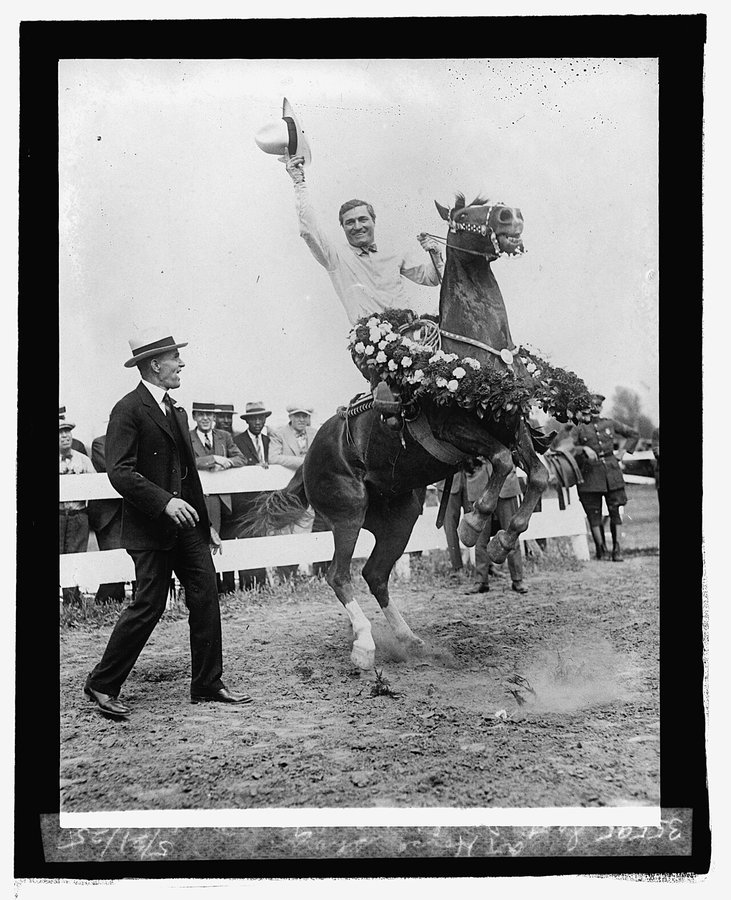
In 1909 the Selig Polyscope Company hired Wild West performers for horse scenes while filming near Dewey, and Mix’s first screen work grew out of that hire. A legitimate rodeo prize winner, he joined Guy Weadick in 1912 to organize the first Calgary Stampede. He signed with Fox Studios in 1917 and, throughout his film career, still “hit the road” occasionally with a Wild West show or a circus. His movies ran on quick action, daredevil stunts, and flashy wardrobe. Tom and his horse Tony did their own riding and falls; limited budgets left little room for trick photography. Tony appeared with him in 181 westerns. The Tom Mix Museum counts 336 feature films, of which he produced 88, wrote 71, and directed 117, along with nine sound features and the fifteen-chapter serial The Miracle Rider. The museum notes that he rides a Henderson motorcycle in the 1919 film Hell Roarin’. He was also under contract at various times with Film Booking Office, Universal, and Mascot. Titles include The Lone Star Ranger (1923), Riders of the Purple Sage (1925), and Destry Rides Again (1932). By 1928 the Oklahoma Historical Society records that he was the highest-paid actor in Hollywood, earning seventeen thousand dollars a week. His screen career spanned twenty-six years, from 1909 to 1935. A later marriage, to Victoria Ford, produced a daughter, Thomasina, born February 12, 1922. In all he married five times and had two children.
Sells-Floto, and a Circus of His Own
As his film popularity declined in the late 1920s, Mix appeared with the Sells-Floto Circus as its feature attraction from 1929 through 1932. In 1934 he was with Sam B. Dill’s motorized circus; in 1935 he bought the show and took out the Tom Mix Circus. Tony appeared as a midway “pit show,” an extra-ticket attraction in a small tent. 1938 was a hard year for circuses, complicated by Mix’s extravagant lifestyle; the show could not complete the season and folded. The equipment was moved to grounds in El Paso, Texas, and sold—trucks to a local auto dealer, tents and seats to a Canadian circus owner.
A Supercharged Cord, a Radio Cowboy, and a Wash Near Florence
His last film paid for the circus. When his partner Sam Dill died, Mix made the fifteen-chapter serial The Miracle Rider for Nat Levine’s Mascot studio in 1935 to finance buying out the business. It was a box-office success and his final picture. By then his name had a second life on the air. Ralston-Purina bought the rights to it, and The Tom Mix Ralston Straight Shooters premiered on NBC on September 25, 1933, a thrice-weekly quarter-hour serial set on a fictional T-M Bar ranch in Texas, in which Mix himself never spoke a line; Artells Dickson voiced him first, and Joe “Curley” Bradley played him longest, from 1944 to the end. Ralston sponsored it from its first broadcast to its last, on December 16, 1951, and rewarded young listeners who mailed in box tops with decoders, badges, and comic books.
Mix loved fast cars as much as fast horses. His last was a supercharged 1937 Cord 812 Phaeton, which he customized with hand-tooled leather fender guards, an accelerator pedal shaped for his boot heel, and a holster on the steering wheel for his Smith & Wesson revolver. On October 12, 1940, he was speeding north from Tucson toward Florence, Arizona, on what was then U.S. Route 80 when he went through a construction barricade and into a shallow wash. The car was damaged but not wrecked. He might have survived the crash, but an aluminum Halliburton case flew forward from the back seat and struck him in the back of the head. He was sixty.
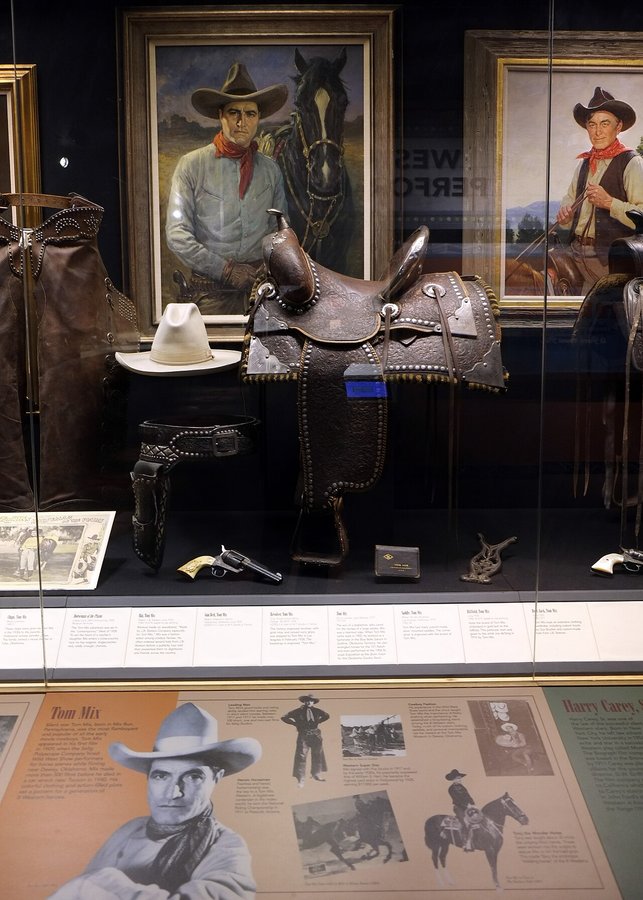
The Pinal County Historical Society dedicated a stone memorial near the spot on December 5, 1947, topped with a riderless-horse silhouette, known as Tony Jr., designed by Fernando Arriola. The original silhouette was stolen and missing for two years and now stands on the society’s museum grounds in Florence, rededicated on February 19, 1994. The monument still stands near milepost 116 on State Route 79, where its marker reads: “In memory of Tom Mix whose spirit left his body on this spot. And whose characterization and portrayals in life served to better fix memories of the old West in the minds of living men.” Travelers from as far as Belgium and South Africa have signed its visitor log. In Dewey, the Tom Mix Museum, an Oklahoma Historical Society affiliate, holds his saddles, wardrobe, and memorabilia, and remembers the Pennsylvania boy who learned horses in a lumber-town stable as Oklahoma’s own King of the Cowboys.
Utopia Lodge No. 537, and Hollywood’s 233 Club
Mix was raised a Master Mason on February 21, 1925, in Utopia Lodge No. 537, Los Angeles, California. He was a Royal Arch Mason and a thirty-second degree Scottish Rite Mason of the Southern Jurisdiction. He also took an active part in conferring the Craft degrees with the 233 Club, a Hollywood group whose August 16, 1924, charter required that a member be “a Master Mason in good standing in any lodge in the world and a motion picture worker in any capacity.” To mark a Shriners national convention in Los Angeles, the club organized a parade on May 5, 1925, from Hollywood Boulevard and Vine Street to the Hollywood Bowl. The next summer the club sponsored a pageant for the nation’s 150th birthday, staged by the director Frank Lloyd at the Los Angeles Coliseum on July 5, 1926, before a crowd the Los Angeles Times put at 50,000. Mix appeared in it as Paul Revere, among a cast of film players in historical roles that included Hoot Gibson as a Pony Express rider and Viola Dana as Betsy Ross. When he died, he was buried with Masonic honors.
How did Mix’s film and circus performances influence the public image of the American cowboy?
Sources
- Oklahoma Historical Society, Encyclopedia of Oklahoma History and Culture — Mix, Thomas Edwin
- Oklahoma Historical Society — Tom Mix Museum (Dewey)
- Grand Lodge of British Columbia and Yukon — Tom Mix (Denslow)
- Sir George Cathcart Lodge No. 617 — Tom Mix (Masonic philately note)
- Circuses and Sideshows — Tom Mix Circus
- Mary Mallory, Los Angeles Daily Mirror — The 233 Club, Hollywood’s Masons
- Radio Spirits — “Howdee, Straight Shooters! Howdee!”
- Arizona Department of Transportation — Tom Mix Monument along SR 79 marks end of the trail for a screen cowboy
- Historical Marker Database — Tom Mix and Tony, Jr.
Life & Masonic Timeline
Albert Witzel, via Wikimedia Commons · Public domain · Source