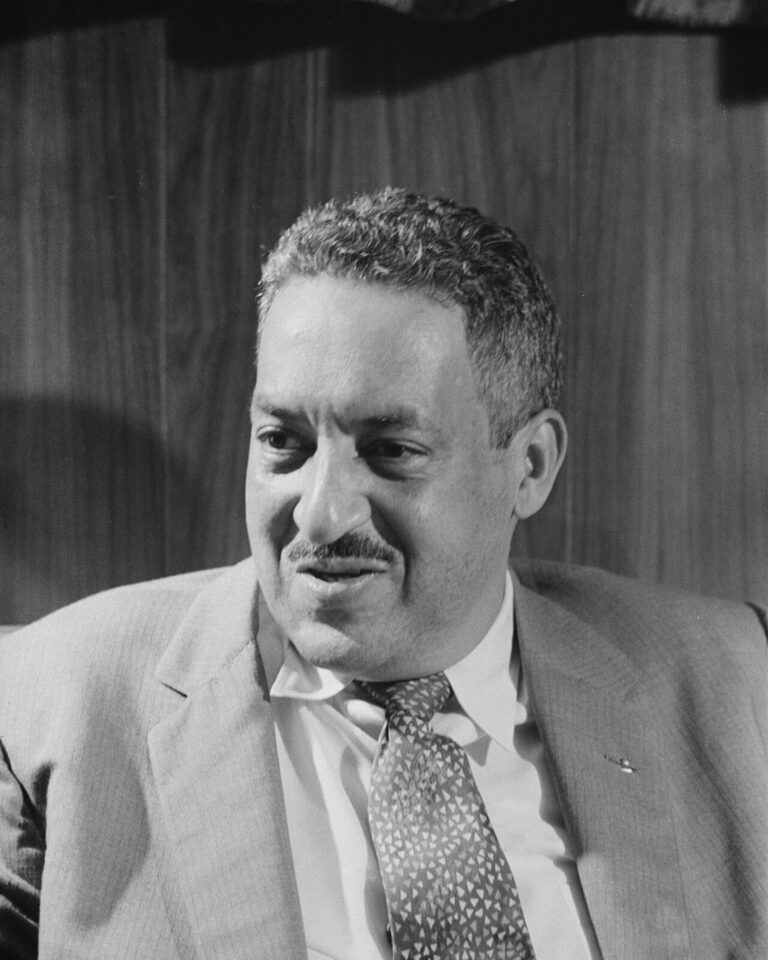
Thurgood Marshall
Born July 2, 1908, Baltimore, Maryland · Died January 24, 1993, Washington, D.C. · Coal Creek Lodge No. 88, Tulsa, Oklahoma (Prince Hall)
A Baltimore boy who learned to argue
Thurgood Marshall was born in Baltimore, Maryland, on July 2, 1908. His parents named him Thoroughgood, after his great-grandfather. The name drew teasing, and at six he shortened it to Thurgood. Both of his parents were descendants of enslaved people. His father, William, worked for the railroad, and his mother, Norma, was a teacher. They loved the Constitution and passed that love on. William took his son to watch court cases, and the family argued them over dinner. Marshall later said his father taught him to be a lawyer “by teaching me to argue, by challenging my logic on every point, by making me prove every statement I made.”
He grew up under segregation, barred from white restrooms and sent to segregated schools. He finished high school a year early, in 1925, and went to Lincoln University, a historically Black college in Pennsylvania. When he applied to the University of Maryland School of Law, he was rejected because he was Black. He went to Howard University instead and graduated first in his class in 1933. He turned down a postgraduate scholarship at Harvard to open a practice in Baltimore, where he often took poor clients for nothing.
In 1935, barely a year out of law school, he helped win Murray v. Pearson, which forced open the very law school that had turned him away. He became the NAACP’s chief legal counsel in 1936, and in 1940 he founded and led its Legal Defense and Education Fund. He won Sweatt v. Painter and McLaurin v. Oklahoma Board of Regents of Higher Education, which began to dismantle segregation in higher education, and he challenged whites-only primaries and racially restrictive housing covenants. At one point he was overseeing as many as 450 cases at once, traveling to hot, hostile courtrooms across the South. In 1954 he won Brown v. Board of Education, in which the Supreme Court declared segregated public schools unconstitutional.
President Kennedy named him to the U.S. Court of Appeals in 1961. Southern senators held up his confirmation until September 11, 1962. None of his 98 majority opinions on that court was reversed. In 1965 President Johnson made him Solicitor General, and he won fourteen of the nineteen cases he argued for the government. On October 2, 1967, he took his seat as the first Black justice of the United States Supreme Court. He served twenty-four years, retired in 1991, and died in 1993. He lay in repose in the Great Hall of the Supreme Court and was buried at Arlington National Cemetery.
Principle after the applause faded
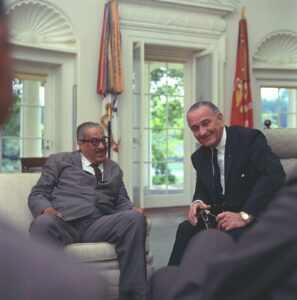
Marshall argued thirty-two cases before the Supreme Court and won twenty-nine, a record no one has matched. Those cases changed what the Constitution’s promise of equal protection actually meant for millions of Americans. Much of the country that came after him, from integrated classrooms to fair housing law, rests on arguments he made.
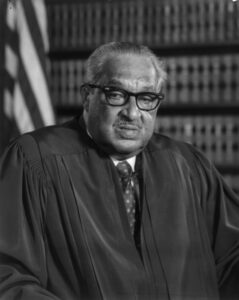
He also shows what principle looks like when it stops being popular. As the Court grew more conservative, his influence faded. He held to his convictions anyway, including his opposition to the death penalty, which he believed was cruel and unusual punishment. He did not change his views to regain influence. Asked about retiring, he answered that he had been appointed to a life term and intended to serve it. Only failing health finally made him step down.
His career is a reminder that great change is usually built case by case, in small courtrooms, by people willing to do slow and unglamorous work for years before anyone notices.
Backed by his Prince Hall Brothers
Marshall was a Prince Hall Freemason, a member of Coal Creek Lodge No. 88 in Tulsa, Oklahoma, under the Most Worshipful Prince Hall Grand Lodge of Oklahoma. As the Grand Lodge of Ohio notes, many details of his Masonic life are limited. The date and place of his degrees are not recorded in the sources we have read, so we leave them blank. We do know that in 1951 he became an Active Member of the United Supreme Council, 33°, Prince Hall Affiliation, Southern Jurisdiction, and that he served as director and counselor of the Prince Hall Grand Master’s Conference.
His Brothers stood behind his work in a practical way. In 1958, speaking of the money that made his civil rights cases possible, he said: “Whenever and wherever I needed money and did not know of any other place to get it, Prince Hall Masons never let me down.” In his own telling, many of the cases he fought could not have been brought at all without that support.
In November 2022 the Scottish Rite Masonic Museum and Library inducted him into its Masonic Hall of Fame. It is a fitting honor. Freemasonry teaches that every man should be met on the level. Marshall spent his life asking his country to live up to the same idea, and his Brothers gave him the means to make that case.
Marshall said Prince Hall Masons never let him down when his cases needed money. What causes in your own community could a lodge quietly stand behind today?
Sources
- Grand Lodge of Ohio, Mr. Civil Rights: Brother Thurgood Marshall: https://www.freemason.com/thurgood-marshall-freemason/
- Scottish Rite, NMJ, Brother Thurgood Marshall: https://scottishritenmj.org/blog/thurgood-marshall-freemason
- Kansas City Scottish Rite, Justice Thurgood Marshall: https://www.srkc.org/history/famous/supremes/marshall_thurgood/
- Supreme Court Historical Society, Thurgood Marshall, 1967-1991: https://supremecourthistory.org/associate-justices/thurgood-marshall-1967-1991/
- NAACP Legal Defense and Educational Fund, Thurgood Marshall: https://www.naacpldf.org/about-us/history/thurgood-marshall/
Life & Masonic Timeline
Thurgood Marshall, 1957. Thomas J. O'Halloran, U.S. News & World Report. Library of Congress. Via Wikimedia Commons. · Public domain · Source