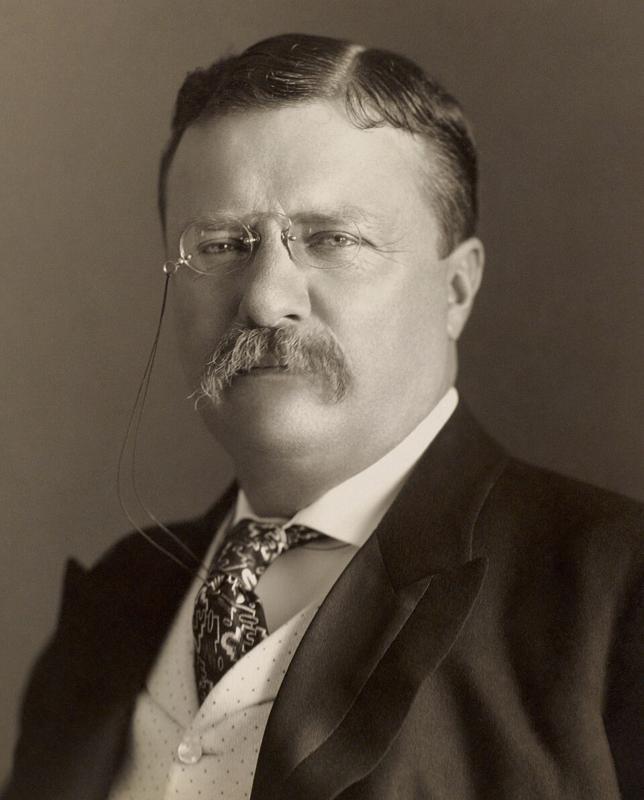
Theodore Roosevelt
Born October 27, 1858, New York City, New York · Died January 6, 1919, Oyster Bay, New York · Matinecock Lodge No. 806, Oyster Bay, NY
Theodore Roosevelt challenged corporate monopolies, expanded conservation and helped establish the presidency as a powerful force in public reform.
It is not the critic who counts; not the man who points out how the strong man stumbles, or where the doer of deeds could have done them better. The credit belongs to the man who is actually in the arena.
From a New York Boyhood and the Dakotas to the Rough Riders
Theodore Roosevelt was born on October 27, 1858, in New York City, into a wealthy family. Frail and sickly as a boy, he developed a rugged physique as a teenager and became a lifelong advocate of exercise and the “strenuous life.” After graduating from Harvard he married Alice Hathaway Lee and studied law for a year at Columbia University before dropping out to enter politics, winning a seat in the New York Assembly in 1882. In 1884 his mother and his wife died in the same house on the same day. He spent most of the next two years in the Dakota Badlands, where he bought two ranches and a thousand head of cattle, rode for days, hunted big game and chased outlaws as a sheriff. He returned in 1886 and married his childhood sweetheart, Edith Kermit Carow. They raised six children, including his daughter from the first marriage. He served as a Civil Service commissioner, as president of the New York City Police Board, and as assistant secretary of the Navy, earning a reputation for honesty that upset party bosses.
When the war with Spain began in 1898, he volunteered as commander of the 1st U.S. Volunteer Cavalry, the Rough Riders, and led a charge during the Battle of San Juan. Returning as a war hero, he became governor of New York and showed an independence that alarmed the state’s political machine. Party bosses “kicked him upstairs” to the vice presidency under William McKinley. He campaigned vigorously in 1900. McKinley’s assassination in 1901 made Roosevelt, at forty-two, the youngest president in the nation’s history. He took the view that the president, as a “steward of the people,” should take any action necessary for the public good unless expressly forbidden by law or the Constitution. “I did not usurp power,” he wrote in 1913, “but I did greatly broaden the use of executive power.”
A Petition from Albany, Three Degrees in Oyster Bay, and a Speech in Pennsylvania
Twenty-two days after his election as vice president, Roosevelt petitioned Matinecock Lodge No. 806 in Oyster Bay, listing Albany as his place of business and Governor as his occupation, and paid a five-dollar fee. An investigating committee that included William Lincoln Swan, a founding member of the lodge, interviewed him at Sagamore Hill. On December 12, 1900, the lodge elected him. On January 2, 1901, within forty-eight hours of leaving the governorship, he received the Entered Apprentice degree in the third-floor lodge room of the Oyster Bay Bank Building on Audrey Avenue, a room the lodge had leased since 1894. Eighteen of the twenty lodges in the First Masonic District sent delegations, with as many as forty-six lodges represented. William H. Baldwin, president of the Long Island Railroad, provided special trains to the north-shore station. The white lambskin apron presented that evening lists him as “Colonel Theodore Roosevelt, Matinecock 806 F. & A.M. January 2, A.L. 5901,” a reminder of the Rough Riders; it is housed in the archives at Sagamore Hill National Historic Site.
He was passed a Fellowcraft on March 27, 1901, three weeks after taking the vice-presidential oath on March 4. On April 24, Grand Master Charles W. Mead of New York raised him a Master Mason—the only sitting vice president so raised. Tickets were issued for the evening; more than two hundred brethren were turned away and waited outside. Seven past grand masters of New York were present, as were Frederick Sylvester Stevens, Grand Master of Connecticut, and other grand officers. When McKinley died on September 14, 1901, Roosevelt became president. He was the only president preceded and succeeded by two Masonic brethren, McKinley and William Howard Taft, and he was not given a Masonic funeral. On November 5, 1902, he addressed the Grand Lodge of Pennsylvania at the sesquicentennial of George Washington’s initiation. “One of the things that attracted me so greatly to Masonry,” he said, “that I hailed the chance of becoming a mason, was that it really did act up to what we, as a government and as a people, are pledged to—of treating each man on his merits as a man.”
A Square Deal, Conservation, the Nobel Prize, and a Bull Moose Campaign
Roosevelt’s “Square Deal” pressed for workplace reform and government regulation of industry. He was the nation’s first environmentalist president and set aside nearly 200 million acres for national forests, reserves, and wildlife refuges. He enlarged national forests in the West, reserved public lands, and fostered irrigation projects. He won the Nobel Peace Prize for mediating the Russo-Japanese War, the first American president to receive that honor. In 1907 he sent the Great White Fleet around the world. He also led the effort to secure rights to build the Panama Canal and issued a “corollary” to the Monroe Doctrine that presented the United States as the “policeman” of the Western Hemisphere. In 1904 he won election in his own right, in a landslide, and vowed not to run in 1908, a promise he later regretted.
After leaving office in 1909 he went on an African safari, then returned to politics. Believing that his successor, William Howard Taft, had failed to continue his program, he ran in 1912 as the Progressive Party candidate. To reporters he remarked that he felt as fit as a “bull moose,” the nickname that attached to the new party. While campaigning in Milwaukee he was shot in the chest; he recovered. He lost to Woodrow Wilson. Then he and his son Kermit set out into the Brazilian jungle to explore the River of Doubt, in the Amazon region. On the seven-month, 15,000-mile expedition he contracted malaria and suffered a serious infection after injuring his leg in a boat accident. Home again, he wrote scientific essays and history books, and when war broke out in Europe he led the call for military preparedness. After the United States entered the war in 1917 he offered to raise a volunteer division, and the War Department turned him down. All four of his sons volunteered; the death of the youngest, Quentin, left him deeply distraught. He died on January 6, 1919. “No man has had a happier life than I have led,” he had said, “a happier life in every way.”
How did Roosevelt’s belief in judging men on their merits shape the public responsibilities he chose to take on?
Sources
- White House Historical Association — Theodore Roosevelt
- Miller Center — Theodore Roosevelt, Life in Brief
- Craftsmen Online — Theodore Roosevelt’s Entered Apprentice degree
- Craftsmen Online — The Raising of Theodore Roosevelt
- Miller Center — Theodore Roosevelt, Life Before the Presidency
- Miller Center — Theodore Roosevelt, Life After the Presidency
Life & Masonic Timeline
Adam Cuerden, via Wikimedia Commons · Public domain · Source