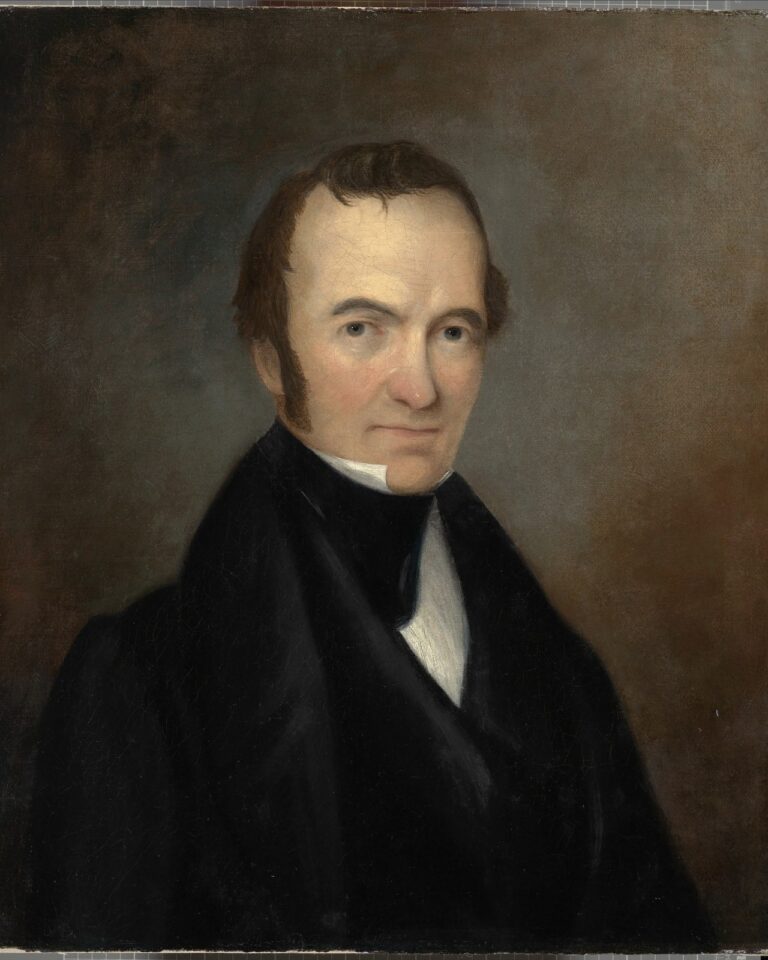
Stephen F. Austin
Born November 3, 1793, Lead mines of southwestern Virginia · Died December 27, 1836 · Louisiana Lodge, Ste. Genevieve, Missouri
The prosperity of Texas has been the object of my labors, the idol of my existence—it has assumed the character of a religion, for the guidance of my thoughts and actions, for fifteen years.
A failed business and a borrowed dream
Stephen Fuller Austin was born on November 3, 1793, at the lead mines of southwestern Virginia, the son of Moses and Maria Austin. When he was a small boy his father moved the family to the lead country of southeastern Missouri and founded the town of Potosi. At eleven Stephen was sent to school in Connecticut, and he later spent two years at Transylvania University in Lexington, Kentucky. Back in Missouri he ran much of the family’s lead business, served as a militia adjutant and sat for several years in the territorial legislature.
Then the Austin business failed. Stephen tried land speculation and trade in Arkansas, briefly served as a circuit judge there and by late 1820 was in New Orleans studying law. Meanwhile his father had set out for San Antonio to ask Spanish authorities for permission to settle three hundred American families in Texas. Stephen was not enthusiastic, but he agreed to help. He was waiting to join his father when word came that Moses Austin had died. The son carried the plan forward alone, arriving in San Antonio in August 1821.
The work that followed was relentless. Mexico won its independence just as the first colonists arrived, and the new government refused to honor the Spanish grant. Austin went to Mexico City and stayed until he secured a colonization law and then a contract of his own. Over the next decade he brought in his first three hundred families, won further contracts for nine hundred more and, by 1832, his colonies held about eight thousand people. He surveyed land, recorded titles, wrote a simple legal code, organized courts and militia, and kept peace with Mexican officials. Most of the fees he collected went to public expenses no one else would pay.
Patience, prudence and the price of both
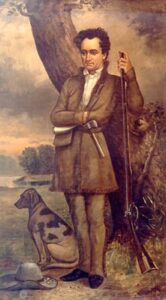
Austin’s watchword was caution. He urged his colonists to stay out of Mexico’s political quarrels and, in his own phrase, to “play the turtle, head and feet within our own shells.” He opposed the conventions of 1832 and 1833, but when they met he served in them and carried their petitions to Mexico City. He won repeal of the 1830 law that had closed Texas to new settlers from the United States, only to be arrested on his way home on suspicion of inciting rebellion. No charges were ever filed. He was moved from prison to prison until December 1834, then held on bond in Mexico City until a general amnesty freed him in July 1835. By the time he returned, Texas was heading for war.
His record has a hard side that must be told. Expecting most settlers to come from slave states, Austin worked to have slavery legalized in the first colonization law, and when the state constitution barred bringing in more enslaved people, he backed a law that evaded it through labor contracts with nominally freed slaves. He described the evils of slavery vividly and at times seemed to accept limits on it, but after 1833 he consistently said Texas must be a slave state. The Handbook of Texas concludes that whatever his private convictions, they yielded to what he took to be the needs of Texas.
He commanded the volunteers at the start of the revolution, went to the United States as a commissioner to raise money and support, and lost the 1836 presidential election to Sam Houston. He accepted the post of secretary of state and died in office on December 27, 1836, at forty-three. Shortly before his death he wrote that the prosperity of Texas had been “the idol of my existence.”
The Master of a lodge that never met
Austin came to Texas already a Mason, a member of Louisiana Lodge at Ste. Genevieve, Missouri. The Austin Masonic Library and Museum gives the lodge’s number once as 111 and once as 109, so we leave the number out until a Grand Lodge record settles it. The dates of his degrees are not recorded in the sources we have read.
He tried to bring the Craft with him. On February 11, 1828, he called a meeting of Masons at San Felipe, where he and six others petitioned the Grand York Lodge of Mexico for a charter. They elected Austin Worshipful Master of the proposed lodge. The petition reached Matamoros and vanished, apparently lost in the bitter quarrel between Mexico’s York and Scottish Rite factions. In October 1828 the Mexican government outlawed Freemasonry. When Austin called the Brethren together again in 1829, they decided it would be “impolitic and imprudent, at this time, to form Masonic lodges in Texas.”
It is a small story, but a telling one. Austin was a builder by temperament, and he wanted the fraternity in the colony he had built. He was also prudent enough to wait when waiting was wiser. Others finished the work. In 1835 Anson Jones and five Brothers founded Holland Lodge, and in 1837 the Grand Lodge of the Republic of Texas was formed, with Sam Houston presiding over the convention. Austin did not live to see it, but the lodge he could not open was the first stone of the building that followed.
Austin waited rather than open a lodge that might have endangered his colonists. When is patience the braver choice for a lodge or a leader?
Sources
- Texas State Historical Association, Handbook of Texas, “Austin, Stephen Fuller” (Eugene C. Barker): https://www.tshaonline.org/handbook/entries/austin-stephen-fuller
- Texas State Historical Association, Handbook of Texas, “Freemasonry” (William Preston Vaughn): https://www.tshaonline.org/handbook/entries/freemasonry
- Austin Masonic Library and Museum, Famous Texas Masons: https://www.masonic.museum/masonic-history/famous-texas-masons/
Life & Masonic Timeline
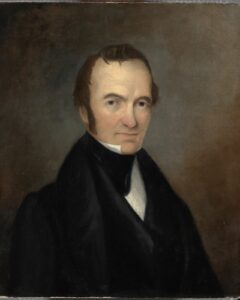
Stephen F. Austin, c. 1840. Unidentified artist. National Portrait Gallery, Smithsonian. Via Wikimedia Commons. · Public domain · Source