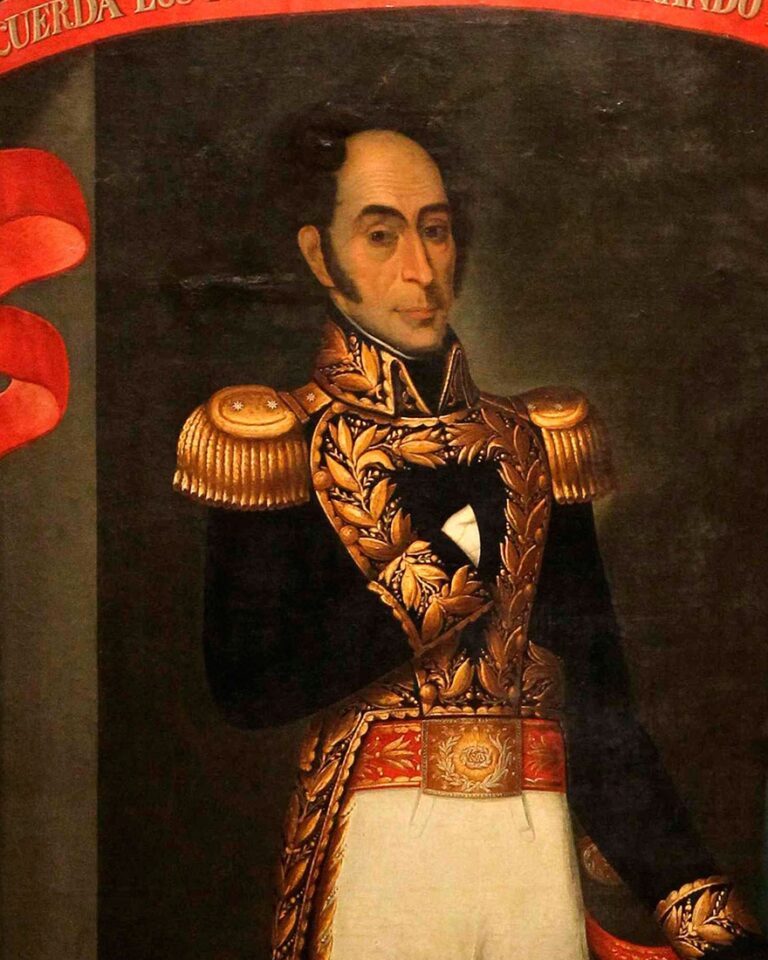
Simón Bolívar
Born July 24, 1783, Caracas · Died December 17, 1830, Near Santa Marta (Quinta de San Pedro Alejandrino) · Saint-Alexandre d’Écosse (Mother Scottish Lodge), Paris
Simón Bolívar led the campaigns that freed much of South America from Spanish rule and founded Gran Colombia, earning the enduring name El Libertador.
An Orphaned Mantuano Who Swore an Oath on the Monte Sacro
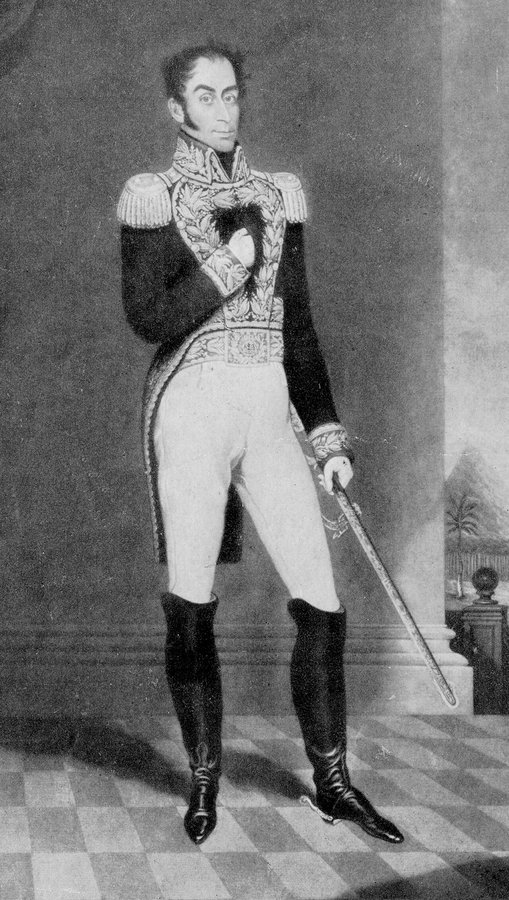
Simón Bolívar was born in Caracas on July 24, 1783, the fourth child of a wealthy Creole family of the class known in Venezuela as the mantuanos. His father, Juan Vicente Bolívar Ponte, died when the boy was two; his mother, María de la Concepción Palacios Blanco, when he was nine. He felt that loss keenly, and later issued a decree to protect destitute children. He attended the public school kept by the teacher Simón Rodríguez, whose ideas left a lasting mark; Bolívar would later write to him, “You formed my heart for liberty, for justice, for what is great, for what is beautiful.” At twelve he ran away to his sister María Antonia. Before he was sixteen he sailed for Spain, where he studied history and mathematics, learned French, and moved in court society. There he met María Teresa Rodríguez del Toro. They married on May 26, 1802, and returned to Caracas; in January 1803 she died of fever. He went back to Europe, settled in Paris in the spring of 1804, and reunited with Rodríguez. Together they traveled to Italy, and on the Monte Sacro he swore not to rest until Spanish America was independent.
From the Admirable Campaign to Ayacucho
In Europe he read Locke, Montesquieu, Voltaire and Rousseau, and in Paris he encountered the ideas of the French Revolution and met Napoleon and the naturalist Alexander von Humboldt. He returned to Venezuela in 1807. After Napoleon’s invasion weakened Spain’s hold on its colonies, he joined the independence movement; Venezuela declared independence in July 1811, with Francisco de Miranda among its early leaders. The first republic failed, and Bolívar fled in 1812, issuing from Cartagena a manifesto that called for a new rising. In 1813 the Admirable Campaign carried him into Caracas, and the city council granted him the title Libertador. “The title of Liberator of Venezuela,” he wrote, “is more glorious and satisfying than the scepter of all the empires of the earth.” A royalist recovery under José Tomás Boves drove him to Jamaica in 1814–15. He returned, and over the following years a series of battles—Boyacá in 1819, which secured New Granada (today’s Colombia); Carabobo in 1821, which secured Venezuela; Pichincha in 1822, with Antonio José de Sucre, which freed Quito; Junín in August 1824 and Ayacucho in December, which ended Spanish power in Peru—gave independence to a vast stretch of the continent. In 1822 he met José de San Martín, who had already freed Chile and entered Lima, at Guayaquil; the two men differed over how the new states should be governed, and San Martín soon withdrew to Europe, leaving Bolívar to finish the campaign in Peru. In the course of the war he formed a lasting relationship with Manuela Sáenz, who later saved his life.
Gran Colombia, and a Union That Would Not Hold
Bolívar wanted more than the expulsion of Spain. At the Congress of Angostura in 1819 he helped frame a constitution for a Republic of Colombia—Gran Colombia—that came to include the lands of today’s Colombia, Venezuela, Ecuador and Panama, and he served as its president. He was also president of Peru and of Bolivia, the republic created in 1825 from Upper Peru and named in his honor. In those last two states he advanced a “monocratic” constitution with a president for life. He sought, in decrees and in the congresses he convened, a larger association of the new republics and a reform of society, including the abolition of slavery and an improvement in the condition of Indigenous peoples; those efforts did not find the echo he hoped for. Regional loyalties and the particular interests of local elites proved stronger than his authority. Gran Colombia broke apart. Accused of tyranny and usurpation, already ill, he resigned and prepared to go again into exile. He died of tuberculosis near Santa Marta, on the Colombian coast, on December 17, 1830, at forty-seven, believing, he said, that he had “plowed in the sea.” In a final address he wrote: “Colombians! My last wishes are for the happiness of the country. If my death contributes to ending the parties and consolidating the Union, I shall go down calmly to the grave.”
His remains were taken back to Caracas in the 1840s. In the decades that followed, especially under the government of Antonio Guzmán Blanco from 1870 to 1887, monuments, public squares and a national pantheon made his memory central to Venezuelan civic life. Bolivia kept the name adopted in 1825; Venezuela’s currency later took the name bolívar, and Bolivia’s the boliviano.
A Paris Lodge, a Hurried Departure, and the Ban of 1828
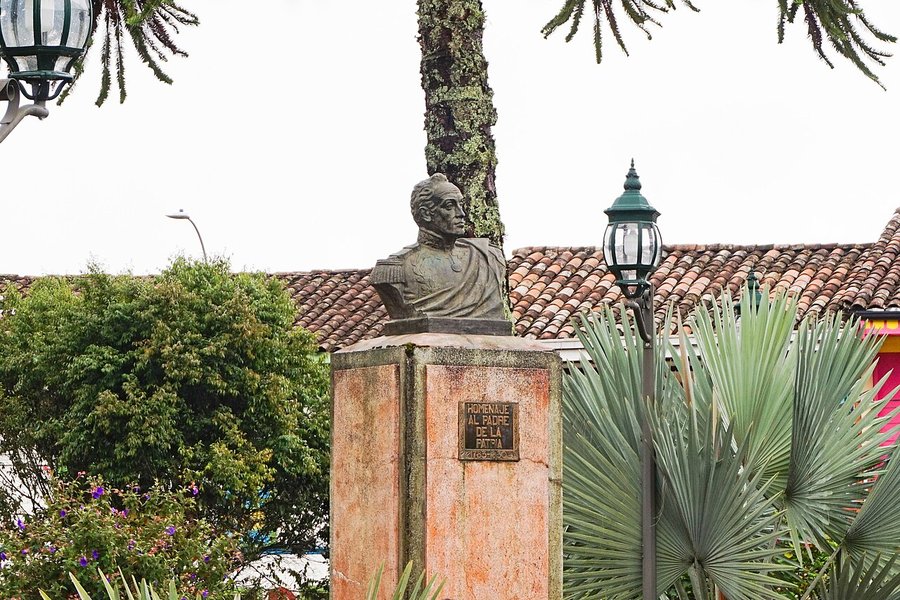
Bolívar’s Masonic life was short, and it was lived in Paris. The minute book of the Mother Scottish Lodge of Saint-Alexandre d’Écosse records a meeting, dated by the lodge’s calendar to about January 1806, at which the Worshipful Master proposed advancing “Brother Bolívar, recently initiated” to the degree of Fellow Craft because he was about to set out on a journey. The brethren agreed unanimously, and his signature stands among eight at the foot of the page. A printed roll of the lodge’s members lists him as “Spanish officer, Master Mason,” beside his countryman Emmanuel Campos. French rules of the day let a soldier facing an imminent departure receive degrees faster than usual. His name appears on no earlier or later roll of that lodge, and on none in the Americas.
Much of what is often said about him rests on later tradition. Older compilations, William R. Denslow’s among them, place his initiation at Cádiz and credit him with joining the Scottish Rite in 1807 and founding the lodge Order and Liberty No. 2 in Lima in 1824. The historian José Antonio Ferrer Benimeli, working from the surviving documents, found no proof of the Cádiz initiation or of the Lima founding, which he attributes to General Antonio Valero. Bolívar himself told his aide Louis Perú de Lacroix that he had become a Mason in Paris and had left the fraternity because he found nothing new in it, only empty repetition.
In 1828 he turned against secret societies altogether. After the failure of the Convention of Ocaña that June and an attempt on his life in late September, plotted by members of a so-called Philological Society, he issued a decree on November 8, 1828, prohibiting all secret associations in Colombia, on the ground that experience had shown they served to prepare political upheaval. Freemasonry was not named, but it was understood to be included, and for several years the decree all but ended its existence in Gran Colombia.
What kept Bolívar’s victories on the battlefield from becoming the lasting political union he hoped to build?
Sources
- British Broadcasting Corporation, Mundo — Simón Bolívar
- Biografías y Vidas — Simón Bolívar
- Université de Rouen Normandie — Qui était Simon Bolivar?
- Grand Lodge of British Columbia and Yukon — Simón Bolívar (Denslow)
- José Antonio Ferrer Benimeli, REHMLAC+ (Universidad de Costa Rica) — El masón Simón Bolívar entre el mito y la verdad histórica
Life & Masonic Timeline
Simón Bolívar, c. 1825. José Gil de Castro. via Wikimedia Commons, cropped · Public domain · Source