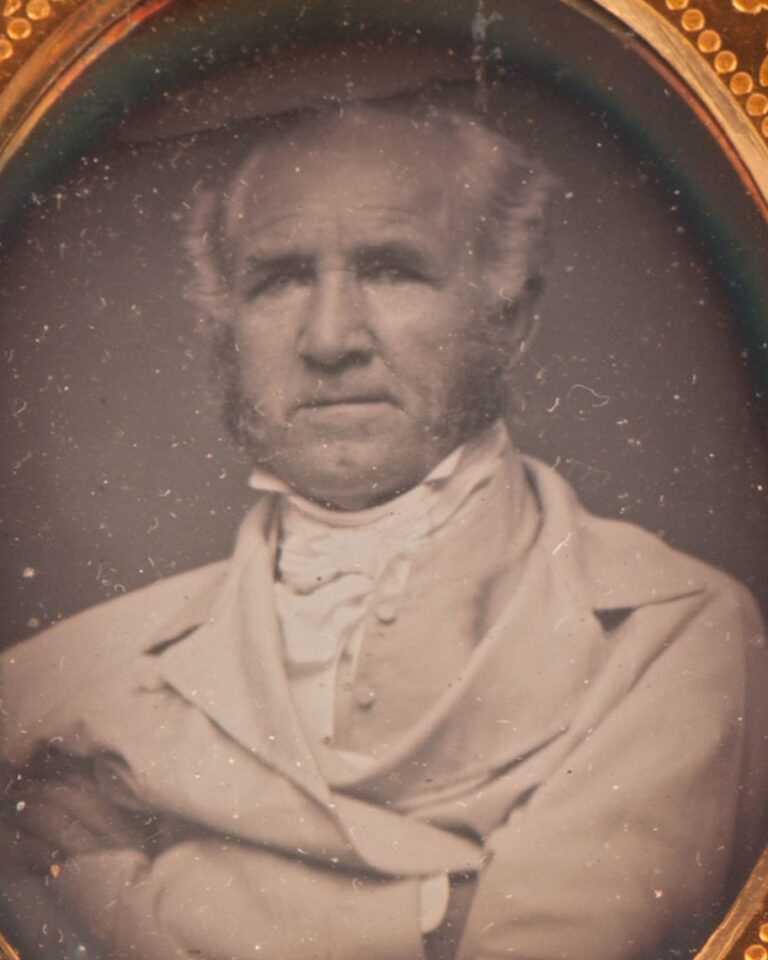
Sam Houston
Born March 2, 1793, Rockbridge County, Virginia · Died July 26, 1863, Huntsville, Texas · Cumberland Lodge No. 8, Nashville, Tennessee (later Holland Lodge No. 1, Houston, Texas)
I would lay down my life to maintain the Union, and prevent dissolution… but I have refused, and will never take, an oath of allegiance to any other government.
The Raven’s rise and fall
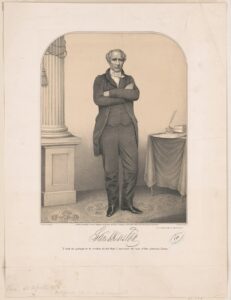
Sam Houston was born on March 2, 1793, on his family’s plantation near Timber Ridge Church in Rockbridge County, Virginia. He had about six months of formal schooling. After his father died, his mother moved the family to Blount County in East Tennessee in 1807. Houston did not take to farm work or to the family store. As a teenager he ran away across the Tennessee River to live among the Cherokee, where Chief Oolooteka adopted him and gave him the name Colonneh, “the Raven.” For the rest of his life he kept a deep sympathy for Native peoples.
He joined the army as a private in 1813. At the Battle of Horseshoe Bend on March 26, 1814, he was struck by an arrow and twice by rifle balls, wounds he barely survived. His courage caught the eye of Andrew Jackson, who became his patron. After the war Houston read law in Nashville, opened a practice and rose fast: district attorney, major general of the state militia, two terms in Congress and, in 1827, governor of Tennessee at thirty-four.
Then his life broke apart. In 1829 his brief marriage to Eliza Allen ended after eleven weeks, for reasons neither of them ever explained. He resigned the governorship and went west to live again among the Cherokee, drinking so heavily for a time that he reportedly earned the name “Big Drunk.” He also worked to keep peace among the tribes, was granted Cherokee citizenship and often served as a tribal emissary. In December 1832 he crossed into Mexican Texas. When revolution came, he was made commander of the Texas army. On April 21, 1836, at San Jacinto, his men defeated Santa Anna’s army in a battle that, by the Grand Lodge of Tennessee’s account, lasted eighteen minutes. Texas was independent.
Houston was twice elected president of the Republic of Texas. After annexation he served thirteen years in the U.S. Senate, where he stood as a Southern man for the Union. In 1859 he was elected governor of Texas, the only man to govern two different states. When Texas seceded in 1861 he refused to swear loyalty to the Confederacy and was removed from office. He died in Huntsville on July 26, 1863.
An oath he would not take
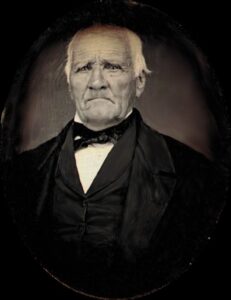
Houston is remembered for San Jacinto, but his finest hour may have been his last. Old, ill and with a young family, he gave up the governorship rather than take an oath he believed was wrong. He had warned Texans that secession would bring war and ruin. He was right, and he paid for it.
His record is not simple. He was a slaveowner who defended slavery in the South, even as he opposed its spread into new territories and broke with his party to protect the Union. He drank hard for years and was once tried by the House of Representatives for beating a congressman with a cane. He also argued for fair dealing with Native peoples when that position won him few friends. His life is a reminder that a man can carry real failings and still act with real courage when it counts.
It is also a story of recovery. Few public men have fallen as far as Houston did in 1829, and fewer still have come back to lead a nation. He rebuilt his life in middle age, remarried in 1840, raised eight children and found steadier footing. In 1854, in the middle of his hardest political fights, he joined the Baptist Church.
A Mason through every chapter
Houston’s Masonic record is unusually well documented. According to the Grand Lodge of Tennessee, he was initiated an Entered Apprentice in Cumberland Lodge No. 8 in Nashville on April 19, 1817, passed to Fellowcraft on June 20 and raised a Master Mason on July 22, 1817, at twenty-four. The lodge minutes still survive. By the early 1820s he was a prominent Mason in Nashville.
In Texas he affiliated with Holland Lodge, first chartered as No. 36 under the Grand Lodge of Louisiana and reopened at Houston in October 1837. On December 20, 1837, while serving as president of the Republic, he presided over the convention of delegates from Holland, Milam and McFarland lodges that formed the Grand Lodge of the Republic of Texas. Anson Jones was elected its first Grand Master, and Holland Lodge became Holland Lodge No. 1. The Texas apron made for him, embroidered with the Lone Star, survives as a treasured relic.
He was buried in Masonic regalia in Oakwood Cemetery at Huntsville. The Grand Lodge of Tennessee sums him up as a Mason through every chapter of an improbable life. For a man who knew both disgrace and glory, the Craft’s teaching that a man is measured by his conduct, not his station, was a lesson he lived in both directions.
Houston gave up the governorship of Texas rather than swear an oath he believed was wrong. When has keeping your word cost you something, and was it worth it?
Sources
- Grand Lodge of Tennessee, TN Masonic Museum & Library, Sam Houston: https://tnmasonicmuseum.org/articles/houston
- Texas State Historical Association, Handbook of Texas, “Houston, Sam” (Thomas H. Kreneck): https://www.tshaonline.org/handbook/entries/houston-sam
- Texas State Historical Association, Handbook of Texas, “Freemasonry” (William Preston Vaughn): https://www.tshaonline.org/handbook/entries/freemasonry
- Austin Masonic Library and Museum, Famous Texas Masons: https://www.masonic.museum/masonic-history/famous-texas-masons/
Life & Masonic Timeline
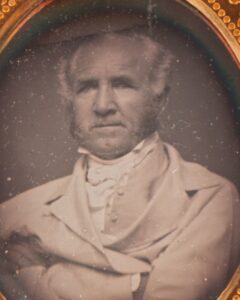
Sam Houston, c. 1856-1859. Daguerreotype, photographer unknown. Via Wikimedia Commons. · Public domain · Source