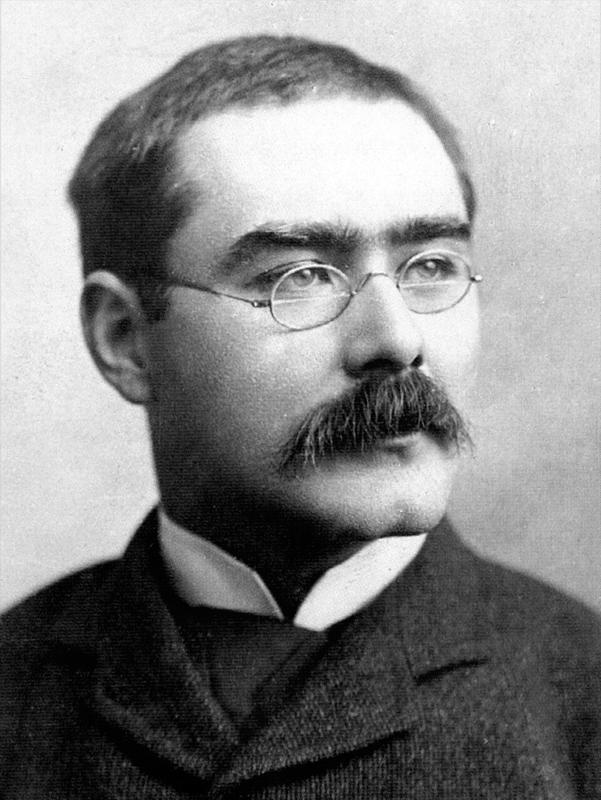
Rudyard Kipling
Born December 30, 1865, Bombay (Mumbai), India · Died January 18, 1936, London, England · Lodge Hope and Perseverance No. 782 (English Constitution), Lahore
Rudyard Kipling wrote The Jungle Book, Kim and If—, and in 1907 became the first English-language writer to win the Nobel Prize in Literature.
Outside—"Sergeant! Sir! Salute! Salaam!" / Inside—"Brother," an' it doesn't do no 'arm.
A Lahore Journalist Who Wrote of India
Rudyard Kipling was born in Bombay on December 30, 1865, the son of John Lockwood Kipling, an artist and teacher, and Alice Macdonald. As a child he was sent to England, where he lived with a foster family in Southsea and then attended the United Services College at Westward Ho, in Devon. In 1882 he returned to India and joined the staff of the Civil and Military Gazette in Lahore as an assistant editor. Departmental Ditties appeared in 1886, and the short-story collections Plain Tales from the Hills and Soldiers Three followed in 1888. Those books made his name in England, and in 1889 he went to live in London. Barrack Room Ballads, published in 1892, was written for, as much as about, the common soldier of the British Army.
The Jungle Book, Kim and a Nobel Prize
In 1892 he married Caroline Balestier, the sister of an American friend, and the couple moved to Vermont, where her family lived. Their two daughters, Josephine and Elsie, were born there, and Kipling wrote The Jungle Book, published in 1894, and The Second Jungle Book the following year. A quarrel with his wife’s family prompted their return to England in 1896. Their son John was born the next year. Captains Courageous appeared in 1897, and Stalky and Co., drawn from his school days, in 1899. Kim was published in 1901; the Swedish Academy later called it perhaps his most felicitous work.
The Just So Stories, published in 1902, began as stories for Josephine, who had died of pneumonia in 1899, at the age of six. The family first saw Bateman’s, a sandstone house in East Sussex with the date 1634 carved above the door, in 1900, and bought it, with thirty-three acres, two years later. He declined a knighthood and the poet laureateship. At Bateman’s he wrote Puck of Pook’s Hill (1906) and Rewards and Fairies (1910), the second of which included the poem “If—.” In 1907 he became the first English writer to receive the Nobel Prize in Literature, and he remains its youngest recipient. In 1926 he received the Gold Medal of the Royal Society of Literature, an honor that only Walter Scott, George Meredith and Thomas Hardy had held before him.
John Kipling and the Graves of the Fallen
In September 1915, John, a lieutenant in the 2nd Battalion of the Irish Guards, went missing at the Battle of Loos. He was eighteen. His father had helped secure his commission despite the young man’s severe short-sightedness. John was killed on September 27, and his body was not identified during Kipling’s lifetime. Kipling later wrote The Irish Guards in the Great War.
In 1917 he became one of the original members of the Imperial War Graves Commission and its first literary adviser. He chose the biblical words “Their Name Liveth For Evermore,” from the Book of Ecclesiasticus, for the Stone of Remembrance that stands in the larger cemeteries, and the inscription “Their Glory Shall Not Be Blotted Out” for special memorials. At the Commission’s request he wrote The Graves of the Fallen in 1919. On August 4, 1930, he was present at the unveiling of the Loos Memorial in France, where John’s name is recorded.
Hope and Perseverance, His Mother-Lodge
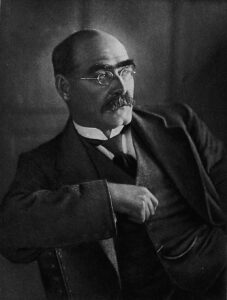
Kipling was initiated, by dispensation of the District Grand Master, in Lodge Hope and Perseverance No. 782, under the English Constitution, at Lahore on April 5, 1886. He was twenty years old. In the minutes he appears as assistant editor of the Civil and Military Gazette, and the Worshipful Master, Colonel G. B. Wolseley, conferred the degree. He was passed on May 3 and raised on December 6 of that year.
He later wrote that the lodge had hoped for a good secretary. He was appointed to that office at once, in part because, as a young journalist, he had a typewriter; the minutes of the meeting at which he was raised are entered in his own hand. He asked his father to advise on decorating the bare walls of the Masonic Hall with hangings after the pattern of Solomon’s Temple. There, he recalled, he met Muslims, Hindus, Sikhs, members of the Arya Samaj and the Brahmo Samaj, two Hindu reform movements, and a Jewish tyler who was priest and butcher to his small community in the city. “So yet another world opened to me which I needed,” he wrote.
Within a few months of his raising he lectured the lodge on the origin of the Craft, and again, in July 1887, on popular views of Freemasonry. In 1887 he also became a Mark Master Mason and a Royal Ark Mariner. After he moved to Allahabad he joined Lodge Independence with Philanthropy No. 391 on April 17, 1888. He demitted from Hope and Perseverance on March 4, 1889, and was placed on the Allahabad lodge’s absent list that same month; he resigned from it in 1895, while living in the United States.
Published in The Seven Seas in 1896, “The Mother-Lodge” looks back on a lodge in which Hindu, Muslim, Sikh and Christian members met as Brothers, whatever distinctions were observed outside the door. “Outside—‘Sergeant! Sir! Salute! Salaam!’ / Inside—‘Brother,’ an’ it doesn’t do no ’arm.” The poem made that fraternity one of Kipling’s most lasting Masonic themes. His writing about empire, though, remains bound up with its assumptions about race and colonial rule. He was a committed advocate of British imperialism, and a poem such as “The White Man’s Burden” sits uneasily beside the equality pictured in “The Mother-Lodge.”
Builders of the Silent Cities, and Poets’ Corner
In later life he was an honorary member of Author’s Lodge No. 3456 and of Motherland Lodge No. 3861, both under the English Constitution. In January 1922 he became a founding member of Builders of the Silent City Lodge No. 12 at St. Omer, France, under the Grande Loge Nationale Française, a lodge connected with men raising the memorials of the Imperial War Graves Commission. In 1925 he was a founding member of a sister lodge, Builders of the Silent Cities Lodge No. 4948, in London.
Kipling died in London on January 18, 1936, after an operation for a perforated ulcer, and was buried on January 23 in Poets’ Corner at Westminster Abbey. His pallbearers included his cousin Stanley Baldwin, then prime minister. The War Graves Commission sent a wreath of flowers gathered from its cemeteries around Loos. In 1939 Caroline Kipling, with the support of their surviving daughter, Elsie, transferred Bateman’s and its contents to the National Trust.
How should the brotherhood Kipling celebrated in “The Mother-Lodge” be read alongside his writing in praise of empire?
Sources
- British Broadcasting Corporation — Rudyard Kipling (1865–1936)
- National Trust — History of Bateman’s
- Nobel Prize — Rudyard Kipling, Biographical
- Nobel Prize — Facts on the Nobel Prize in Literature
- Commonwealth War Graves Commission Archive — Kipling, (Joseph) Rudyard
- Westminster Abbey — Rudyard Kipling
- United Grand Lodge of England — Rudyard Kipling
- Grand Lodge of British Columbia and Yukon — Rudyard Kipling
- Grand Lodge of British Columbia and Yukon — Rudyard Kipling and Freemasonry
- The Kipling Society — If—
- Rudyard Kipling, The Seven Seas (Project Gutenberg)
Life & Masonic Timeline
Elliott & Fry, via Wikimedia Commons · Public domain · Source