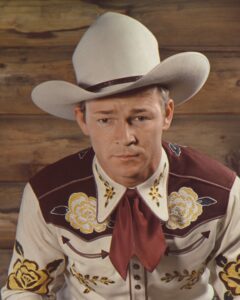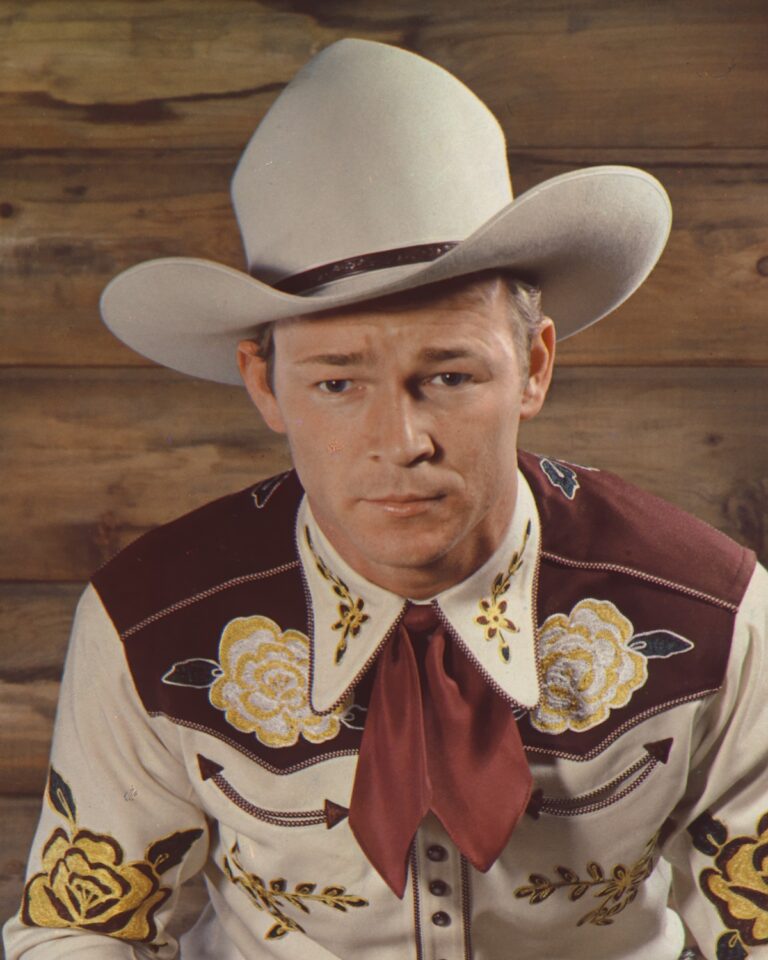
Roy Rogers
Born November 5, 1911, Cincinnati, Ohio · Died July 6, 1998, Apple Valley, California · Hollywood Lodge No. 355, California
When I was a boy, our parents taught us that hitting below the belt was a cowardly thing. I don't believe this kind of thing is 'entertainment' no matter how you look at it.
From peach picker to King of the Cowboys
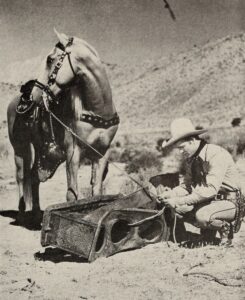
Roy Rogers was born Leonard Slye on November 5, 1911, in Cincinnati, Ohio. (Some older references spell the name Sly.) His family moved to California in 1930, at the start of the Depression, and young Leonard took whatever work he could find. He drove a truck and picked peaches, and he sang.
Singing is what got him out. In the mid-1930s he co-founded a group first called the Pioneer Trio and soon renamed the Sons of the Pioneers. Their harmonies on “Tumbling Tumbleweeds” and “Cool Water” became Western standards, and his first film appearances came as a member of the group. In 1937 he got himself onto the lot at Republic Studios and landed a job as a singing cowboy at seventy-five dollars a week. His first starring picture, Under Western Stars, came out in 1938, and Variety praised a cowboy who looked like a real wrangler and could act and sing besides.
Republic billed him as “The King of the Cowboys” from 1943, and the title fit. From 1943 to 1954 he was the number one Western star at the box office. He made about a hundred films, then moved to television with The Roy Rogers Show from 1951 to 1957. With him came his golden palomino Trigger, his dog Bullet, his sidekick Gabby Hayes and, from 1947, his wife and co-star Dale Evans, who co-wrote their theme song, “Happy Trails to You.” At the height of his fame, the Sears catalog carried four hundred products bearing his name, and his comic books sold twenty-five million copies a year.
He was twice elected to the Country Music Hall of Fame, in 1980 with the Sons of the Pioneers and in 1988 on his own. He and Dale gave their last performance together at a charity benefit marking their fiftieth wedding anniversary on May 17, 1997. He died in his sleep at their home in Apple Valley, California, on July 6, 1998, with his family beside him.
A hero who won fairly
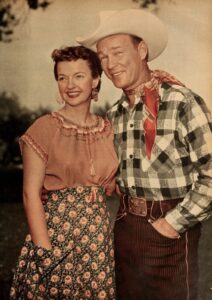
Rogers built a screen hero who won without cruelty. His character shot the gun out of a villain’s hand rather than shooting the man, and his fights were always fair. He spoke out publicly against more violent Westerns. He took seriously that children were watching and tried to give them a hero worth copying.
It is fair to say the image was also a business. The lunchboxes, cereal boxes and comic books made him a millionaire, along with real estate, a restaurant chain and a television production company. But those who knew him said there was no great gap between the man and the role. “He portrayed himself as a good, honest man,” the critic Leonard Maltin said at his death, “and that’s what he was.” Rogers himself admitted that show business never came easily. He called himself an introvert at heart.
His family life was marked by grief. He and Dale raised nine children, including adopted and foster children. Their daughter Robin, who was born with an intellectual disability, died before her second birthday in 1952. Their Korean-born daughter Debbie was killed in a church bus crash in 1964, and their son John died the following year while serving in the Army. The couple spoke openly about their Christian faith through these losses, and Dale’s first book, Angel Unaware, told Robin’s story. They kept going, and they kept giving.
A lifelong Mason and Shriner
Rogers was made a Mason in Hollywood Lodge No. 355 in Los Angeles on April 15, 1946, and raised a Master Mason on June 27 of the same year, as recorded by the Henry Wilson Coil Library and Museum of Freemasonry. He was thirty-four and already the King of the Cowboys.
Masonry stayed with him for the rest of his life. In 1950 he joined the Al Malaikah Shrine in Los Angeles, alongside the clown Red Skelton. The Coil Library notes that his love of children, and what he had seen of the hard circumstances some of them faced, drew him to the Shrine. That same year he joined the Los Angeles Scottish Rite. He was made a Knight Commander of the Court of Honour in 1975 and received the honorary 33rd degree in 1979. He also became a Royal Arch Mason, a Royal and Select Master and, in 1983, a Knight Templar.
After the Roy Rogers Museum closed, his son Roy Rogers Jr., known as Dusty, worked with the George Washington Masonic Memorial to find a home for his father’s Masonic belongings. In early 2010 the Coil Library acquired them. For a man whose screen hero rode for the good guys, the fraternity’s lessons on fairness, charity and keeping one’s word were familiar ground.
Roy Rogers believed the heroes children watched should win fairly. Who were the heroes who shaped your own sense of right and wrong, and do they still hold up?
Sources
- The Associated Press, “Roy Rogers, Cowboy Star, Dies At 86,” The Seattle Times, July 6, 1998: https://archive.seattletimes.com/archive/19980706/2759710/roy-rogers-cowboy-star-dies-at-86—-good-honest-man-in-life-and-film-he-was-hero-of-movies-songs-tv
- Henry Wilson Coil Library and Museum of Freemasonry, “Roy Rogers, The King of the Cowboys” exhibit text, as reproduced by ShowBizShriners: http://showbizshriners.blogspot.com/2013/02/leonard-slye-king-of-cowboys.html
Life & Masonic Timeline