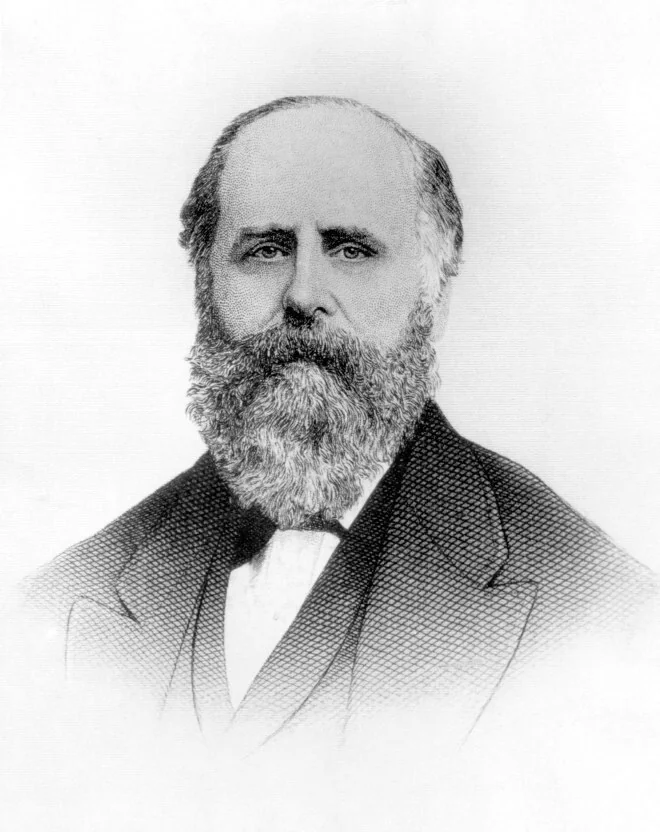
Rowland H. Macy
Born August 30, 1822, Nantucket, Massachusetts · Died March 29, 1877 · Merrimack Lodge, Haverhill, Massachusetts
Rowland H. Macy sold to every customer at one marked price, for cash, and turned four failed shops into the New York store that changed American retail.
One Marked Price for Every Customer
When Rowland Hussey Macy opened his New York store in 1858, he sold every item at one fixed price, the same for every customer, and he sold only for cash. In an era of haggling and shifting prices, that was a radical way to do business. He advertised harder than his rivals, kept his goods moving, and refused to be undersold. When historians list the people who shaped the American department store, his name nearly always appears near the top.
The retailing historians Tom Mahoney and Leonard Sloane were careful to say that Macy “did not invent any of these policies,” though “all of them were radical when they were adopted.” What he did was “to stick with them.” He reached that steadiness the hard way, after four stores that did not last.
A Nantucket Boy, a Whaling Ship, and a Red Star
Macy was born on August 30, 1822, into a Quaker family on Nantucket Island, the fourth of six children. His father ran a bookshop, but the boy wanted the sea. At fifteen he shipped out on the whaling ship Emily Morgan of New Bedford, bound for the Pacific. By 1841 he had given up seafaring and come home to Massachusetts.
From the sources we do have, it is believed he came back from those whaling years with a red star tattooed on his hand or arm, and that the star later became the emblem of his business. A Macy’s spokesman told Boston.com in 2017 that the tattoo was real, but that exactly when and how he got it remains a legend. One story says a star guided him through fog to a safe harbor while he served as a navigator. A research associate at the Nantucket Historical Association doubted that a boy his age would have been trusted with that job.
The same spokesman traced the one-price idea back to the island, too. Macy grew up Quaker, he said, and “felt that there should be one price because there’s only one standard truth.”
Four Stores, Four Hard Lessons
In 1844 Macy married Louisa Houghton, the sister of a Boston dry goods merchant. His biographer, the historian Ralph M. Hower, thought his new brother-in-law may have set him up in a small needle-and-thread shop in Boston. If so, it did not last. Before 1849 he opened and was forced to close at least two dry goods stores in the city. After that first failure, he wrote in his diary: “I have worked for two years for nothing. Damn, Damn, Damn, Damn.”
When news of California gold reached Massachusetts, he left his wife and two-year-old son and went west with his brother Charles to the boomtown of Marysville. There they opened a small dry goods store called Macy and Company. Freight costs soared, and the brothers sold out the next summer, with a small profit to show for it.
By 1851 he was back in Massachusetts, running a new dry goods store in Haverhill under his brother Robert’s name. There he tried the ideas that would later make him famous: newspaper advertising, one price, cash sales, low prices, and stock that turned over quickly. Hower called it a “preliminary sketch of the Macy success formula.” The store did well enough at first to move into larger quarters, but bigger stores in Boston and the neighboring towns took away too much of his trade. In 1855 he sold the business and paid off his creditors at a heavy discount.
He spent a short time as a stockbroker in Boston, and then tried to make a living as a real estate broker in Superior City, Wisconsin, an effort the economic depression of the time doomed. When he tried retailing again in New York, the Los Angeles Times later wrote, it was “the fifth retailing attempt by a four-time loser.”
A Haverhill Lodge Comes Back to Life
On November 9, 1852, while he was running the Haverhill store, Rowland Macy became a member of Merrimack Lodge in Haverhill, according to the records of the Grand Lodge of Massachusetts.
He joined a lodge that was only just coming back to life. Merrimack Lodge was chartered in 1802, but the anti-Masonic feeling that swept the country in the late 1820s hit it hard. Ten men joined in 1827, one in 1828, and after 1829 no one was admitted at all. On December 13, 1843, the members voted to dissolve the lodge and return its charter to the Grand Lodge. A group of brethren petitioned for its restoration in 1851, and the lodge met again under its old charter in November 1852, the same month Macy became a member. Within a year twelve members had been admitted. One of the brethren wrote that, with the help of a few apprentices, they were “determined to make it as useful and influential as in its palmiest days.”
His membership was suspended on June 7, 1876, less than a year before his death. Merrimack Lodge itself lasted until 2023, when it merged into John Hancock Lodge.
Eleven Dollars and Six Cents on Sixth Avenue
On October 28, 1858, at 36, Macy opened a small “fancy goods” store on Sixth Avenue near 14th Street in Manhattan, with his family living upstairs. He sold ribbons, laces, embroideries, artificial flowers, feathers, handkerchiefs, hosiery, and gloves. His first day’s sales came to $11.06. By the end of the first year, the store had taken in close to $90,000.
From the start, he used one price and cash only. Mahoney and Sloane wrote that he was “one of the first to use typographic devices to gain attention,” and that he spent 3 percent of his sales on advertising when well-established competitors spent only 1 percent. He bought goods at auction and sold them at bargain sales. By 1861 the business was a success, and it came through the Civil War years in good shape.
Then the little shop kept growing. Toys, silver, and house furnishings came in 1869; books, stationery, and a soda fountain in 1870; fancy groceries in 1873; china in 1874; and women’s and children’s shoes in 1875. He imported goods directly from Europe, bought straight from factories, and made some goods himself. As early as 1862 he was handing responsibility to managers for each line of merchandise, and by 1869 the whole store ran by departments. By his death, R. H. Macy & Co. filled eleven buildings along Sixth Avenue and around the corners onto 13th and 14th Streets. In Hower’s words, the fancy little dry goods store had become “a department store.” By the 1880s Macy’s was known for fixed prices, cash-only sales, and a money-back guarantee.
Margaret Getchell and the Star on the Price Tags
Macy did not build the store alone. Margaret Getchell, a former mathematics teacher from Nantucket, joined as a clerk. It is not clear whether Macy knew at first that she was family; they were third cousins twice removed. She became the store’s bookkeeper in 1862 and its superintendent by 1866, running its routine operations and its largely female staff. Hower called her “possibly the first of her sex to attain an executive position in American business,” and wrote that Macy credited her with a large part of his success.
The Nantucket Historical Association credits Getchell with convincing Macy to put his red star on the store’s letterhead and price tags. In Haverhill his store’s emblem had been a rooster. In New York, starting around 1862, it became the star. Getchell also pushed for new departments, window displays to draw in shoppers, and the soda fountain at the center of the store. In 1869 she married Abiel T. LaForge, a buyer at the store, whom Macy made a partner in 1872. When Macy and LaForge sailed to Europe on a three-month buying trip in 1873, she was left in charge of the whole store.
The Merchant Who Stretched Christmas
The historian Daniel J. Boorstin wrote that Macy’s promotions hurried Christmas along on its way to becoming “a spectacular nationwide Festival of Consumption.” On Christmas Eve, 1867, Macy kept his store open until midnight and set a single-day record of $6,000. Other merchants began staying open late in the weeks before Christmas, and by 1870 December had become the biggest sales month of the retail year.
In 1874 the store filled a window with part of its doll collection and a purely Christmas theme, and the holiday window became a yearly tradition. Macy’s also claims that children were visiting Santa Claus at the 14th Street store as early as 1862.
The Parade He Never Saw
Rowland Macy died on March 29, 1877. LaForge and Macy’s nephew Robert Macy Valentine took over the business, and both died within two years. In 1888 the brothers Isidor and Nathan Straus, who had run the store’s china and glassware department since 1874, gained a controlling interest, and in 1896 they became its sole owners.
In 1902 the company moved twenty blocks uptown to Herald Square. With a new addition finished in 1924, the Herald Square store became the largest in the world. That same year, 10,000 people watched the company’s first parade, now known as the Macy’s Thanksgiving Day Parade. Macy never saw either one. What he left them was a store built on one price, marked plainly, for everyone who walked in.
Macy failed four times before his fifth store took hold. What setback in your own life taught you something you still use today?
Sources
- Rowland Macy, Masonic Biographies, Grand Lodge of British Columbia and Yukon
- Merrimack Lodge, MasonicGenealogy
- Amelia W. Holmes, “How a Nantucket Woman Made Macy’s,” Nantucket Historical Association
- Dialynn Dwyer, “Macy’s famous red star has Nantucket roots,” Boston.com
- R. H. Macy and Company Store, National Register of Historic Places Inventory, Nomination Form, National Park Service
- R. H. Macy & Co. Store, 14th Street Annex, Landmarks Preservation Commission, New York City
- Recognizing the 150th Anniversary of the Founding of Macy’s, Inc., Congressional Record, September 23, 2008
- Carla Lazzareschi, “Macy Built Retailing Empire on Its Flair for Marketing,” Los Angeles Times
- William Roka, “Shopping for Santa Claus: Origins of Macy’s and the Holiday Icon,” Village Preservation
- Macy’s Brand Heritage: Macy’s Through the Years, Macy’s
Life & Masonic Timeline
Rowland H. Macy. Public domain, via Wikimedia Commons. · Public domain · Source