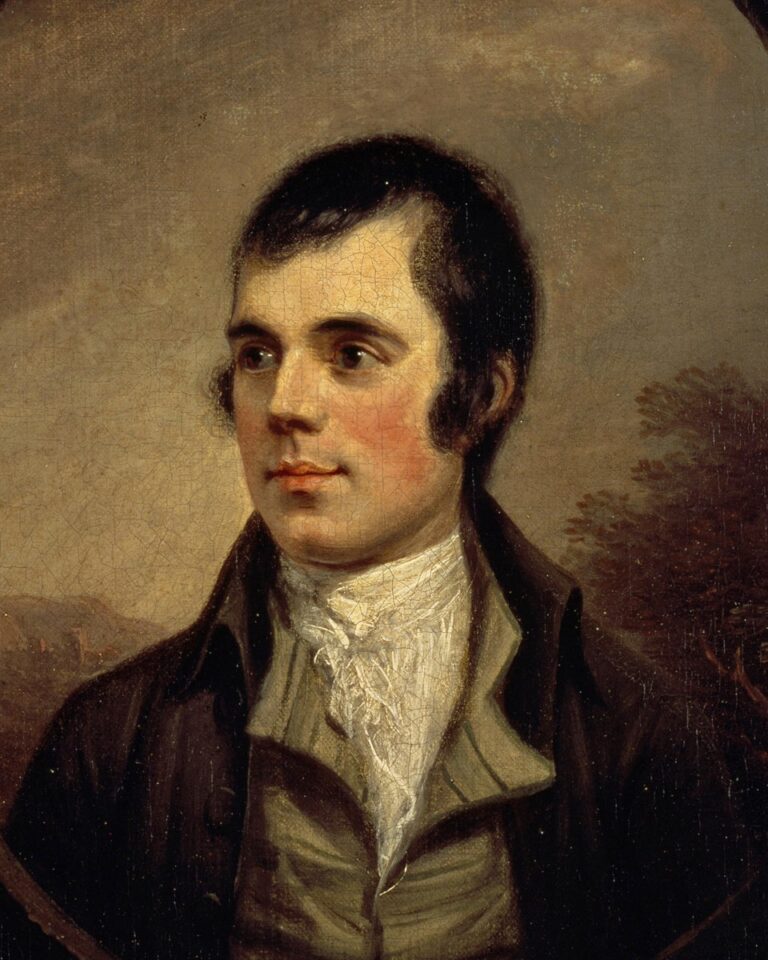
Robert Burns
Born January 25, 1759, Alloway, Ayrshire, Scotland · Died July 21, 1796, Dumfries, Scotland · Lodge St David No. 174, Tarbolton
Scotland’s national poet, whose Masonic songs and farewell to his Tarbolton brethren are still recited in lodges.
Adieu! a heart-warm fond adieu; / Dear brothers of the mystic tie! / Ye favoured, enlighten'd few, / Companions of my social joy
St David’s and the minutes in his own hand
Robert Burns was born at Alloway, Ayrshire, on January 25, 1759. The Grand Lodge of Scotland’s tribute marks Freemasonry—alongside his father William Burness and tutor John Murdoch—as a shaping influence on the man the world still calls Scotland’s National Bard. On July 4, 1781, in his twenty-third year, he was initiated Entered Apprentice in Lodge St David No. 174, Tarbolton; the fee was twelve shillings and sixpence, paid the same day. Brother Alexander Wood, a Tarbolton tailor, introduced him to the Craft.
On October 1, 1781, he was passed and raised. The lodge record book, as quoted by Grand Lodge, names Henry Cowan in the chair and lists the wardens, secretary, treasurer, and Brethren present. Burns was then living with his father at Lochlea. A flax-dressing venture in Irvine failed; he returned to farming and to lodge with undiminished zeal. Grand Lodge notes him as an enthusiastic and regular attender whose talent the Brethren quickly recognized.
On July 27, 1784, at twenty-five, he was elected Depute Master of what had become Lodge St James (Kilwinning), Tarbolton. Because the Master’s role was often honorary, Burns effectively ran the lodge. Twenty-nine minutes bear his signature; three are in his handwriting. When his brother Gilbert received Fellow Craft and Master Mason degrees on March 1, 1786, both signed “Burns,” marking Robert’s break from the paternal spelling Burness.
Kilmarnock subscribers and Canongate’s laureate
July 1786 saw the Kilmarnock Edition financed and published with crucial support from a Brother and some 350 subscribing Brethren of St John’s Lodge, Kilmarnock. Burns became an honorary member there and wrote “Masonic Song” in the lodge’s honor. On March 1, 1787, Lodge Canongate Kilwinning in Edinburgh named him Poet-Laureate of the lodge—a title Grand Lodge says he treasured. The inauguration scene is still represented in a painting at Freemasons’ Hall, Edinburgh.
MotL’s pull quote is from “The Farewell. To the Brethren of St James’s Lodge, Tarbolton” (1786), as Grand Lodge itself quotes it: a heart-warm adieu to the “dear brothers of the mystic tie.” Elsewhere Burns gave the Craft lines that lodges still sing—“Gie me the Master’s apron” and the brotherhood vision of “A Man’s a Man for a’ That.” Grand Lodge cites those verses as evidence that Brotherly Love, Relief, and Truth were meant for the street as well as the lodge room.
He died in Dumfries on July 21, 1796. The first Burns Supper, Grand Lodge notes, gathered at Alloway on the anniversary of his death in 1801; the annual January celebrations of his birth grew from that friendship rite.
Why lodges still raise a glass in January
Burns Suppers are easy to reduce to haggis theater. Grand Lodge’s account restores the Craft spine: a farmer-poet who paid his initiation fee, signed minutes, governed as Depute Master, and let Brethren underwrite the poems that made him immortal. The mystic tie in the Farewell is not a tourist slogan; it is a working Mason’s goodbye.
Lodges outside Scotland that host January nights do best when they read a Masonic poem alongside “To a Haggis”—and when they remember that 350 Kilmarnock subscribers were doing charity of a literary kind: paying so a Brother’s words could leave the farm.
Burns practiced reverence, love of nature, and respect for fellow man, Grand Lodge writes, and so found Freemasonry a natural home. Modern Brethren inheriting his songs inherit that standard. Raise the glass, yes—but also raise the work.
Grand Lodge’s reminder that Burns Suppers began as friends quoting a dead Brother at Alloway keeps January from becoming empty pageantry. Memory first, menu second.
Three minutes in Burns’s handwriting are a treasure any lodge secretary would envy. Modern Brethren who type minutes into cloud folders might ask whether their prose would still be quoted in 240 years.
“A Man’s a Man for a’ That” is not a lodge catechism, yet its brotherhood claim is why Grand Lodge prints it beside the apron verse. Social equality and Craft equality share a stubborn Scottish accent here.
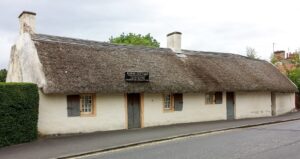
Alloway’s cottage and Edinburgh’s Freemasons’ Hall mark the two poles of his Craft life: farm initiation fees and capital-city laureate honors. Lodges that only toast the fame miss the twelve-and-sixpence beginning.
When Grand Lodge prints Burns’s apron verse beside “for a’ that,” it ties ritual clothing to social hope. MotL follows that pairing without pretending every Burns Supper guest has read the minutes.
MotL’s Burns meta already carried St David No. 174 and the July–October 1781 degree string; this rewrite simply puts Grand Lodge of Scotland’s own narrative under those dates where readers can verify every fee and signature.
Burns’s Brethren paid for the Kilmarnock Edition before the world did. What Brother’s work is your lodge willing to underwrite before fame arrives?
Sources
- Grand Lodge of Scotland, Our National Bard, Brother Robert Burns: https://www.grandlodgescotland.com/our-national-bard-brother-robert-burns/
Life & Masonic Timeline
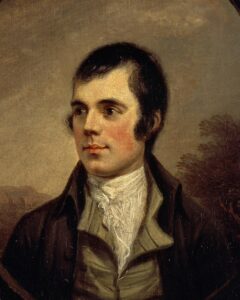
Alexander Nasmyth (1787), Scottish National Portrait Gallery PG 1063, via Wikimedia Commons · Public domain · Source