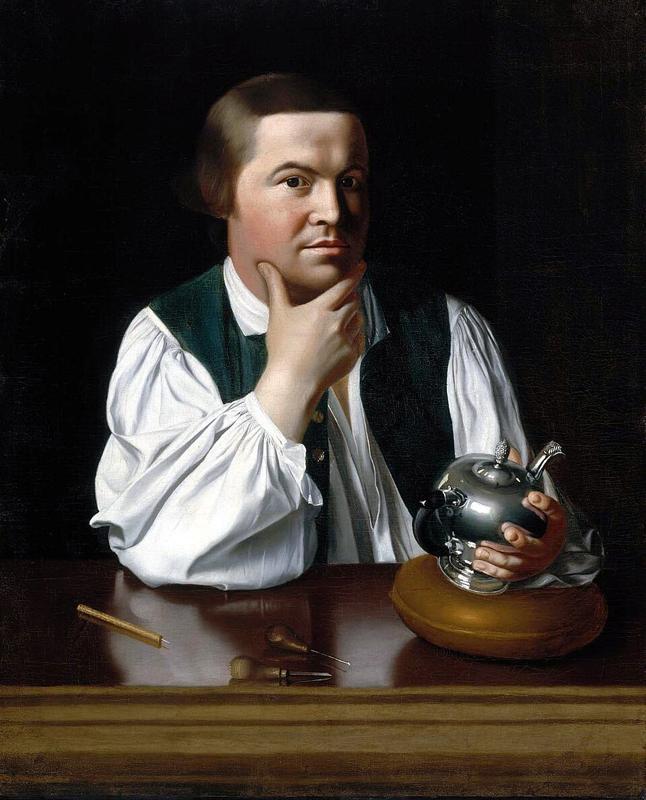
Paul Revere
Born January 1, 1735, Boston, Massachusetts · Died May 10, 1818, Boston, Massachusetts · St. Andrew's Lodge, Boston
Paul Revere was a Boston silversmith and engraver whose midnight ride of April 1775 warned the countryside that British troops were coming.
A North End Goldsmith, and a Lodge of Customers
Paul Revere was born in Boston’s North End on December 21, 1734 — January 1, 1735, under the New Style calendar — the third of nine children and the oldest surviving son. His father, Apollos Rivoire, was a French Huguenot goldsmith who emigrated to Boston at thirteen and anglicized the family name; his mother, Deborah Hichborn, came from early New England settlers. Paul was educated at the North Writing School and apprenticed in his father’s shop, which worked in gold and silver. When his father died on July 22, 1754, the son was still too young to operate the shop legally. In February 1756 he took a commission as a second lieutenant of artillery and served in New York during the Seven Years’ War. He saw no action, came home that autumn, and married Sarah Orne on August 4, 1757. They had eight children between 1758 and 1773, two of whom died young.
Revere entered the Lodge of Saint Andrew in Boston on September 4, 1760, and was raised a Master Mason on January 27, 1761. Membership brought customers to his shop. By 1763 he was making shoe and knee buckles for fellow artisans and tea pots and sugar bowls for merchants, and he later made Masonic jewels and other work for lodge officers. He served as Master of Saint Andrew’s in 1770–71. In 1764 his income stood at about £102; after the Sugar and Stamp Acts it fell to £64. He joined the Sons of Liberty. As he later wrote, Great Britain “wanted to make us hewers of wood and drawers of water.” The Lodge of Saint Andrew owned the Green Dragon Tavern, where opponents of British policy — including Revere, John Hancock and Joseph Warren — met.
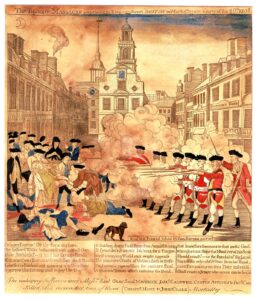
He also worked as a copperplate engraver, producing political cartoons, book illustrations and business cards, and from 1768 to 1775 practiced dentistry — cleaning teeth and fastening false ones; he did not, contrary to a later story, make George Washington’s teeth. In February 1770 he bought a house in North Square and engraved his famous print of the Boston Massacre, adapted from a drawing by Henry Pelham. After Sarah’s death he married Rachel Walker on October 10, 1773. She cared for six surviving stepchildren and had eight children of her own.
A Messenger, a Midnight Ride, and a Court-Martial
On December 17, 1773, the day after the Boston Tea Party — which he had helped plan as a member of the North End Caucus — Revere carried the news to New York and Philadelphia. Thereafter he regularly rode as a courier for the Boston Committee of Correspondence and the Massachusetts Committee of Safety. In the year before the Revolution he also gathered intelligence by, as he later wrote, “watching the Movements of British Soldiers.”
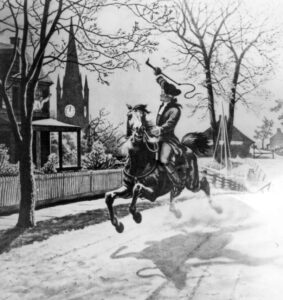
At about 10 p.m. on April 18, 1775, Dr. Joseph Warren sent Revere and William Dawes to Lexington with word that British troops were about to march. Warren believed they meant to arrest John Hancock and Samuel Adams, who were staying there, and then seize the military stores at Concord; in fact the troops had no orders to arrest anyone. In case Revere could not get out of town, he arranged for two lanterns to be hung in the steeple of Christ Church, now the Old North Church, to signal Charlestown that the troops would cross the river by boat. Two friends then rowed him across the Charles, past the warship HMS Somerset, and he borrowed a horse in Charlestown. Dodging a patrol, he rode by way of Medford, alarming nearly every house on the road to Lexington, where a guard asked him not to make so much noise. “Noise!” he answered. “You’ll have noise enough before long. The regulars are coming out!” Dawes arrived by the longer land route about half an hour later. Riding on toward Concord with Dr. Samuel Prescott, the three were stopped by a British patrol. Prescott and Dawes escaped; Revere was questioned, released without his horse, and walked back to Lexington in time to see the end of the fight on the Green. After the battles, Revere and his family lived in Watertown, where he printed paper currency for the Massachusetts government and helped obtain powder and ammunition. He later served as a lieutenant colonel of the Massachusetts artillery and commanded Castle Island in Boston Harbor.
His military service ended with the failed Penobscot expedition of 1779, a large assault on a British fort at Castine, in what is now Maine. Revere was charged with insubordination, neglect of duty, and cowardice. He petitioned the Massachusetts government seven times for a proper hearing and was fully exonerated by court-martial on February 19, 1782.
A Foundry, a Copper Mill, and the Grand Master’s Chair
After a brief period as a hardware merchant, Revere opened a foundry in 1788 and, in 1801, a copper mill at Canton, Massachusetts, after years of experiment and a $10,000 loan from the United States government, which he repaid in copper sheeting. He took pride in making useful manufactures he claimed were equal to British ones — bells, brass cannon, sheets, bolts, spikes and nails. He served as Grand Master of Massachusetts from 1795 to 1797, and also as Suffolk County coroner and president of the Boston Board of Health.
The high point of his years as Grand Master came on July 4, 1795, the twentieth anniversary of independence, when Governor Samuel Adams asked the Grand Lodge to assist him in laying the cornerstone of the new State House on Beacon Hill. Fifteen white horses, one for each state, drew the stone from the Old South Church to the site, and Revere called it “an auspicious day.” Beneath it he and Adams placed coins, a medal honoring George Washington, and a silver plate, probably engraved by Revere himself, naming “the Most Worshipful Paul Revere, Grand Master.”
Revere died in Boston on May 10, 1818, at eighty-three, and was buried in the Granary Burying Ground. The Boston Intelligencer called him “cool in thought, ardent in action.” Henry Wadsworth Longfellow visited the Old North Church steeple on April 5, 1860, began writing “Paul Revere’s Ride” the next day, and published the poem in The Atlantic Monthly in January 1861.
How does Revere’s work as a craftsman, courier and Grand Master broaden the familiar story of his midnight ride?
Sources
- National Park Service — Paul Revere
- Paul Revere House — Biography
- Grand Lodge of Massachusetts — Massachusetts Freemasons Commemorate Boston Tea Party Connections
- Hans Schwartz, “Freemasonry in Revolutionary Boston,” Quatuor Coronati Lodge No. 2076
- Paul Revere House — The Real Story of Paul Revere’s Ride
- Museum of Fine Arts, Boston — Massachusetts State House Time Capsule and Contents on View
- Grand Lodge of Massachusetts, The Trowel (Summer 2015) — America’s Cornerstone
Life & Masonic Timeline
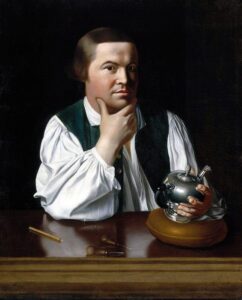
John Singleton Copley, via Wikimedia Commons · Public domain · Source