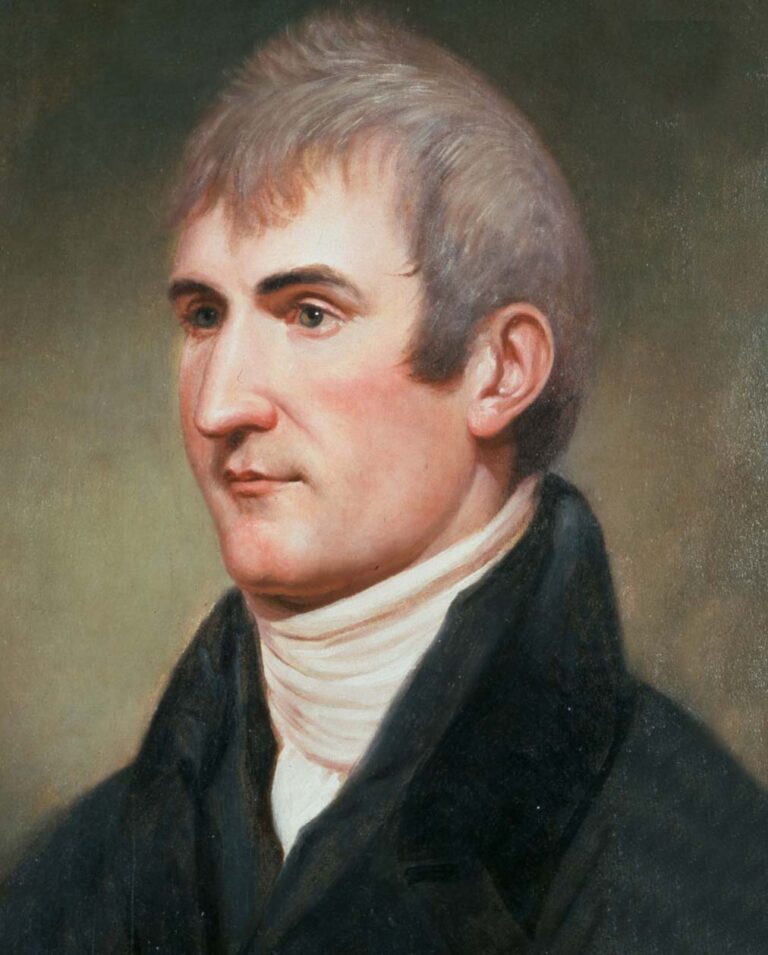
Meriwether Lewis
Born August 18, 1774, Albemarle County, Virginia · Died October 11, 1809, near Hohenwald, Tennessee (Grinder's Stand / Natchez Trace) · Door to Virtue Lodge No. 44, Albemarle County, Virginia; later first Master of St. Louis Lodge No. 111
Meriwether Lewis led the Corps of Discovery with William Clark, mapping the American West from St. Louis to the Pacific and back between 1804 and 1806.
An Albemarle Captain, Jefferson’s Secretary, and Door to Virtue Lodge
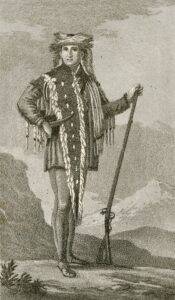
Meriwether Lewis was born on August 18, 1774, near Charlottesville in Albemarle County, Virginia, a son of Lucy Meriwether and William Lewis. After his father’s death his mother remarried and moved the family to Georgia, where the boy explored the countryside and took an interest in natural history. He often returned to Virginia to manage the family plantation and to obtain a formal education. After his stepfather died, while Lewis was still in his late teens, he became head of the household for his mother and four siblings. He enlisted in the United States Army in 1794, joining forces sent to put down the Whiskey Rebellion, and served in Kentucky, Pennsylvania, Michigan, and Ohio. By 1800 he held a captain’s commission. Army service brought a lasting friendship with William Clark, a lieutenant under whom he served at the Battle of Fallen Timbers in 1794, and who commanded the Chosen Rifle Company of elite riflemen.
Lewis joined the Craft in 1797, at twenty-three, receiving his degrees in Door to Virtue Lodge No. 44 in Albemarle County. In 1801 President Thomas Jefferson, writing that a “personal acquaintance with [Lewis], owing to his being of my neighborhood,” had led him to the choice, made Lewis his private secretary. Lewis served in that post, living and working at the White House, until 1803, when Jefferson selected him as the “intelligent officer…fit for the enterprise and willing to …explore…to the Western Ocean.”
The Corps That Mapped a Continent
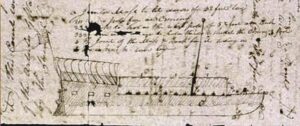
Lewis prepared in Philadelphia for about a month under leading men of science: astronomy with Andrew Ellicott, botany with Benjamin Smith Barton, surveying and mathematics with Robert Patterson, medicine with Benjamin Rush, and anatomy with Caspar Wistar. His studies also covered the preservation of plant and animal samples, the use of navigation instruments for latitude and longitude, and fossils. He invited Clark to share the risks and honors of command. The Corps of Volunteers for Northwestern Discovery—today called the Corps of Discovery—was a military expedition of thirty-five members, sent as diplomats, scientists, and navigators, to find and map an all-water route to the Pacific and to establish peaceful relations with Native nations along the way. Between 1804 and 1806 they traveled from Wood River, Illinois, near St. Louis, to the Pacific and back, nearly 8,000 miles by boat, horseback, and on foot, fighting the current of the Missouri in summer heat, crossing the Bitterroot Mountains in bitter cold, and portaging boats around waterfalls. They returned to St. Louis in September 1806, among rumors that the party had been lost. Clark mapped; Lewis described plants and animals. The explorers told tribes of the Louisiana Purchase of the change in sovereignty and tried to make peace between them, but, not understanding complex intertribal relations and tribal structures, they saw few of those efforts meet with enduring success. They never found the all-water route to the Pacific, but they documented and described for science 122 animal species and 178 plant species, and they came in contact with about fifty American Indian tribes. Along the way the men endured frequent malnutrition, swarms of mosquitoes and biting fleas, and every evening the captains and sergeants wrote up the day in their journals. Lewis was a diligent journal-keeper at some times and silent at others; modern historians can only guess at the gaps.
Jefferson’s later tribute still catches the man the president thought he had chosen: courage that “yielded to nothing but impossibilities,” a rigid disciplinarian who was yet “tender as a father of those committed to his charge,” and “a scrupulous fidelity to truth.” After the expedition, Congress made grants of land to the men of the Corps. Jefferson appointed Lewis governor of the Louisiana Territory—the purchase lands except the present state of Louisiana. Clark resigned from the army in 1807, served as an Indian agent, and was later appointed a brigadier general for the territory of Upper Louisiana.
First Master of Saint Louis Lodge, and a Road Along the Natchez Trace
In St. Louis, Lewis also turned to the Craft. On August 2, 1808, he and companions petitioned the Grand Lodge of Pennsylvania for a lodge, nominating Lewis as first Master. Grand Master James Milnor granted the request; a warrant for Saint Louis Lodge No. 111 issued on September 16, 1808. At Lewis’s urging, Clark petitioned and was accepted. Initiation records do not survive, but on September 18, 1809, the lodge issued Clark a traveling certificate. Because the warrant came from Pennsylvania, Clark was, for all technical intents and purposes, a Pennsylvania Mason. The lodge later returned its warrant, in 1815; Clark’s membership transferred to Missouri Lodge No. 12, which for several years met on the second floor of a house he had built. Upon his death on September 1, 1838, Clark was buried with Masonic honors, and a Masonic monument was erected.
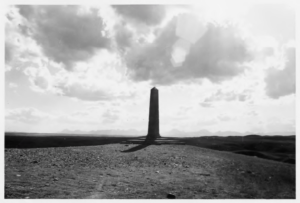
The governorship brought personality conflicts, questions about how government money was being spent, heavier drinking, and a strained relationship with Jefferson. Lewis and the territorial secretary, Frederick Bates, differed on politics and on policy. In 1809 the new Madison administration imposed a stricter approval process on territorial governors and denied several of Lewis’s bills, leaving him personally liable for them. Facing dishonor and personal bankruptcy, and struggling with melancholy, he set out for Washington in September 1809 to defend his accounts, to arrange publication of the expedition journals, and to meet Jefferson. On the road he wrote his will, leaving his possessions to his mother, Lucy Marks. At Fort Pickering, near present-day Memphis, the party met James Neelly, the Chickasaw agent who would escort them through Chickasaw country, and his companions grew worried for his safety. At Grinder’s Stand, an inn on the Natchez Trace near present-day Hohenwald, Tennessee, Mrs. Grinder prepared a meal and made up a room. Later that evening gunshots were heard; he was found with two wounds, one to the head and one to the chest. He died on the morning of October 11, 1809, at thirty-five. Many who knew Lewis believed he had taken his own life, and the recorded circumstances indicate the probability of suicide, though some accounts from 1848 and later suggest he may have been murdered. He is buried near Grinder’s Stand; a memorial was erected in 1848 at what is now the Meriwether Lewis Monument.
Which part of Lewis’s work as an explorer or lodge organizer deserves wider recognition?
Sources
- National Park Service — Meriwether Lewis
- National Park Service, Natchez Trace Parkway — Meriwether Lewis
- National Park Service, Lewis and Clark National Historic Trail — Meriwether Lewis
- Grand Lodge of Pennsylvania, The Pennsylvania Freemason — Brothers Lewis and Clark (May 2003, archived)
Life & Masonic Timeline
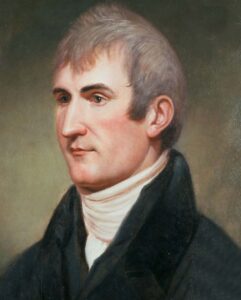
Charles Willson Peale, c. 1807, via Wikimedia Commons · Public domain · Source