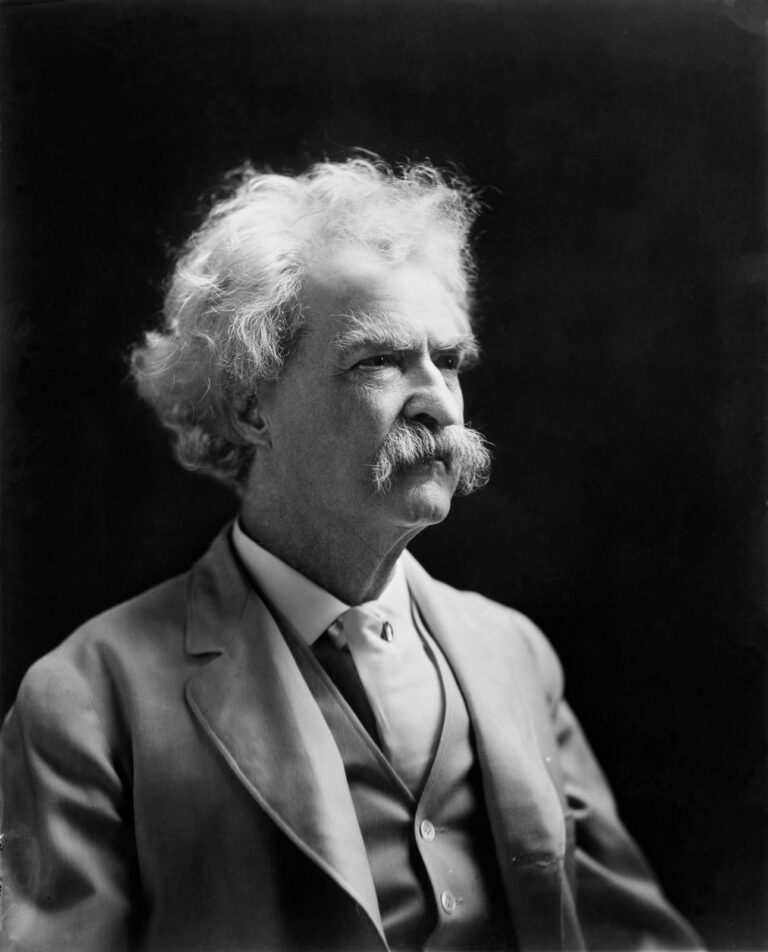
Samuel Langhorne Clemens (Mark Twain)
Born November 30, 1835 · Died April 21, 1910 · Polar Star Lodge No. 79, St. Louis
Courage is resistance to fear, mastery of fear—not absence of fear.
From the river to the page
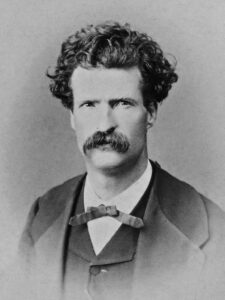
Samuel Langhorne Clemens was born on November 30, 1835, in Florida, Missouri, the sixth of seven children. When he was four, the family moved to Hannibal, a small frontier town on the Mississippi. Missouri was a slave state. The Mark Twain House notes that his father owned one enslaved person and his uncle owned several. That world later became the setting, and the moral problem, of his greatest books.
He was apprenticed to a printer at 12, wrote for newspapers, and by 1857 had become a pilot on the Mississippi. The Civil War closed the river in 1861. He joined a volunteer Confederate unit, the Marion Rangers, and quit after two weeks. He then went west with his brother Orion, who had been appointed secretary of the Nevada Territory. Writing for western papers, he found the voice the world would know as Mark Twain. His story of the jumping frog made his name across the country in 1865. A reporting trip to the Sandwich Islands launched his career as a lecturer, and his letters from an 1867 voyage to Europe and the Holy Land became The Innocents Abroad.
He married Olivia Langdon and settled in Hartford, where he wrote Roughing It, The Adventures of Tom Sawyer and Adventures of Huckleberry Finn (1884). The Mark Twain House describes the last as attacking the institution of slavery and the continued poor treatment of African Americans in his own time. Bad investments led to bankruptcy, and when his publishing company failed in 1894 he set out on a worldwide lecture tour to repay his debts. He succeeded. Grief marked his family life. His son Langdon died at two of diphtheria. In 1873 he and Charles Dudley Warner wrote The Gilded Age, a novel that attacked political corruption and gave a whole era its name. In 1896 his daughter Susy died of meningitis, and his later writing turned dark, aimed at human greed and cruelty. He died on April 21, 1910.
His sharp tongue did not spare the famous. In 1900 he gave a harshly sarcastic public introduction of a young Winston Churchill, who also appears among our Famous Masons. By then some people were calling Twain a traitor for his writings and speeches against his own government. Several of his works went unpublished in his lifetime, either because magazines would not take them or because he feared for his reputation. He was brave on paper, and like most of us, not always brave.
Laughter that told hard truths
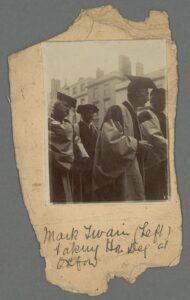
Twain showed that humor can tell hard truths that sermons cannot. He used laughter to expose hypocrisy, corruption and cruelty, including the cruelty of the society he grew up in. His books still start arguments in classrooms today, and that is part of their value. He also showed integrity in money matters. Ruined by his own bad bets, he took to the lecture platform at nearly sixty and worked his way out of debt.
A pilot’s petition to Polar Star Lodge
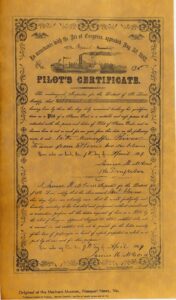
On December 26, 1860, Clemens, then a river pilot, petitioned Polar Star Lodge No. 79 in St. Louis. The Mark Twain Project has published the petition. In it he offered himself “unbiased by friends and uninfluenced by mercenary motives,” prompted by “a favorable opinion conceived of the Institution, a desire of knowledge and a sincere wish of being serviceable to his fellow creatures.” Polar Star had more members than any other Missouri lodge, many of them rivermen. He was elected on February 13, 1861, and received the first degree on May 22, the second on June 12 and the third on July 10, 1861. Sixteen days later he was on the stage west to Nevada.
His membership lapsed while he was in the West, though he attended lodges at Carson City in 1862 and Angels Camp in 1865. He was reinstated in Polar Star Lodge on April 24, 1867. On his voyage to the Holy Land he had a gavel made for his lodge. Its mallet was cedar from Lebanon, and he cut the handle himself from a cedar outside the walls of Jerusalem. It was presented to Polar Star in 1868, and the lodge still treasures it. The Scottish Rite, NMJ notes Masonic phrases in The Innocents Abroad, such as “great Architect of the Universe.”
It is also true that his active Masonic life was short. The Mark Twain Project records that he remained a Mason only until October 8, 1869, when his lodge granted his request for a demit. He never affiliated again. Still, the young pilot’s petition is worth rereading. A desire for knowledge and a wish to be useful to others are good reasons to knock on a lodge door in any century, and Twain spent his life pursuing both.
Twain asked to join because of “a desire of knowledge and a sincere wish of being serviceable to his fellow creatures.” What were your own reasons for knocking on the door, and have they changed since?
Sources
- The Mark Twain House & Museum, Biography
- Mark Twain Project, Clemens’s petition to Polar Star Lodge No. 79, 26 December 1860
- Scottish Rite, NMJ, The Masonic Life of Mark Twain
- Polar Star Lodge No. 79, Brief History of the Lodge
Life & Masonic Timeline
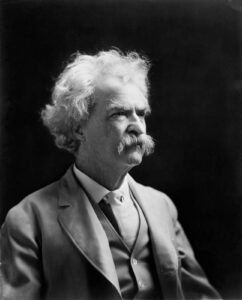
Mark Twain. Library of Congress. Via Wikimedia Commons. · Public domain · Source