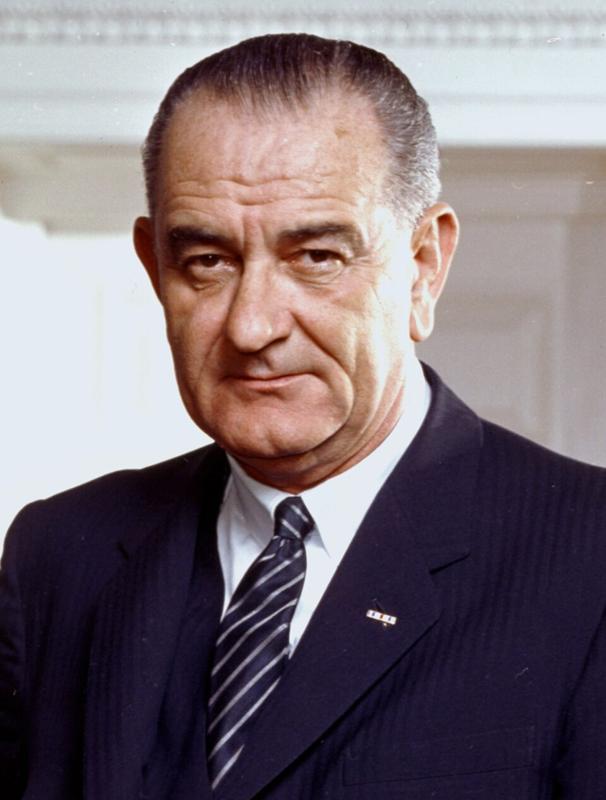
Lyndon B. Johnson
Born August 27, 1908, Stonewall, Texas · Died January 22, 1973, Stonewall, Texas · Johnson City Lodge No. 561, Johnson City, TX
Lyndon B. Johnson signed landmark civil-rights and voting-rights laws, created Medicare and greatly expanded American involvement in Vietnam.
It is all of us, who must overcome the crippling legacy of bigotry and injustice. And we shall overcome.
A Boyhood on the Pedernales
Lyndon Baines Johnson was the eldest of five children of Samuel Ealy Johnson and Rebekah Baines, born in a farmhouse on the Pedernales River in the Texas Hill Country. On the day of his birth, from the sources we do have, it is believed that his father rode up and down the river announcing that the boy would be governor of Texas someday. Sam Johnson served in the Texas legislature, and politicians were regular visitors to the house; young Lyndon hid where he could hear their conversations. At twelve he told classmates, “Someday I’m going to be president of the United States.”
In 1913 the family moved to Johnson City, into a house with neither electricity nor indoor plumbing. Sam Johnson later bought the family farm on the Pedernales and tried to grow cotton, but he sold it deeply in debt in 1922. Johnson remembered deciding at fourteen that he “was not going to be the victim of a system which would allow the price of a commodity like cotton to drop from forty cents to six cents and destroy the homes of people like my own family.”
The Schoolteacher from Cotulla
Johnson graduated in 1924 as president of a senior class of six, then drifted: to California with four friends and a shared car, back to Texas and a road crew. In 1927 he entered Southwest Texas State Teachers College in San Marcos, working his way through. For one year he was principal and teacher at the Welhausen School in Cotulla, a poor Mexican American community, and he pushed his long-neglected students hard. The experience shaped his view of poverty and of what government could do about it. He finished his degree in 1930 and taught in Pearsall and then in Houston.
The Congressman Who Brought Power to the Hill Country
Late in 1931 Johnson went to Washington as secretary to Congressman Richard Kleberg of Corpus Christi, answering every constituent letter and learning every detail of congressional procedure. On a visit home in 1934 he met Claudia Alta Taylor, known since childhood as “Lady Bird,” and they married on November 17, less than three months later. From 1935 to 1937 he directed the National Youth Administration in Texas, putting young people to work on a system of roadside parks and quietly opening some programs to African Americans.
When the congressman for Texas’s Tenth District died in 1937, Johnson entered the race as a devoted supporter of President Franklin Roosevelt and won at twenty-eight. He brought federal housing projects and dams to his district and, above all, electric power to the Hill Country of his boyhood, which he called his proudest achievement. He lost a 1941 special election for the Senate narrowly, then served in the Navy as a lieutenant commander. On a 1942 inspection tour of the South Pacific he flew one bombing mission and received the Silver Star; the plane he had first boarded and then left crashed into the sea with no survivors. In 1943 the Johnsons bought a struggling Austin radio station, KTBC, with part of Lady Bird’s inheritance, and their daughters Lynda Bird and Luci Baines were born in 1944 and 1947.
Entered Apprentice in Johnson City Lodge
Johnson received the Entered Apprentice degree in Johnson City Lodge No. 561 on October 30, 1937, about six months after he was sworn in to the House. The lodge, chartered in 1882, was older than Johnson City’s standing as county seat, and many of his Hill Country neighbors had taken the same first step there. He did not receive the Fellowcraft or Master Mason degrees, but the record of his initiation remains in the lodge’s minute book.
“Landslide Lyndon,” Master of the Senate
In 1948 Johnson ran for the Senate against former Governor Coke Stevenson, crisscrossing Texas by helicopter. He won the Democratic runoff by 87 votes out of 988,295 cast, helped by highly suspicious tallies from three border counties and also by the legal votes of Black Houstonians newly able to vote in Democratic primaries. The nickname “Landslide Lyndon” followed him for years.
His rise in the Senate was startling. He became Democratic whip in 1951, minority leader in 1953 and majority leader in 1955, the youngest man to hold either leadership post. He became known for the “Johnson Treatment,” in which he leaned in close, flattering and cajoling until he had a vote. A severe heart attack in July 1955 made him give up smoking, lose weight and try to delegate more of his work. He steered the Civil Rights Act of 1957, the first since the 1860s, and its successor in 1960, and after the Soviet Union launched Sputnik he pressed for an American space program. In 1960 he was elected vice president on John F. Kennedy’s ticket, and on November 22, 1963, after Kennedy’s assassination, he became president.
Great Society, Civil Rights, and Vietnam
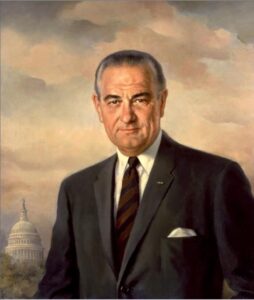
Johnson first secured the two measures Kennedy had been urging at his death, a major civil rights bill and a tax cut; he signed the Revenue Act in February 1964. In his State of the Union address that January he declared “unconditional war on poverty in America.” He then called on the nation “to build a great society, a place where the meaning of man’s life matches the marvels of man’s labor.” In 1964 he defeated Senator Barry Goldwater by more than fifteen million votes, and the election brought him a heavily Democratic Congress.
Johnson signed the Civil Rights Act of 1964 and, on August 6, 1965, the Voting Rights Act. His Great Society program expanded federal aid to education, created Medicare and supported urban renewal and conservation.
In April 1965 he signed the Elementary and Secondary Education Act at the one-room schoolhouse between Stonewall and Hye that he had attended as a child, with Kate Deadrich Looney, his teacher when he was four, beside him. That November he signed the Higher Education Act at his old college in San Marcos. The Social Security Amendments of 1965 created Medicaid alongside Medicare. In October, at the base of the Statue of Liberty, he signed the Immigration and Nationality Act, which phased out quotas based on national origin. He created the Department of Housing and Urban Development and named Robert Weaver to lead it, the first African American in a presidential cabinet, and pushed through the Highway Beautification Act that Lady Bird had championed. The Economic Opportunity Act of 1964 created the Job Corps and Volunteers in Service to America, and Head Start and legal aid for poor families followed. Between 1964 and 1974 the share of Americans below the poverty line fell from about 20 to 12 percent, helped also by a booming economy.
In his March 15, 1965, address to Congress, “The American Promise,” Johnson called on the country to overcome the legacy of racial injustice. The speech connected the voting-rights struggle to a national obligation rather than a sectional cause. It followed “Bloody Sunday,” March 7, 1965, when state troopers attacked marchers setting out from Selma for Montgomery. Within four years Black voter turnout in the South had tripled. When riots struck American cities, his Kerner Commission reported in 1968 that the nation was dividing into two societies, “separate and unequal,” findings he largely rejected as too radical. After the assassination of Martin Luther King Jr. in April 1968, he pressed Congress into passing a law against racial discrimination in housing.
In August 1964, after reports that American ships had been attacked in the Gulf of Tonkin, Congress passed a resolution, 98 to 2 in the Senate and unanimously in the House, that he treated as the equivalent of a declaration of war. On the campaign trail that fall he said, “We are not about to send American boys nine or ten thousand miles away from home to do what Asian boys ought to be doing for themselves.” In February 1965 he authorized Operation Rolling Thunder, the sustained bombing of North Vietnam, and on March 8 two Marine battalions came ashore near Da Nang, the first American combat troops on mainland Asia since Korea. By the end of 1968 there were 536,000 American troops in Vietnam and more than 30,000 Americans had died there. “I can’t get out, I can’t finish it with what I have got. So what the hell do I do?” he asked Lady Bird. The Tet Offensive in January 1968 broke public support, and Senator Eugene McCarthy won 42 percent against him in the New Hampshire primary. On March 31, 1968, he announced that he was limiting the bombing of North Vietnam to open formal negotiations and, to general astonishment, that he would not seek reelection. In 1967 he signed the Outer Space Treaty, and in 1968 the United States joined the Nuclear Nonproliferation Treaty.
Johnson’s Space Program and Final Years
Space exploration was a sustained interest. Johnson championed the national space program as both senator and president, and the space agency’s center for human spaceflight in Houston was renamed the Lyndon B. Johnson Space Center in 1973.
He retired to his ranch on the Pedernales in 1969, in poor health, and spent his last years managing his investments, writing his memoirs, published in 1971 as The Vantage Point, and overseeing his presidential library at the University of Texas at Austin, which opened that same year. One of his last calls came from President Richard Nixon, who told him a Vietnam peace agreement was close. Johnson died of a heart attack on January 22, 1973, a day before the Paris accords were concluded, and was buried in the family cemetery under live oaks beside the river.
How should Johnson’s expansion of civil rights be weighed alongside his escalation of the Vietnam War?
Sources
- White House Historical Association — Lyndon B. Johnson
- Miller Center, University of Virginia — Lyndon B. Johnson: Life Before the Presidency
- Miller Center, University of Virginia — Lyndon B. Johnson: Life After the Presidency
- Handbook of Texas, Texas State Historical Association — Johnson, Lyndon Baines
- American Presidency Project — Special Message to the Congress: The American Promise
- Johnson City Lodge No. 561 — A Lodge Older Than the County Seat
- Miller Center, University of Virginia — Lyndon B. Johnson: Domestic Affairs
- Miller Center, University of Virginia — Lyndon B. Johnson: Foreign Affairs
Life & Masonic Timeline
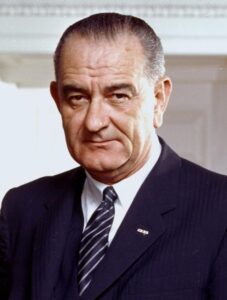
Arnold Newman, via Wikimedia Commons · Public domain · Source