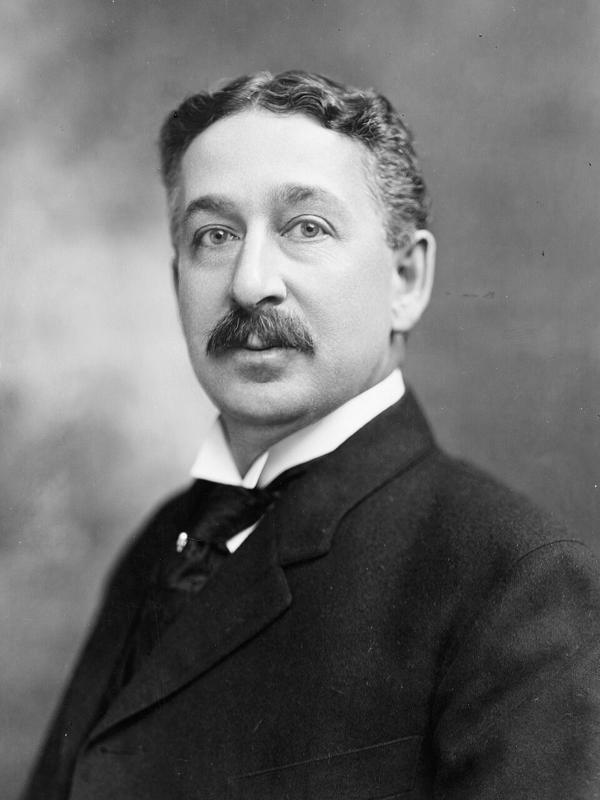
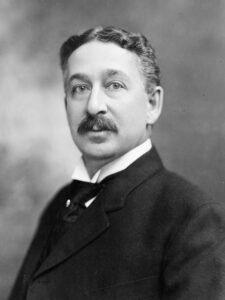
King C. Gillette
Born January 5, 1855, Fond du Lac, Wisconsin · Died July 9, 1932, Los Angeles, California · Adelphi Lodge, Quincy, Massachusetts; later Columbian Lodge, Boston
King C. Gillette brought the safety razor with disposable blades to market, changing how millions of men shaved and pioneering the razor-and-blades model.
I advocate a system of united intelligence and material equality, under which system, the perfection of the machinery of production and distribution would be the constant and watchful care of the individual and collective mind.
A Fond Du Lac Salesman Who Wanted Something That Would Sell Again
King Camp Gillette was born in Fond du Lac, Wisconsin, on January 5, 1855. His ancestors had come to Massachusetts from England in 1630, but his own childhood followed the Midwest. His father was a sometime patent agent and a persistent tinkerer; his mother’s years of experiments produced a cookbook, published in 1887, that remained in print for a hundred years. The family moved to Chicago in 1859, then—after the Great Fire of 1871 destroyed their hardware-supply business—to New York City. At seventeen Gillette became a traveling salesman who improved the goods he sold as readily as he pitched them. By 1890 he held four patents. More important, a company president taught him that disposable items, used up and bought again, made for steady sales.
On the road he shaved with a Star Safety Razor, a heavy, wedge-shaped blade fitted perpendicular to its handle. A straight razor would have been dangerous in the lavatory of a rumbling train, but even the Star still needed frequent sharpening on a leather strop, and eventually wore past sharpening. One morning in 1895, now living in Boston, he imagined a thin square of sheet steel, sharp enough to shave and cheap enough to throw away when it grew dull. Metallurgists at the Massachusetts Institute of Technology told him it could not be done. It took six years to find William Emery Nickerson, an engineer trained there, who devised a machine that would harden, hone, grind and sharpen the thin blades Gillette wanted.
Fifty-One Razors in the First Year, Then Millions of Blades
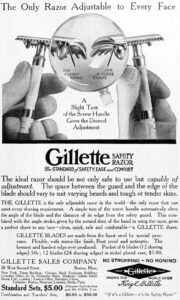
In 1901 Gillette and Nickerson formed the American Safety Razor Company, with Gillette as president. It was soon renamed the Gillette Safety Razor Company. For the first time, blades were sold in multiple packages, and the handle was a one-time purchase. Production began in 1903, and advertising followed that October, first in Systems Magazine. That year the company sold just 51 razor sets, at $5 each, and 168 blades; by 1904 razor sales had jumped to about 90,000. Gillette received United States patent 775,134 on November 15, 1904, on an application filed December 3, 1901. The specification set out his main object: a safety razor that did away with the need to hone or strop the blade, with a holder that took a blade having two cutting edges, so that the life of each blade might be doubled.
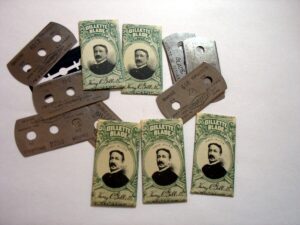
His portrait appeared on the blade wrappers, eventually reaching tens of billions of packages. A London sales office opened in 1905, and by 1909 there were manufacturing plants in Paris, Montreal, Berlin and Leicester, England. In 1910 Gillette sold a substantial portion of his controlling share to the company’s major investor, John Joyce, for about $900,000. He kept the title of president and visited foreign branches, but he no longer managed the company’s day-to-day affairs. During the First World War the United States government ordered 3.5 million razors and 36 million blades to supply its troops, making the razor standard issue and introducing a huge number of men to self-shaving with a disposable blade. After the war, veterans needed blades to fit the razors they had been issued.
When the patent expired in 1921, the company was ready. It brought out a “new improved” razor at the old price, renamed the old model the Silver Brownie and sold it for a dollar, and gave razor handles away as premiums with other products, building customers for the more profitable blades. Royal patronage followed: in 1922 the company became purveyor to the Prince of Wales and in 1924 to King Gustav V of Sweden, and its Paris office presented Charles Lindbergh with a gold traveling set the day after his transatlantic flight. By 1926 the company was already producing 2.1 million blades each day.
The Human Drift, and a World Corporation
In his writing Gillette remained an opponent of competition even as he built a business on it. In The Human Drift, published in Boston in 1894, he rejected the familiar claim that “competition is the life of trade,” and proposed that the people form a united stock company large enough to absorb production and distribution. In the preface, dated August 1, 1894, he wrote that he advocated “a system of united intelligence and material equality.” He described a great central city, “Metropolis,” near Niagara Falls, whose power would drive the machinery of production. The people would live in circular apartment buildings of steel, brick, glass and tile, run as part of a single machine of production and distribution, with walks and gardens between them. He estimated that, with a national population of seventy million, some sixty million people would occupy twenty-four thousand such buildings.
He returned to the idea in later books, including World Corporation (1910), in which he published a charter filed in the Territory of Arizona that June, with offices in the Beacon Building at 6 Beacon Street, Boston, and with himself as president. The corporation’s capital stock was to be unlimited and progressive, and its purpose was to gather the world’s material assets into one corporate body. Two earlier volumes, Gillette’s Social Redemption (1907) and Gillette’s Industrial Solution (1908), had been written by M. L. Severy to set out Gillette’s views. He hoped the profits of the razor company might finance these plans. The social designs never took hold. At the end of the 1920s a patent suit from the AutoStrop Safety Razor Company ended in a merger, after which AutoStrop’s owner, Henry J. Gaisman, found that the company had over-reported its earnings for five years by about $3 million. The stock, at $125 early in 1929, fell as low as $18, and Gillette resigned as nominal president. Patent battles, corporate infighting and the crash of 1929 depleted his personal fortune. He died in Los Angeles on July 9, 1932, at the age of seventy-seven.
Adelphi Lodge in Quincy, Then Columbian Lodge in Boston
Gillette was raised a Master Mason in Adelphi Lodge in Quincy, Massachusetts, in June 1901, the same year he and Nickerson formed the razor company. He demitted from Adelphi in January 1904 and affiliated with Columbian Lodge in Boston in April 1909.
How did Gillette’s success in business compare with the social ideals he described in The Human Drift?
Sources
- Lemelson Program at the Massachusetts Institute of Technology — King Gillette
- National Inventors Hall of Fame — King Camp Gillette
- FundingUniverse — The Gillette Company History
- Grand Lodge of British Columbia and Yukon — King Camp Gillette (citing Grand Lodge of Massachusetts Trowel, 2003)
- King C. Gillette, The Human Drift (1894), Internet Archive
- King C. Gillette, World Corporation (1910), Internet Archive
- United States patent 775,134, “Razor,” issued November 15, 1904
Life & Masonic Timeline
Benjamin Joseph Falk, via Wikimedia Commons · Public domain · Source