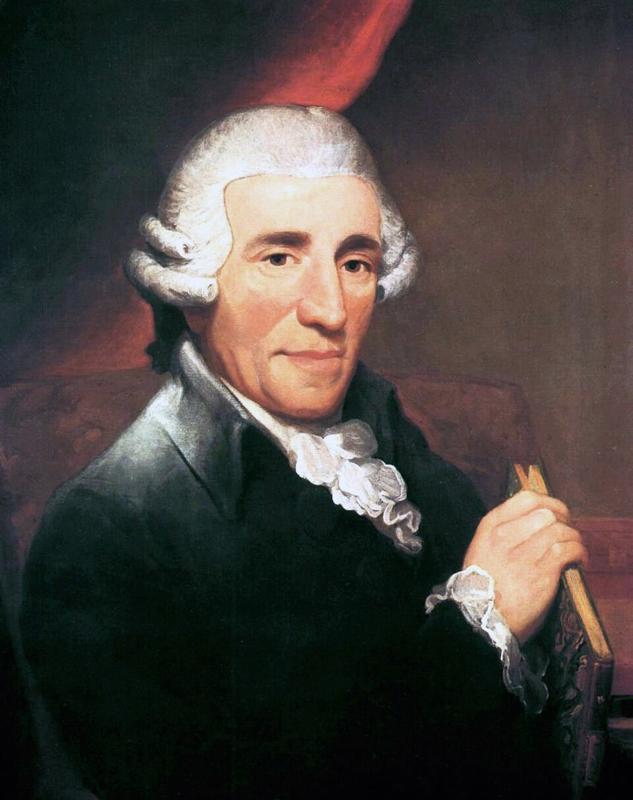
Joseph Haydn
Born March 31, 1732, Rohrau, Lower Austria · Died May 31, 1809, Vienna · Zur wahren Eintracht (True Concord), Vienna
Joseph Haydn shaped the classical symphony and string quartet, wrote The Creation and The Seasons, and gave lessons to the young Beethoven.
From Rohrau and St. Stephen’s to the Esterházy Court
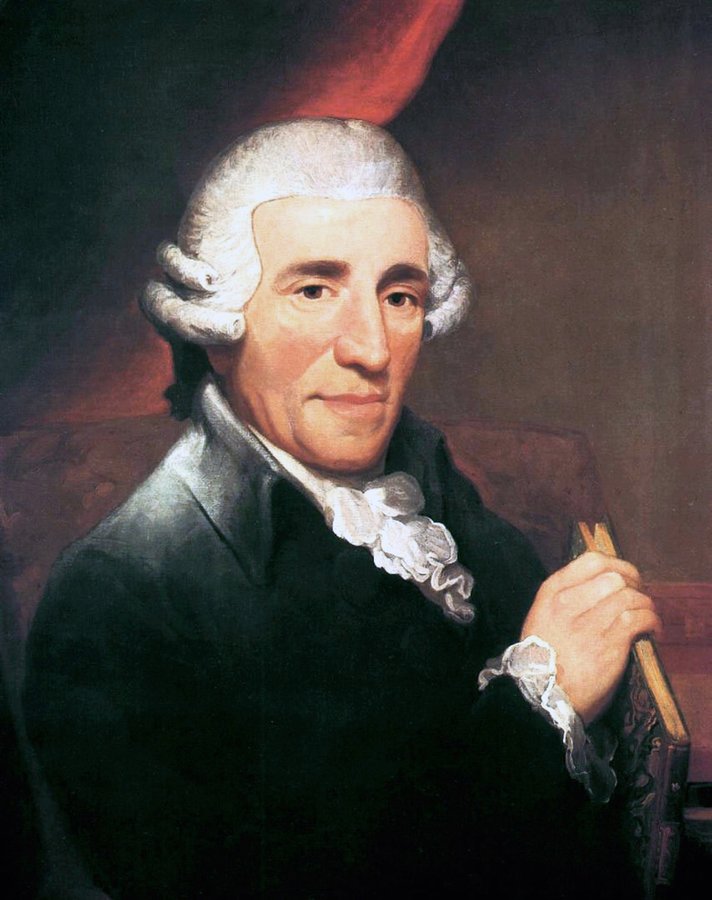
Franz Joseph Haydn was born on March 31, 1732, in Rohrau, Lower Austria, the son of a wheelwright, and was raised in a Catholic household. A visiting schoolmaster noticed his aptitude and persuaded his parents to send him, at six, to a parish school in neighboring Hainburg, where he received his first formal musical training. At eight he entered the choir school of St. Stephen’s Cathedral in Vienna and remained there nearly ten years, leaving around 1749 when his voice broke. He was dismissed with no income and no roof over his head. By 1751 he was living in an unheated garret in the Michaelerhaus, across from the Hofburg, and patching together a living from lessons and church work: sixty gulden a year to accompany Mass for the Brothers of Mercy in Leopoldstadt at eight in the morning, Count Haugwitz’s chapel at ten, and singing at St. Stephen’s at eleven for seventeen kreuzers. His first string quartets, written for Baron Karl Joseph von Fürnberg, caught on quickly, and in 1764 they became the first of his works printed abroad, in Paris, without his knowledge. They led to his first real post. In about 1757 Count Morzin made him Kapellmeister at a salary of two hundred gulden a year plus bed and board, and for the count’s musicians he wrote his first symphony and a set of divertimenti for wind instruments.
On May 1, 1761, Prince Paul Anton Esterházy engaged him as vice-Kapellmeister, responsible for the secular side of the court chapel, while Gregor Joseph Werner remained in charge of church music. Paul Anton died on March 18, 1762, and his brother Nikolaus, later called “the Magnificent,” succeeded him. After Werner’s death in 1766, Nikolaus promoted Haydn to Kapellmeister, with responsibility for chamber music, church music, and music for the theater. Haydn served the family for nearly forty years, working by turns at Eisenstadt, Fertőd (Esterháza), and Vienna. He composed for the court’s own musicians and directed performances, including operas in the prince’s theater. Comic works on librettos by Carlo Goldoni—among them Lo speziale (1768), Le pescatrici (1769–1770), and Il mondo della luna (1777)—and the dramatic Armida (1783) belong to those years. Between about 1768 and 1772 he also wrote symphonies in a tense, experimental manner later associated with the term Sturm und Drang. During visits to Vienna in the 1770s and 1780s, his quartets took on the conversational style that became their hallmark. The Haydn-Haus credits him with 107 symphonies, more than 70 string quartets, 24 operas, 14 Masses, and concertos for keyboard, violin, and cello.
Two London Seasons, an Oxford Doctorate, and the Creation
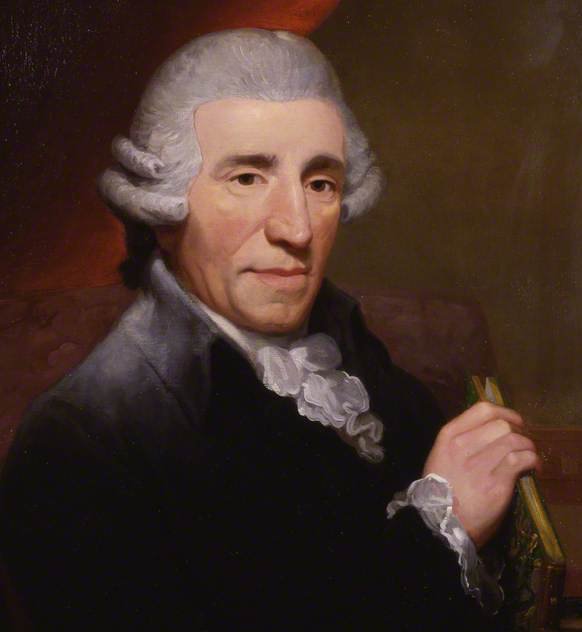
In the mid-1780s he began to gain financial independence from his patrons by selling works to publishers in Vienna, London, and Paris, and by commissions such as The Seven Last Words of Our Saviour on the Cross (1785–1786), written for the cathedral at Cádiz. His music also travelled widely in France, where the six Paris Symphonies, Nos. 82 to 87, and Nos. 88 to 92 owed their existence to Claude-François-Marie Rigoley, Comte d’Ogny, a driving force behind the Concert de la Loge Olympique.
Prince Nikolaus died in 1790. His successor, Paul Anton II, dissolved the court orchestra to reduce expenses and pensioned Haydn, who kept his salary and title. The violinist and concert promoter Johann Peter Salomon came for him in person, and Haydn later recalled his words: “I am Salomon from London and have come to fetch you.” For five thousand gulden Haydn agreed to write an opera, six new symphonies and other works and to conduct them himself. Mozart objected that he could not even speak English. “My language is understood all over the world,” Haydn replied. He accepted the invitation and stayed in England from January 1, 1791, until the middle of 1792. He was received by royalty, composed Symphonies Nos. 93 to 98, and was deeply impressed by a Handel festival in Westminster Abbey in 1791. In July of that year, Oxford University conferred on him the honorary degree of Doctor of Music. After returning to Vienna he bought a house and accepted Ludwig van Beethoven as a pupil. A second visit to England, commissioned by Salomon for six new symphonies, lasted from February 1794 to August 1795 and was even more successful, artistically and financially, than the first.
When Nikolaus II restored the Esterházy orchestra in 1795, he reengaged Haydn as Kapellmeister. Haydn kept his home in Vienna and composed only for special occasions. Between 1796 and 1802 he wrote six settings of the Mass. In 1797 he composed “Gott erhalte Franz den Kaiser,” later adopted as Austria’s national anthem. His chief work in those years was the oratorio Die Schöpfung (The Creation), first performed privately in Vienna in 1798, followed by Die Jahreszeiten (The Seasons), first performed in 1801. The Haydn-Haus regards these as founding works of the secular oratorio. Hearing Handel’s music in England had helped turn Haydn toward that large form.
His health declined. In 1804 the pianist and composer Johann Nepomuk Hummel was appointed concertmaster at the Esterházy court as Haydn’s duties became harder to fulfill. He made his last public appearance on March 27, 1808, days before his seventy-sixth birthday, when Antonio Salieri conducted The Creation in the Great Hall of the Old University in Vienna before the city’s leading figures. Haydn died in Vienna on May 31, 1809, during the French occupation of the city, then the most celebrated composer in Europe. He was first buried in the Hundsthurm cemetery; Prince Nikolaus II later had his remains moved to the Bergkirche in Eisenstadt, where so much of his working life had been spent. He is sometimes called the father of the symphony and of the string quartet; the Haydn-Haus locates his decisive achievement in the development of sonata form, the establishment of the quartet, and the deepening of the symphony.
True Concord, and an Evening of Mozart’s Quartets
Freemasonry was fashionable among educated Viennese under Emperor Joseph II, and it caught Haydn’s interest as he looked for reasons to get away from Eszterháza. On February 11, 1785, he was initiated in the lodge Zur wahren Eintracht, or True Concord, one of the city’s most distinguished lodges. Its secretary recorded him in the minutes as Joseph Haydn, son of Mathias, a Catholic of Rohrau, aged fifty-one, by occupation director of Prince Esterházy’s orchestra.
The next day, at Mozart’s apartment, Haydn heard the string quartets Mozart had written and dedicated to him. Mozart’s father, Leopold, was there and wrote to his daughter what Haydn told him: “Before God and as an honest man I tell you that your son is the greatest composer known to me either in person or by name; he has taste, and, furthermore, the most profound knowledge of composition.”
Haydn’s lodge did not outlast the year. Under a decree issued by the emperor that year, Vienna’s eight lodges were merged into a few, and True Concord ceased work on December 28, 1785, joining the lodge Zur Wahrheit, or Truth. Haydn’s name was struck from the membership roll in 1786. From the sources we do have, it is believed that he later visited the Viennese lodge Zur neugekrönten Hoffnung, or Hope Crowned Anew, in Mozart’s company between 1786 and 1790.
Which Haydn work best shows why later composers learned so much from him?
Sources
- Haydn-Haus Eisenstadt — Joseph Haydns musikalisches Leben
- Encyclopedia.com — Franz Joseph Haydn
- Grand Lodge of British Columbia and Yukon — Franz Joseph Haydn
- Joseph Haydn Stiftung Basel, Haydn2032 — About Joseph Haydn
- The Alberta Freemason, Grand Lodge of Alberta — Bro (Franz) Joseph Haydn, by Robert E. Juthner (April 2006)
Life & Masonic Timeline
Thomas Hardy, via Wikimedia Commons · Public domain · Source