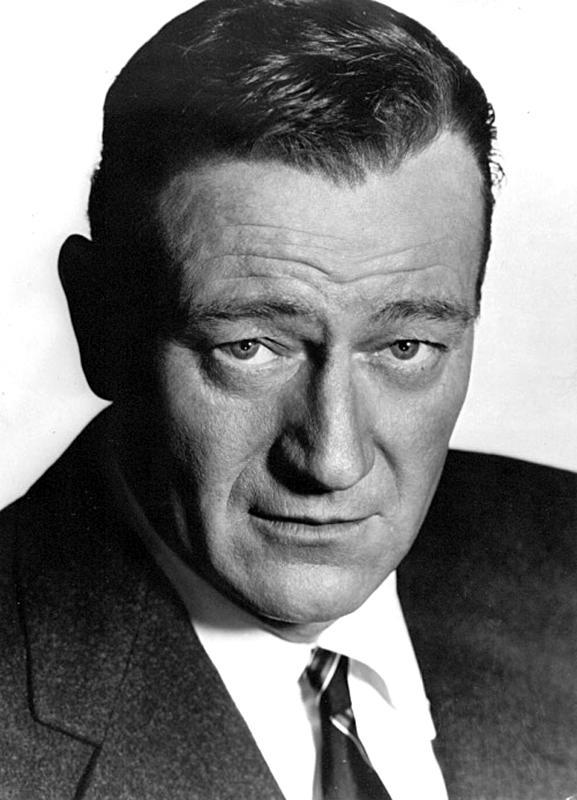
John Wayne
Born May 26, 1907, Winterset, Iowa · Died June 11, 1979, Los Angeles, California · Marion McDaniel Lodge No. 56, Tucson, AZ
John Wayne became the defining star of the Hollywood Western in films such as Stagecoach and The Searchers, and won an Oscar for True Grit.
A Winterset Boy Called Duke, After His Dog
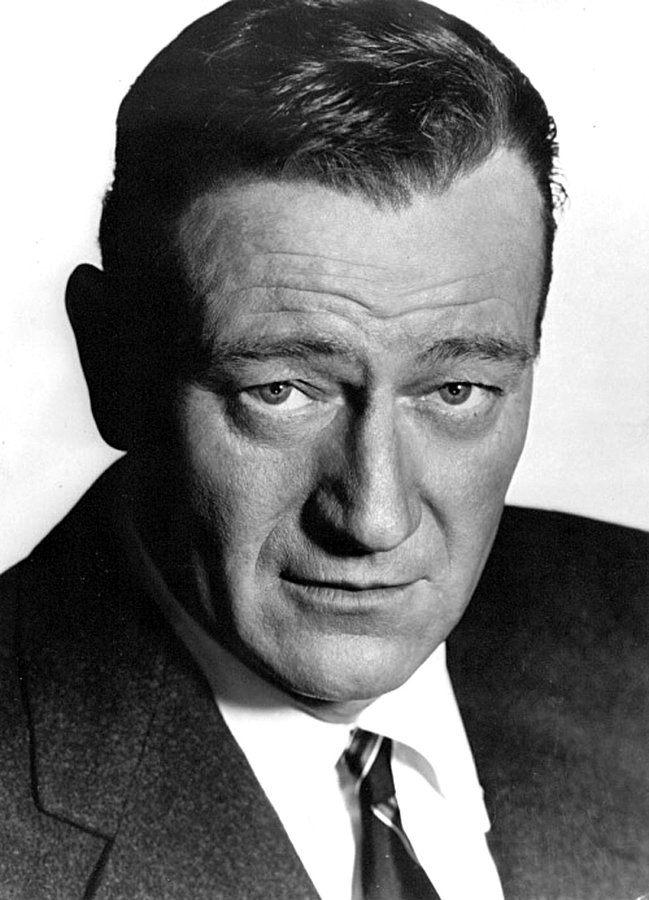
John Wayne was born Marion Robert Morrison on May 26, 1907, in Winterset, Iowa, to Clyde Leonard Morrison, a pharmacist, and Mary “Molly” Alberta Brown. In 1914 the family moved to Glendale, California, with his younger brother, Robert. From the age of twelve he helped in his father’s drugstore and took other odd jobs. A local firefighter nicknamed him “Duke,” after the Airedale terrier he walked, and he preferred the name for the rest of his life. At Glendale High School he played on the 1924 championship football team and served as president of the Latin Society. He hoped for the United States Naval Academy but was not admitted. His parents were divorced in 1926. A football scholarship took him to the University of Southern California, where he studied pre-law and joined the Trojan Knights and Sigma Chi. A bodysurfing injury broke his collarbone; he lost the scholarship and had to leave the university after two years.
A Prop Man, a New Name, and Eight Years of Small Westerns
Work as a property man at the Fox studio, beginning while he was still at the university, led to small parts, including early films for the director John Ford, at first under the name Duke Morrison. Through Ford’s help he was given the leading role in Raoul Walsh’s The Big Trail, and a new screen name: studio executives are said to have taken “Wayne” from the Revolutionary War general “Mad Anthony” Wayne. The expensive picture was not a success, and Fox dropped him. Through the 1930s he worked mostly on what was called Poverty Row, appearing in more than fifty features and serials, nearly all Westerns, and even, in a few, as a character billed “Singing Sandy.” Tall, able to do his own stunts, he seemed likely to remain a lead in low-budget pictures. Ford, with whom he had stayed friends, then cast him as the Ringo Kid in Stagecoach in 1939. The film was a hit and a turning point. Exhibitors voted him one of the year’s top ten box-office attractions, a ranking he held in twenty-three of the next twenty-four years.
Ford, Hawks, and an Oscar for Rooster Cogburn
During the Second World War, while a number of other leading men entered the armed forces, Wayne continued to work in Hollywood. He appeared in a series of military pictures, among them Flying Tigers, The Fighting Seabees, Back to Bataan and Ford’s They Were Expendable. Howard Hawks later cast him as the cattleman Tom Dunson in Red River in 1948. Ford’s cavalry pictures Fort Apache, She Wore a Yellow Ribbon and Rio Grande followed between 1948 and 1950. Sands of Iwo Jima, in which he played Marine Sergeant John Stryker, brought an Academy Award nomination. In 1952 he starred for Ford, opposite Maureen O’Hara, in The Quiet Man. The Searchers, in 1956, gave him one of his most demanding roles, as Ethan Edwards, a Civil War veteran whose racism and obsessive hunt for a kidnapped niece drive the film. Hawks’s Rio Bravo followed in 1959. Wayne directed and starred as David Crockett in The Alamo in 1960, then returned to Ford for The Man Who Shot Liberty Valance in 1962. In 1968 he co-directed and starred in The Green Berets, a film that spoke for American involvement in the Vietnam War. From the mid-1940s he had become known for conservative politics: he served as head of the Motion Picture Alliance for the Preservation of American Ideals, and he later supported Republican candidates including Barry Goldwater and Richard Nixon.
He won the Academy Award for Best Actor for True Grit in 1969, as the aging marshal Rooster Cogburn, and returned to the character opposite Katharine Hepburn in 1975. His final film, The Shootist in 1976, cast him as a gunfighter dying of cancer. He was married three times, to Josephine Saenz, Esperanza Bauer and Pilar Palette, and had seven children. In 1964 he publicly announced that he had overcome lung cancer, but a form of the disease later returned. Over a career of some fifty years he appeared in more than two hundred films.
“John Wayne, American,” and a Fight Carried on with Grit
In the spring of 1979, with Wayne gravely ill, Congress took up a bill to strike a gold medal in his honor. On May 21 Maureen O’Hara, his co-star in five films and his friend of thirty-nine years, flew in from St. Croix and spoke to a House subcommittee without a prepared statement. “To the people of the world, John Wayne is not just an actor,” she said through tears. “John Wayne is the United States of America.” She asked that the medal say just one thing: “John Wayne, American.” The act authorizing it, with those words required on its face, was approved on May 26, 1979, his seventy-second birthday.
He died of cancer on June 11, 1979, at the University of California, Los Angeles, Medical Center, and is buried at Pacific View Memorial Park in Corona del Mar. The finished gold medal was presented to his family on March 6, 1980, and that June President Jimmy Carter awarded him the Presidential Medal of Freedom, calling him “both an example and a symbol of true American grit and determination,” and asked Mrs. John Wayne to come forward to receive it. Wayne had beaten lung cancer in 1964 and spent his last years wanting to help others facing the disease; in 1985 his family founded the John Wayne Cancer Foundation, which funds research, surgical fellowships, education and patient support.
Marion McDaniel Lodge No. 56 — Three Degrees in Three Days
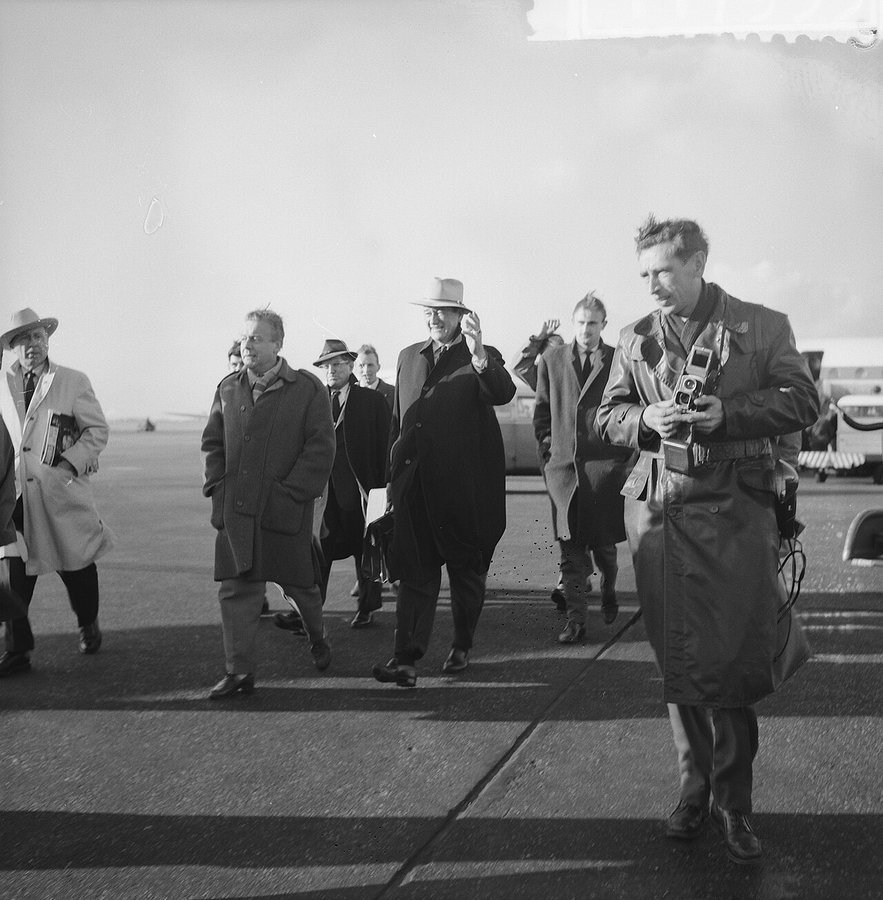
Wayne had been an active member of the Glendale Chapter of DeMolay as a young man, and his father had been a Mason before him. In 1970, after decades as a star, he received the DeMolay Legion of Honor and became a Master Mason in Marion McDaniel Lodge No. 56 in Tucson, Arizona. He wanted camaraderie away from the limelight, and he later recalled that in lodge his fame seemed to melt away. His Craft degrees were conferred on three consecutive days: initiated on July 9, passed on July 10 and raised on July 11. In December he joined California York Rite bodies and became a Shriner in Al Malaikah Temple. He also received the thirty-second degree of the Scottish Rite. His Craft membership began late, in the year of his Oscar, and lasted until his death. His lodge long called itself “The Duke’s Lodge,” and in 2026 it consolidated with Oasis Lodge No. 52 under the Grand Lodge of Arizona as Marion McDaniel Lodge No. 52.
Which Wayne performance most challenges the familiar image of his screen persona?
Sources
- Encyclopedia.com, International Dictionary of Films and Filmmakers — John Wayne
- Encyclopedia.com, UXL Encyclopedia of World Biography — John Wayne
- John Wayne Birthplace & Museum
- Marion McDaniel Lodge No. 52 — About Us
- Grand Lodge of British Columbia and Yukon — John Wayne
- Cowboys & Indians — Maureen O’Hara’s Tribute to John Wayne
- United States Government Publishing Office — Public Law 96-15, May 26, 1979
- The American Presidency Project — Presidential Medal of Freedom Remarks at the Presentation Ceremony, June 9, 1980
- John Wayne Cancer Foundation — About
- CoinWeek — John Wayne Congressional Gold Medal (1980): A Collector’s Guide
Life & Masonic Timeline
Unknown photographer, via Wikimedia Commons · Public domain · Source