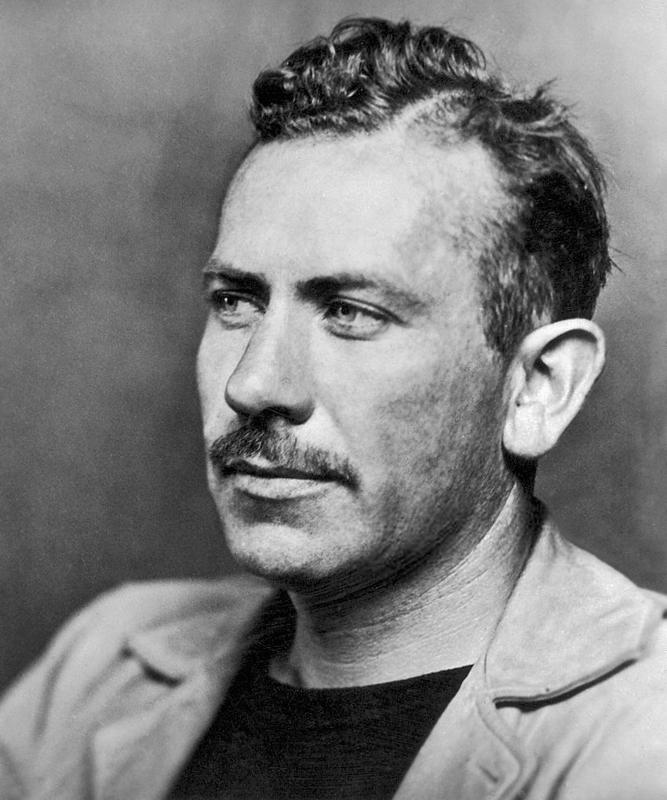
John Steinbeck
Born February 27, 1902, Salinas, California · Died December 20, 1968, New York City, New York · Salinas Lodge No. 204, California
John Steinbeck gave America’s migrant workers a voice in The Grapes of Wrath and Of Mice and Men, and won the Nobel Prize in Literature in 1962.
The writer is delegated to declare and to celebrate man's proven capacity for greatness of heart and spirit—for gallantry in defeat—for courage, compassion and love.
A Salinas Boy Who Worked the Fields Before He Wrote Them
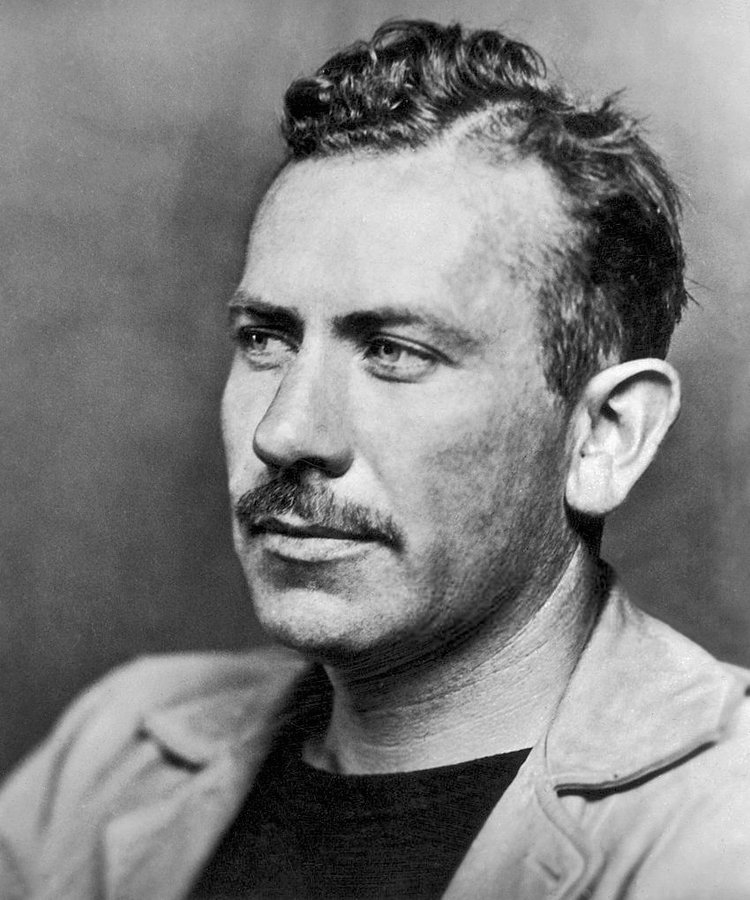
John Ernst Steinbeck Jr. was born on February 27, 1902, in Salinas, California, the only son of John Ernst Steinbeck, a bookkeeper who served for many years as Monterey County treasurer, and Olive Hamilton, a former teacher who gave him a love of reading. His favorite book, he later said, was Sir Thomas Malory’s Le Morte d’Arthur. The family belonged to the Episcopal Church. He decided in high school that he wanted to write, played sports, and in the summers worked on ranches, seeing at first hand the migrant labor that later filled his fiction. He graduated from Salinas High School in 1919. He studied English literature at Stanford University for six years, supporting himself as a laboratory assistant and farm laborer, and left in 1925 without a degree, taking only the courses that interested him. That year he traveled to New York by freighter, through the Panama Canal, and tried to establish himself as a reporter and freelance writer; he also worked on a construction crew at Madison Square Garden. The attempt failed, and he returned to California.
From Tortilla Flat to the Grapes of Wrath
His first novel, Cup of Gold, a story about the privateer Henry Morgan, appeared in 1929. In January 1930 he married Carol Henning in Los Angeles. As work grew scarce, his parents put the couple up in a cottage in Pacific Grove, near Monterey, and helped them with a loan and with paper for him to write. There he formed a close friendship with the marine biologist Ed Ricketts, who taught him and hired both John and Carol in his laboratory; their later collaboration produced The Sea of Cortez. Early books including The Pastures of Heaven (1932), To a God Unknown and The Red Pony (both 1933) found little notice. The breakthrough came with Tortilla Flat in 1935, linked stories about the paisanos of Monterey, which brought him a wide audience and, later, a film.
In Dubious Battle (1936) turned to a strike among migratory fruit pickers. Of Mice and Men followed in 1937, the story of two migrant laborers, including Lennie, a physically powerful man with an intellectual disability; it was soon adapted for the stage and for film. The Long Valley collected short stories in 1938.
His biggest book began as newspaper work. In the summer of 1936 George West, editorial page editor of the San Francisco News, asked him to report on the migrants pouring into California from the Dust Bowl. Off and on for eighteen months he drove an old bakery truck through the Central Valley, from the roadside Hoovervilles of Kern County to the new federal camp at Arvin, near Bakersfield. Its manager, Tom Collins, kept reports running to some thirty pages a week on the campers, their jobs, their sicknesses and their songs. Steinbeck read them, traveled with Collins, interviewed families with him, and helped him bring food to the destitute and care for the sick. The News ran his series, “The Harvest Gypsies,” in October 1936 with Dorothea Lange’s photographs. Collins became the model for the kindly camp manager in The Grapes of Wrath, and the book’s dedication reads, in part, “To Tom who lived it.”
Published on April 14, 1939, the novel followed Oklahoma tenant farmers, unable to live from their land, on a journey to California that ended in migrant work rather than security. More than 45,900 copies went to bookstores before publication day, and its 83,361 sales in the first month were a record for its publisher, Viking Press. It was the best-selling book of 1939 and won the Pulitzer Prize in 1940. Californians were less pleased: many said it misrepresented conditions, growers resented its portrait of them, and Kern County banned it from 1939 to 1941.
A War Correspondent, East of Eden, and a Lion’s Roar in Stockholm
During the Second World War he served as a foreign correspondent for the New York Herald Tribune, accompanying American forces on raids, including an invasion of an island off the Italian coast, and sustaining shrapnel wounds. He wrote the story for Alfred Hitchcock’s film Lifeboat and later asked that his name be taken off the credits, believing the finished picture carried racist messages he rejected. Later fiction included Cannery Row (1944), The Pearl (1947) and East of Eden (1952), his longest novel, which his third wife, Elaine, later said he considered his finest; a 1955 film version was the screen debut of James Dean. In 1947 he was among the first well-known Americans to travel in the Soviet Union, an experience recorded in A Russian Journal, and he was elected to the American Academy of Arts and Letters. For Travels with Charley (1962) he made a three-month journey by truck through forty states with his poodle, Charley. The Winter of Our Discontent, in 1961, studied the moral decline of a man of high ideals. He received the Nobel Prize in Literature in 1962, and at the banquet in Stockholm on December 10 he set aside modesty, saying the honor impelled him “not to squeak like a grateful and apologetic mouse, but to roar like a lion out of pride in my profession.” Speaking in the shadow of nuclear weapons, he argued that a writer’s old commission was to expose humanity’s faults and to celebrate its capacity for courage, compassion and love, and that a writer who did not believe in the perfectibility of man had no membership in literature. In his later years he gave a broad support to American policy, including the war in Vietnam, which cost him the admiration of some who had once praised his social commitments. He and Elaine spent a period in Somerset, in England, while he researched the Arthurian legends; an unfinished book on King Arthur was published after his death, in 1976. He died in New York City on December 20, 1968.
Man himself has become our greatest hazard and our only hope.
— John Steinbeck
Salinas Lodge No. 204 — Four Years a Mason
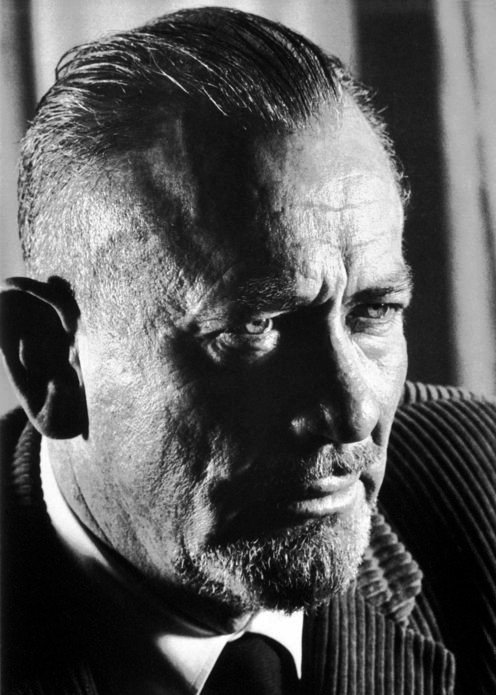
Steinbeck was initiated in Salinas Lodge No. 204 on March 1, 1929, passed on April 12 and raised a Master Mason on May 24, in the year his first novel appeared. He withdrew on July 21, 1933, and never held lodge office. His father was also a Freemason. Masonic references appear in novels written long after those four years of membership: in East of Eden, Adam Trask joins the fraternity later in life; in The Winter of Our Discontent, a Templar sword and uniform form part of a family’s history.
How did Steinbeck turn the work he saw in California’s fields into stories with a national audience?
Sources
- Nobel Prize — John Steinbeck, Biographical
- Encyclopedia.com, UXL Encyclopedia of World Biography — John Steinbeck
- Grand Lodge of Ohio — John Steinbeck
- Grand Lodge of British Columbia and Yukon — John Steinbeck (Grand Lodge of California records)
- The Steinbeck Institute, Stanford University — Migrants and Misdeeds
- Library of America — The Grapes of Wrath at Seventy-Five: 1939–2014
- Nobel Prize — John Steinbeck, Banquet Speech
Life & Masonic Timeline
McFadden Publications, Inc.; no photographer credited; photo likely the work of Sonya Noskowiak, as Steinbeck is wearing the same clothes from her 193, via Wikimedia Commons · Public domain · Source