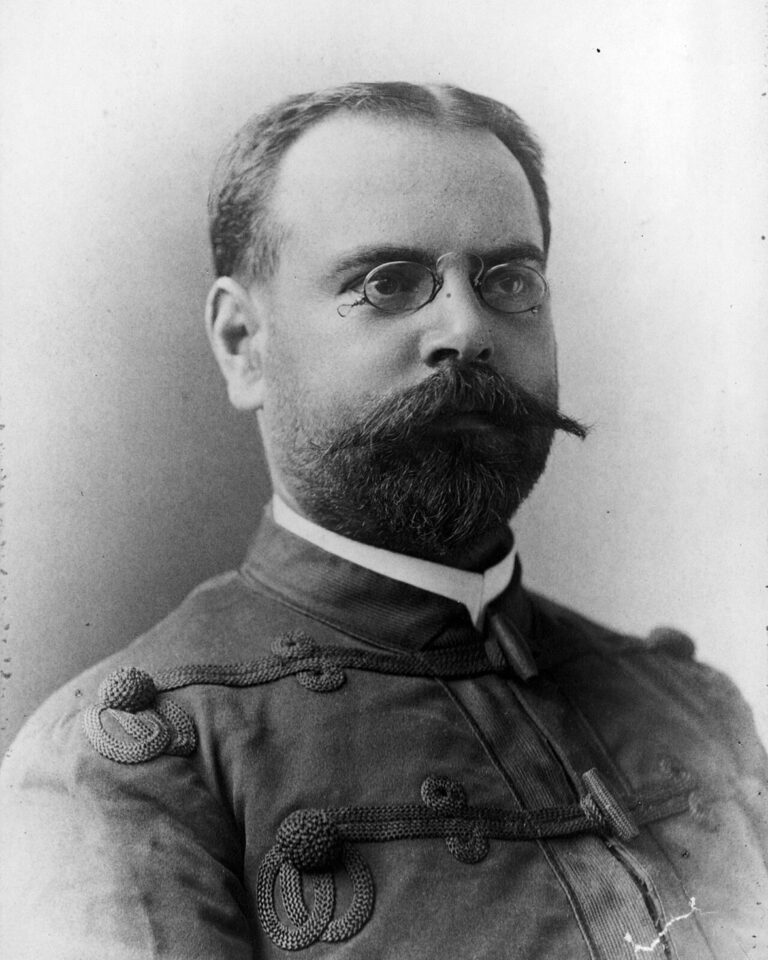
John Philip Sousa
Born November 6, 1854, Washington, D.C. · Died March 6, 1932, Reading, Pennsylvania · Hiram Lodge No. 10, Washington, D.C. (now Hiram-Takoma Lodge No. 10)
The Marine Band’s young leader
John Philip Sousa was born in Washington, D.C., on November 6, 1854, the third of ten children of João António de Sousa and Maria Elisabeth Trinkhaus. His father played trombone in the United States Marine Band, and music filled the house. The boy started lessons at an evening conservatory and soon learned violin, piano, flute, several brass instruments and voice. He had perfect pitch and was composing before he was a teenager.
At thirteen he began studying with George Felix Benkert, and that same year his father enlisted him in the Marine Corps as an apprentice musician. Because he signed on as a minor, he served until he turned twenty-one. When the apprenticeship ended in 1875 he went out into civilian life as a violinist and found his first taste of conducting in theater pit orchestras.
In 1880 he came back to the Marine Band, this time as its leader. Over the next twelve years he served five presidents, from Rutherford B. Hayes to Benjamin Harrison, and turned a respectable service band into the country’s premier military ensemble. He demanded precision, rebuilt the band’s library and changed its instrumentation. Recordings by the Columbia Phonograph Company spread its sound across the country. His own marches did the rest. “Semper Fidelis” became the march of the Marine Corps, and “The Washington Post” (1889) became so popular on both sides of the Atlantic that he was called the March King.
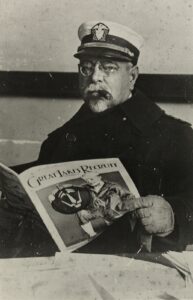
In 1892 he left the Marines to form his own civilian band. The Sousa Band toured from 1892 to 1931 and gave 15,623 concerts, including performances at the Paris Exposition and London’s Royal Albert Hall. Dissatisfied with the tubas of his day, he asked the instrument maker James Welsh Pepper for a horn that would send its sound up and over the band. The result was the sousaphone. When the United States entered the First World War, Sousa, then sixty-two, accepted a commission in the Naval Reserve and led the Navy band at Great Lakes, giving most of his naval salary to a relief fund for sailors and Marines. He wrote about 130 marches, fifteen operettas, novels and instruction books, and he was still conducting the day before he died, in Reading, Pennsylvania, on March 6, 1932.
A march for every American occasion
Few composers are heard as often as Sousa, and few by so many people who never learn his name. Every Fourth of July, every high school band field show and every military parade carries some of his music. In 1987 Congress made “The Stars and Stripes Forever” the national march of the United States.
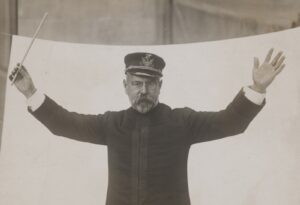
His real contribution was larger than any single tune. He showed that popular music could be played with the discipline of the concert hall, and that a band could be a serious artistic enterprise. He took American music to audiences across Europe at a time when Americans were expected to import their culture, not export it.
He was also a man of habits worth admiring. The historian Paul Bierley described him as disciplined, approachable and tolerant, with very high moral standards and a constant concern for how best to serve his audiences. He was ambitious and he was famous, but he never stopped working at his craft, and he gave his wartime pay to men who needed it more.
Fifty-one years in Hiram Lodge
Sousa came to Freemasonry as a young married man at the head of the Marine Band. He was initiated in Hiram Lodge No. 10 in Washington, D.C., on July 15, 1881, passed on September 2 and raised a Master Mason on November 10, 1881. He never transferred his membership, and he remained a Master Mason in that same lodge for fifty-one years. The lodge, now Hiram-Takoma Lodge No. 10 after later mergers, still names him as a lifetime member.
He kept on in the York Rite. In September 1886 he was exalted in Eureka Chapter No. 4, and that December he was knighted in Columbia Commandery No. 2, Knights Templar. On April 21, 1922, he joined the Shrine at Almas Temple in Washington and was named honorary leader of its band.
Three of his best-known marches have Masonic origins: “The Crusader” (1888), “The Thunderer” (1889) and “Nobles of the Mystic Shrine” (1923). He first conducted the Shrine march in June 1923 with a massed band of about 6,200 players, the largest he ever led, wearing a red Almas fez. In his band’s later years, close to half of its members were Shriners. When he died, a Masonic memorial service was held at his grave in Congressional Cemetery on March 10, 1932. For half a century, the March King kept time with his Brothers as faithfully as he kept it on the podium.
Sousa stayed in the same lodge for fifty-one years and never transferred. What keeps a man faithful to one lodge for a lifetime, and what can lodges learn from members like him?
Sources
- Scottish Rite, NMJ, The Marching Mason: John Philip Sousa: https://scottishritenmj.org/blog/john-philip-sousa-freemason
- John Philip Sousa Foundation (Jari Villanueva), Sousa the Master Mason: https://sousamusic.com/sousa-the-master-mason/
- Hiram-Takoma Lodge No. 10, About: https://www.ht10.org/about
Life & Masonic Timeline
John Philip Sousa, c. 1890-1910. Library of Congress. Via Wikimedia Commons. · Public domain · Source