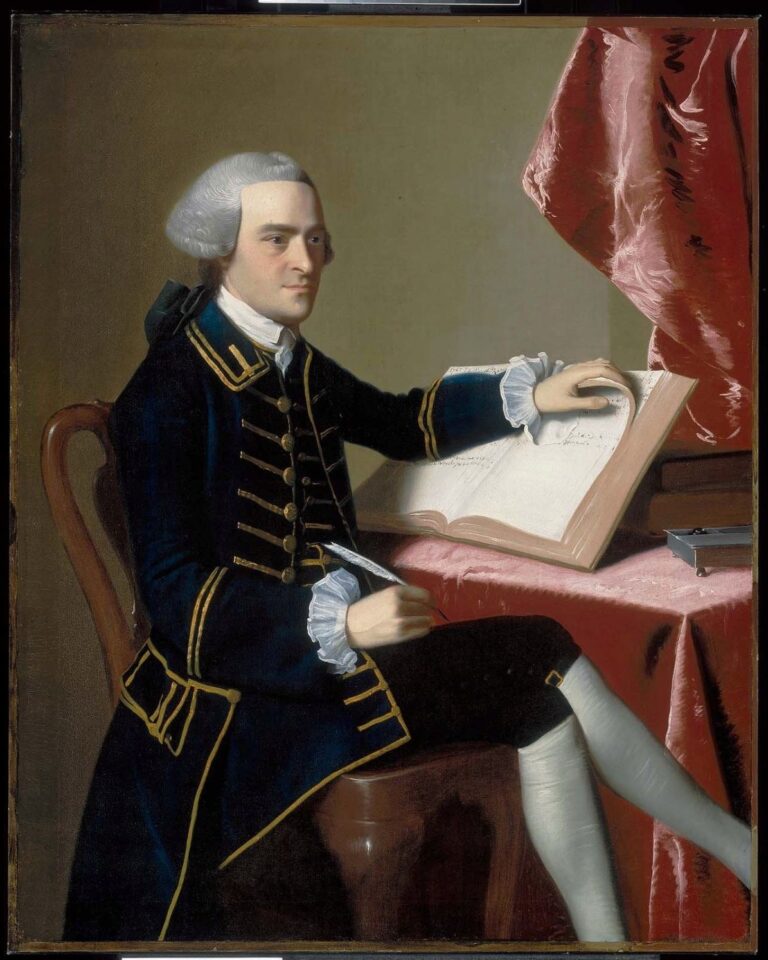
John Hancock
Born January 23, 1737, Braintree, Massachusetts · Died October 8, 1793, Boston, Massachusetts · Merchants Lodge, Quebec; affiliated with the Lodge of Saint Andrew, Boston (1762)
Some boast of being friends to government; I am a friend to righteous government, to a government founded upon the principles of reason and justice; but I glory in publicly avowing my eternal enmity to tyranny.
A merchant’s heir in a restless town
John Hancock was born in Braintree, Massachusetts, on January 23, 1737. (By the old calendar then in use, the date was January 12.) His father, a clergyman, died when John was seven, and the boy was taken in by his uncle Thomas Hancock, one of the richest merchants in Boston. He grew up in his uncle’s household.
The National Park Service is frank about what came next: his rise required no small amount of privilege. When Thomas Hancock died in 1764, John inherited the business and, almost overnight, became one of the wealthiest men in the colony. That same year he was elected one of Boston’s selectmen. Wealth gave him a platform. What he did with it made him a public figure.
Britain’s new taxes struck merchants first, and Hancock joined the boycotts of the Stamp Act and the Townshend Acts. In 1768 customs officials seized his sloop Liberty and accused him of smuggling. After a widely publicized trial, the charges were dropped, probably for lack of evidence. The case made him a hero to Boston’s patriots. In 1773 he moderated the Faneuil Hall town meeting on the Tea Act, which declared anyone who bought the tea an enemy of America. The Boston Tea Party followed.
The signature that outlived the man
When Governor Thomas Gage dissolved the provincial assembly, its members met at Concord as a Provincial Congress and elected Hancock president. In April 1775, as British troops marched toward Concord, he and Samuel Adams fled to avoid arrest. He went on to Philadelphia and the Continental Congress, which promptly and unanimously elected him its president.
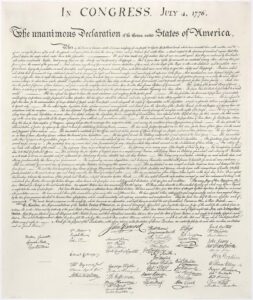
He held that office when the Declaration of Independence was adopted in 1776, and as president he signed it first. Early printed copies carried only his name. His name and the Declaration became so closely linked that the signature is now his most famous trait. That fame has a way of hiding the rest of his career. He served as president of Congress for about two and a half years, returned to Massachusetts in 1777 and was elected the state’s governor in 1780. He held the office until 1785, stepped away for a year, returned in 1786 and served until his death in Boston on October 8, 1793.
Hancock was never known as a great writer or speaker. The Park Service notes that he was an odd choice to give the 1774 Boston Massacre oration, and that Bostonians came to hear him because they liked him, not because of his eloquence. He was a merchant who lent his name, money and standing to a cause that could easily have ruined him. Signing first, in large letters, was a personal risk as much as a flourish.
A Brother among Boston’s patriots
Hancock’s Masonic story begins far from Boston. According to the historian Hans Schwartz, writing for Quatuor Coronati Lodge No. 2076 in London, he was raised in the Merchants Lodge at Quebec, which made him a member under Boston’s St. John’s Grand Lodge, and in 1762 he affiliated with the Lodge of Saint Andrew in Boston. The exact dates of his degrees are not given in the sources we have read, so we leave them blank.
The Lodge of Saint Andrew mattered to the Revolution. In 1764 its members bought the Green Dragon Tavern, which Daniel Webster later called the headquarters of the Revolution. The Grand Lodge of Massachusetts lists Hancock with Paul Revere and Joseph Warren among the Sons of Liberty who belonged to the lodge. Hancock also sat with the Moderns as a dual member and, as Schwartz shows, stood near the top of a movement whose leaders often met first as Brothers. His clerks William Palfrey and John Lowell were members too, and Schwartz finds Palfrey and Hancock attending lodge together as early as May 14, 1761. On the night of Paul Revere’s ride in April 1775, it was Revere and Brother John Lowell who carried Hancock’s chest of papers to safety. On the night of the Tea Party, St. Andrew’s secretary recorded that the lodge closed early “on account of the few Members present.”
Historians should be careful here, and so should we. The Grand Lodge of Massachusetts notes that Hancock is generally acknowledged not to have taken part in the Tea Party itself, and Schwartz himself concludes that Freemasonry was not the cause of the Revolution. It did, he argues, bring many of its leaders together, and it offered a network that reached across the colonies. Hancock’s life fits that picture. The lodge did not make him a patriot, but it put him in a room with the men he would risk everything beside.
Hancock’s wealth gave him a platform, and he spent it on a cause that could have ruined him. What does responsible use of privilege look like for a Mason today?
Sources
- National Park Service, John Hancock: https://www.nps.gov/people/john-hancock.htm
- Hans Schwartz, “Freemasonry in Revolutionary Boston,” Quatuor Coronati Lodge No. 2076 (via 1723constitutions.com): https://www.1723constitutions.com/wp-content/uploads/2021/01/Schwartz.pdf
- Grand Lodge of Massachusetts, Massachusetts Freemasons Commemorate Boston Tea Party Connections: https://massfreemasonry.org/news/massachusetts-freemasons-celebrate-boston-tea-party-connections/
Life & Masonic Timeline
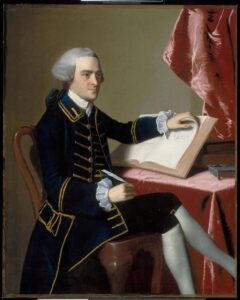
John Hancock, 1765. John Singleton Copley. Museum of Fine Arts, Boston. Via Wikimedia Commons. · Public domain · Source