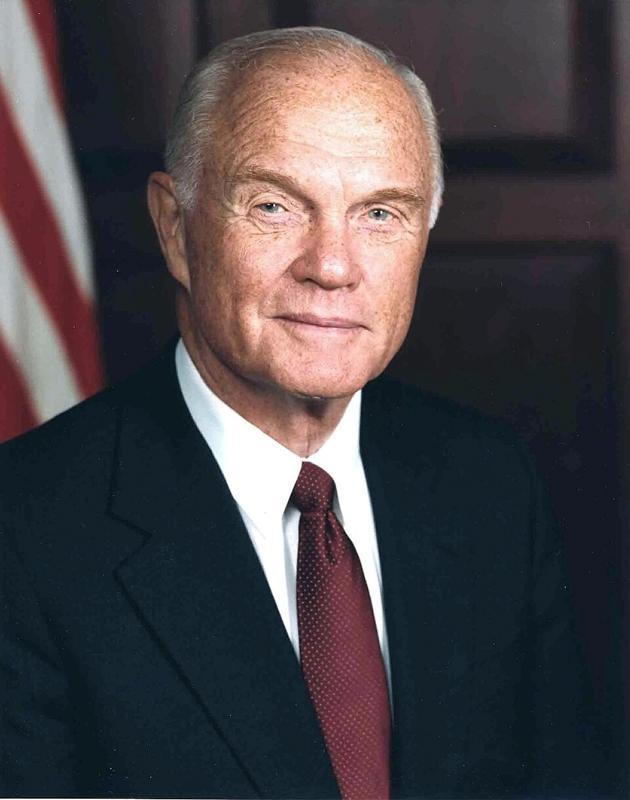
John Glenn
Born July 18, 1921, Cambridge, Ohio · Died December 8, 2016, Columbus, Ohio · Concord Lodge No. 688, New Concord, Ohio
John Glenn became the first American to orbit the Earth in 1962, served four terms as a senator from Ohio, and flew in space again at age 77.
Whether I would be the one that goes up or not, I think they should start this program, whether I'm the one involved with it or not, because it's that important.
From New Concord and the Marine Corps to a Transcontinental Record
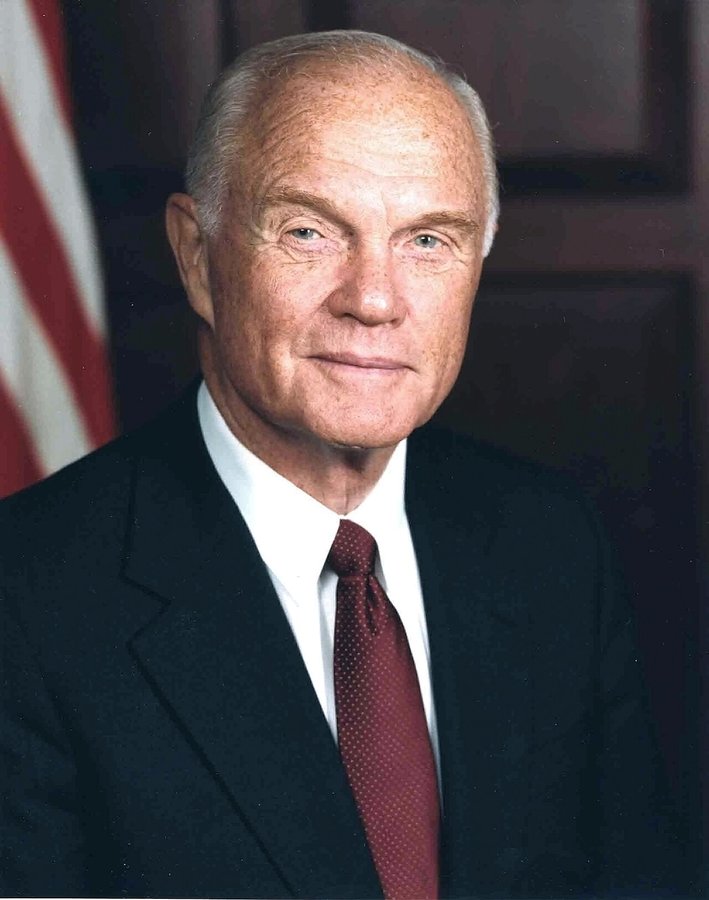
John Herschel Glenn Jr. was born on July 18, 1921, in Cambridge, Ohio, and attended schools in New Concord. He received a bachelor of science degree in engineering from Muskingum College there. He entered the Naval Aviation Cadet Program in March 1942, was commissioned in the Marine Corps in 1943, and, after advanced training, joined Marine Fighter Squadron 155, flying F-4U fighters in the Marshall Islands. He flew 59 combat missions in the Second World War. After the war he served with Marine Fighter Squadron 218 on the North China patrol and on Guam, then as an instructor in advanced flight training at Corpus Christi, Texas, from June 1948 to December 1950.
In Korea he flew 63 missions with Marine Fighter Squadron 311 and, as an exchange pilot with the Air Force, 27 more in the F-86 Sabre. In the last nine days of fighting he shot down three MiG aircraft along the Yalu River. In all he flew 149 combat missions in the two wars, and he received the Distinguished Flying Cross six times and the Air Medal with 18 clusters. He attended Test Pilot School at the Naval Air Test Center, Patuxent River, Maryland, and later served in the Fighter Design Branch of the Navy Bureau of Aeronautics in Washington from November 1956 to April 1959. In July 1957, as project officer for the F-8U Crusader, he set a transcontinental speed record from Los Angeles to New York in three hours and 23 minutes, the first such flight to average supersonic speed. He accumulated nearly 9,000 hours of flying time, about 3,000 of them in jets.
Friendship 7, Four Hours and 55 Minutes, and the First American in Orbit
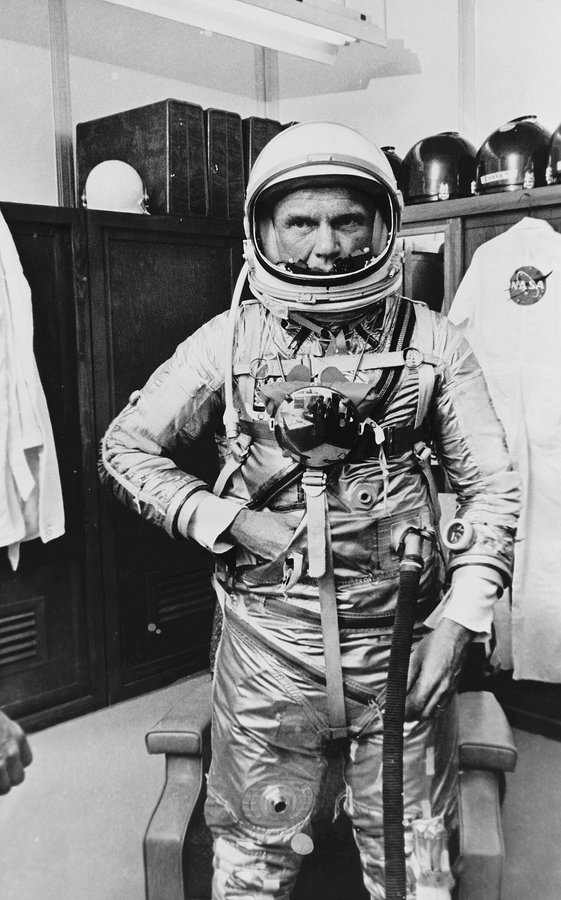
In 1959 Glenn was selected as one of the Mercury Seven astronauts of the National Aeronautics and Space Administration (NASA) and assigned to the Space Task Group at Langley, Virginia, in April. The group later moved to Houston and became part of the Manned Spacecraft Center, now the Johnson Space Center. Before his own orbital flight he served as backup pilot for Alan Shepard, the first American in space, who flew on May 5, 1961, and for Virgil “Gus” Grissom on the next suborbital mission. When astronauts were assigned to give pilots’ advice on spacecraft design, Glenn specialized in cockpit layout and control functioning, including some early designs for the Apollo program.
On February 20, 1962, he piloted the Friendship 7 capsule on the Mercury-Atlas 6 mission and became the first American to orbit the Earth. The flight lasted four hours and 55 minutes. President John F. Kennedy presented him with the NASA Distinguished Service Medal. Glenn later received the Congressional Space Medal of Honor and a long list of military decorations from the two wars and from his astronaut service. He resigned as an astronaut on January 16, 1964, was promoted to colonel in October 1964, and retired from the Marine Corps on January 1, 1965.
Four Senate Terms and a Discovery Flight at Seventy-Seven
After leaving NASA he became an executive with Royal Crown International and took an active part in Ohio politics and in environmental protection. In 1974 he won a Senate seat, carrying all 88 counties of Ohio. He was re-elected in 1980 with the largest margin in the state’s history, again in 1986, and in 1992, becoming the first popularly elected senator from Ohio to win four consecutive terms. He retired from the Senate in 1999. In his last term he was the ranking member of the Governmental Affairs Committee and of the Subcommittee on Air/Land Forces of the Senate Armed Services Committee, and he also served on the Select Committee on Intelligence and the Special Committee on Aging. He was regarded as one of the Senate’s leading experts on technical and scientific matters, worked to prevent the spread of weapons of mass destruction, and used the Governmental Affairs Committee to address waste in government and the cleanup of nuclear materials production plants.
In 1998, at the age of 77, Glenn returned to space on the STS-95 flight of the space shuttle Discovery, a nine-day mission. The crew deployed the Spartan solar-observing spacecraft and the Hubble Space Telescope Orbital Systems Test Platform, and Glenn conducted investigations on space flight and the aging process. The mission launched on October 29, 1998, and made him the oldest person to have flown in space. In 2000 he helped found the John Glenn Institute for Public Service and Public Policy, now part of the John Glenn College of Public Affairs, at The Ohio State University.
In 2012 President Barack Obama awarded him the Presidential Medal of Freedom, the highest civilian honor the nation can bestow, and he also received the Congressional Gold Medal. “The most important thing we can do is inspire young minds and advance the kind of science, math and technology education that will help youngsters take us to the next phase of space travel,” he said. “To me, there is no greater calling … If I can inspire young people to dedicate themselves to the good of mankind, I’ve accomplished something.” NASA announced his death on December 8, 2016. His wife was Annie Glenn.
A Petition in 1964, a Mason at Sight in Chillicothe, and a 33° Ring in Orbit
Glenn petitioned Concord Lodge No. 688 in New Concord in 1964 and was elected to receive the degrees, but his schedule delayed the work for 14 years. On August 19, 1978, Jerry C. Rasor, Grand Master of Ohio, made him a Mason at sight. The ceremony was held in the high school gymnasium at Chillicothe, the only building large enough for the hundreds of Masons who attended. When Glenn died he was a member of Malta Lodge No. 118. He received the Scottish Rite degrees in the Valley of Cincinnati on April 11, 1997, and the next year was named a Sovereign Grand Inspector General, a 33rd degree Scottish Rite Mason and honorary member of the Supreme Council. He wore that 33° ring on the Discovery flight in 1998. From the sources we do have, it is believed that his cap and that ring are now preserved at the Scottish Rite Masonic Museum and Library in Lexington, Massachusetts.
How did Glenn’s return to orbit at seventy-seven connect his work as an astronaut with his interest in aging?
Sources
- NASA — John H. Glenn
- NASA — NASA Remembers American Legend John Glenn
- Grand Lodge of Ohio — John Glenn
- Grand Lodge of Ohio — Brother John Glenn passes
- Scottish Rite, Northern Masonic Jurisdiction — Masonic astronauts
Life & Masonic Timeline
U.S. Senate Historical Office, via Wikimedia Commons · Public domain · Source