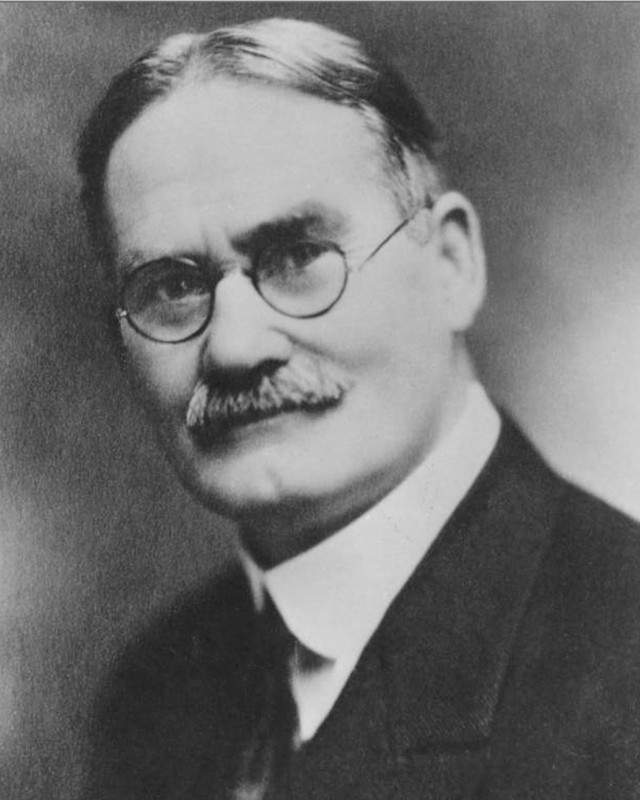
James Naismith
Born November 6, 1861, Almonte (Ramsay Township), Ontario, Canada · Died November 28, 1939, Lawrence, Kansas · Roswell Lee Lodge, Springfield, Massachusetts; later Lawrence Lodge No. 6, Kansas
James Naismith invented basketball in 1891 at a Springfield, Massachusetts, school for physical education instructors, and later coached the game at Kansas.
From a Ramsay Township Farm to McGill
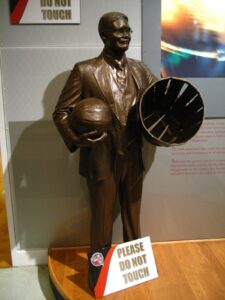
James Naismith was born on November 6, 1861, in Ramsay Township, near the mill town of Almonte in Ontario’s Ottawa Valley, the eldest son of Scottish immigrants John Naismith and Margaret Young. Orphaned as a boy, he and his sister Anne and brother Robbie were raised by their uncle, Peter Young, at Bennie’s Corners. He spent his free time at outdoor games, among them “duck on a rock,” in which a stone perched on a larger rock had to be knocked off by a thrown one. A high, arcing lob proved more effective than a hard straight throw — a lesson he later carried into basketball.
He left Almonte High School after two years to work on the family farm and in a logging camp, then returned and finished his equivalency in 1883. That fall he enrolled at McGill University in Montreal, where he studied philosophy and Hebrew and received a Bachelor of Arts in 1887. He was a standout athlete in lacrosse, football, rugby, soccer and gymnastics, won the Wicksteed gold medal as the top athlete of his graduating class, and started for three seasons on the football team. He then studied theology at Presbyterian College, paying his way by teaching physical education at McGill, where in 1889 he became the university’s first full-time athletics instructor. He took a diploma in theology in 1890, decided he could have a greater influence through sport than through a conventional ministry, and left Montreal for the International Young Men’s Christian Association Training School in Springfield, Massachusetts, the school now known as Springfield College.
Thirteen Rules and Two Peach Baskets
In Springfield he studied physical education under Luther Halsey Gulick, superintendent of the program and a leading voice in the field in the United States. Gulick wanted an indoor winter game “that would be interesting, easy to learn, and easy to play in the winter and by artificial light.” In December 1891 he gave Naismith, then a graduate student and instructor, the restless class that had already worn out two other teachers.
Naismith wanted a game that could be played indoors, by many players at once, with plenty of exercise but without the roughness of football or rugby in a confined space. He drew on passing from American rugby, the jump ball from English rugby, a goal from lacrosse, a soccer ball, and “duck on a rock.” The goal had to sit high, with a horizontal opening, so that the ball would be tossed rather than slammed through. The school janitor, asked for boxes, came back with two peach baskets, which Naismith nailed to the lower rail of the gymnasium balcony — ten feet above the floor — at each end. The ball had to be fished out after every score until, a few years later, the bottoms were cut out; by 1906 the peach baskets had given way to metal hoops with backboards.
He wrote thirteen rules, among them that a player could not run with the ball, and that shouldering, holding, pushing, tripping or striking an opponent was a foul. An umpire judged the players; a referee judged the ball and the goals. The game ran as two fifteen-minute halves with a five-minute rest. The first teams had nine men each: three centers, three forwards and three guards. The first game of “basket ball,” then two words, was played in December 1891. It was rough. “The boys began tackling, kicking, and punching in the clinches,” he recalled in January 1939. “They ended up in a free-for-all in the middle of the gym floor.… It certainly was murder.” The most important change, he said, “was that there should be no running with the ball. That stopped tackling and slugging.” The school held the first public game on March 12, 1892, before more than two hundred spectators. The rules had appeared on January 15, in The Triangle, the school magazine, which reached Young Men’s Christian Associations across the country. Students carried the game home, and international students took it abroad. Passing was at first the only way to move the ball; dribbling was part of the game by 1896. High schools and colleges adopted it, and by 1905 it was recognized as a permanent winter sport.
A Chaplain, Physician and Coach at Kansas
In 1894 he married Maude Sherman of Springfield; they had five children, Margaret, Helen, John, Maude and James. The next year they moved to Denver, where he served as physical education director at the Young Men’s Christian Association and earned a medical degree in 1898 from Gross Medical College. That year he joined the University of Kansas as an associate professor of physical culture and chapel director, and later became the university physician. He also founded the men’s basketball program and coached it to a record of 55–60 before handing the team, in 1907, to a former student, Forrest “Phog” Allen. Naismith remains the only Kansas basketball coach without a winning record. When Allen went to coach at Baker University, Naismith told him that basketball was a game to play and needed no coach. Allen later became known as the “father of basketball coaching.” Naismith himself preferred gymnastics and wrestling to his own invention. “I am sure that no man can derive more pleasure from money or power than I do from seeing a pair of basketball goals in some out of the way place,” he said. He detested segregation: through the 1930s he tried, without success, to get Black students onto the varsity Jayhawks, and he helped end the segregation of the university swimming pool.
In 1916 Naismith volunteered as a chaplain with the First Kansas Infantry of the Kansas Army National Guard and spent four months, from July to October, on the Mexican border after a raid by the revolutionary Pancho Villa, organizing sports, holding services and counseling soldiers. In September 1917 the Young Men’s Christian Association sent him to France as an overseas secretary; he spent nineteen months based in Paris and returned to Kansas in March 1919. He received an honorary master’s degree in physical education in 1910, became an American citizen on May 4, 1925, and retired from the university in 1937, the year Maude died, as professor emeritus at seventy-six.
Roswell Lee Lodge and the Master’s Chair in Lawrence
Naismith was initiated in Roswell Lee Lodge, in Springfield, in 1894, the same year as his marriage, while the game he had invented was spreading through schools and athletic associations. After he settled in Kansas he affiliated with Lawrence Lodge No. 6 and served as its Worshipful Master in 1927 and 1928.
An Olympic Tip-Off, and a Hall That Bears His Name
His biggest thrill came in 1936, when the National Association of Basketball Coaches sponsored his journey to Berlin to see basketball’s debut as an Olympic medal sport. He was there for the first match and threw the ball for the opening tip-off. The United States took the gold medal and Canada the silver. He presented medals to the winning teams and was named honorary president of the International Basketball Federation.
Naismith died at his home in Lawrence on November 28, 1939, eight months after the first national collegiate basketball championship was played. In 1959 he was among the inaugural class of the Basketball Hall of Fame, which took his name and first stood on the Springfield College campus. His original handwritten rules were sold at auction in December 2010 for $4.3 million and later given to the University of Kansas.
What did forbidding players to run with the ball change about the indoor game Naismith first put on a Springfield gym floor?
Sources
- Springfield College — Where Basketball Was Invented: The History of Basketball
- The Canadian Encyclopedia — James Naismith
- Kansas Historical Society, Kansapedia — James Naismith
- Naismith Memorial Basketball Hall of Fame — James Naismith
- University of Kansas, Kenneth Spencer Research Library — Personal Papers of James Naismith
- Grand Lodge of British Columbia and Yukon — Dr. James Naismith
- Grand Lodge of Ohio — The Architect of Basketball: James Naismith
Life & Masonic Timeline
Springfield College, via Wikimedia Commons · Public domain · Source