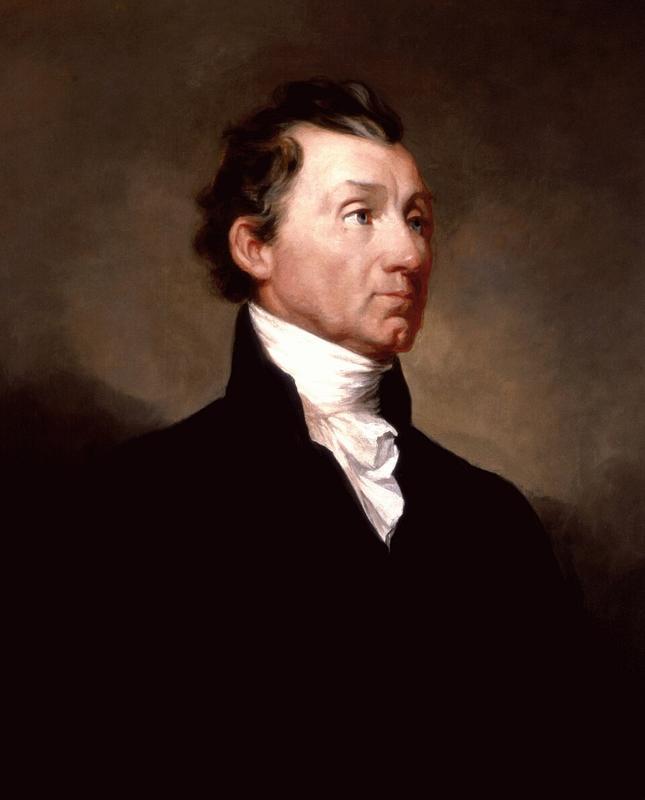
James Monroe
Born April 28, 1758, Westmoreland County, Virginia · Died July 4, 1831, New York City, New York · Williamsburg Lodge No. 6, Williamsburg, VA
James Monroe, the fifth President of the United States, set out the Monroe Doctrine and led the country through the Era of Good Feelings.
National honor is national property of the highest value.
A Seventeen-Year-Old Entered Apprentice at Williamsburg
James Monroe was born on April 28, 1758, in Westmoreland County, Virginia, into a prosperous, slave-owning planter family. His parents, Spence and Elizabeth Jones Monroe, sent him to a school run by the Reverend Archibald Campbell, where his time overlapped with that of John Marshall, later chief justice of the United States. Both parents died while he was still in his teens; an uncle, Joseph Jones, became a mentor and encouraged him to enter the College of William and Mary in 1774. Williamsburg was then in turmoil. After the royal governor fled, Monroe and fellow students raided the arsenal at the Governor’s Palace and carried off some two hundred muskets and three hundred swords for the Virginia militia.
He was initiated, at seventeen, in the lodge that became Williamsburg Lodge No. 6 on November 9, 1775. A candidate usually had to be at least eighteen. He would have entered as an Entered Apprentice, the first of the three Craft degrees. His dues remained paid through October 1780, but no record shows that he took further degrees in that lodge. The initiation preceded the formation of the Grand Lodge of Virginia, in 1778, by three years.
Monroe left college for the Continental Army, served as an officer in the Third Virginia Infantry, and joined General George Washington’s army in New York. At Trenton, in December 1776, he was severely wounded in the shoulder while leading a charge against a cannon. He was promoted to captain and then major and served on the staff of General William Alexander. Resigning his Continental commission in 1779, he was appointed a colonel in the Virginia service; in 1780 Governor Thomas Jefferson sent him to North Carolina to report on the British advance. After the war he studied law with Jefferson, served in the Virginia assembly and in the Continental Congress, and, in New York, met Elizabeth Kortright, the daughter of a merchant. They married on February 16, 1786, and settled in Fredericksburg, where he practiced law. Soon afterward he joined the Lodge at Fredericksburgh, now Fredericksburg Lodge No. 4. The James Monroe Museum preserves the apron presented to him on that occasion. After 1786 the record of his Masonic life is almost blank.
A Vote Against the Constitution, and the Purchase of Louisiana
As a delegate to Virginia’s ratifying convention, Monroe voted against the new Constitution, holding out for the direct election of the president and of senators and for a bill of rights. Those concerns helped bring about the first ten amendments in 1791. He narrowly lost a race for the House of Representatives to James Madison, then was appointed to the United States Senate in 1790. President Washington sent him to Paris as minister to France in 1794; there he obtained the release of Thomas Paine from prison. Recalled after the Jay Treaty strained relations with France, he returned to Virginia, was elected governor in 1799, and, in 1803, was sent by President Jefferson, with Robert Livingston, to secure access to the Mississippi and New Orleans. The two men instead negotiated the purchase of some 828,000 square miles for fifteen million dollars. The acquisition opened land to white settlement, often at Native peoples’ expense, and intensified the struggle over the expansion of slavery. Monroe later served as minister to Britain and, briefly, as a special envoy to Spain.
His own prosperity depended on enslaved labor. Over his lifetime he owned more than two hundred people across several properties, including Highland, the plantation he established near Jefferson’s Monticello. Some accompanied the family to Washington and the White House.
The Era of Good Feelings, and a Doctrine for the Hemisphere
Monroe served as secretary of state under James Madison and, for a time, also as secretary of war, before becoming the fifth president in 1817. He carried sixteen states in the Electoral College to three for the Federalist Rufus King. His first inaugural address, on March 4, called national honor “national property of the highest value.” A fifteen-week tour of the northern states, in the style of Washington, led a Boston newspaper to describe his reception as the beginning of an “Era of Good Feelings.” He later toured the Chesapeake and the South and West. The phrase did not erase hard problems: the Panic of 1819 brought unemployment and foreclosures, and in 1820 he signed the Missouri Compromise, which admitted Missouri as a slave state and Maine as a free state and barred slavery in the remaining Louisiana Purchase territory north of 36°30′. Working with Secretary of State John Quincy Adams, he also concluded the Adams–Onís Treaty of 1819, by which Spain ceded Florida. In 1820 he ran unopposed, the first uncontested presidential election since Washington’s; former President John Adams served as one of his electors in Massachusetts, and only one elector, Governor William Plumer of New Hampshire, cast his vote for someone else.
In his message to Congress on December 2, 1823, Monroe set out the policy later called the Monroe Doctrine: a warning against new European colonization in the Americas, and a claim of an American sphere of influence in the Western Hemisphere, coupled with a pledge to stay out of European wars.
Oak Hill, Old Debts, and a Funeral up Broadway
Monroe followed Washington, Jefferson and Madison in serving only two terms, and stayed neutral in the crowded race of 1824. After John Quincy Adams’s inauguration he remained in the White House for three weeks, because Elizabeth was too ill to travel, then retired with her to Oak Hill, in Loudoun County, Virginia. Decades in posts that paid modestly but demanded constant entertaining had left him deeply in debt, and he spent years pressing the federal government for tens of thousands of dollars he said it owed him; part of it was eventually repaid. He joined the Board of Visitors of Jefferson’s University of Virginia in 1826, presided over the Virginia Constitutional Convention in 1829, and began an autobiography he never finished.
Elizabeth died in 1830, and Monroe, at seventy-two, moved to New York City to live with his daughter and son-in-law. His health failed in the spring of 1831. He died on July 4, the third of the first five presidents to die on that date; John Adams and Thomas Jefferson had died on the Fourth five years earlier. Thousands of mourners followed his hearse up Broadway to the Gouverneur family vault in Marble Cemetery while church bells tolled and guns fired at Fort Columbus. His body was later moved to Hollywood Cemetery in Richmond.
How does the enslaved workforce at Monroe’s homes change the story of the expanding republic he helped lead?
Sources
- White House Historical Association — James Monroe
- Miller Center — James Monroe: Life in Brief
- Miller Center — James Monroe: Life Before the Presidency
- Miller Center — James Monroe: Domestic Affairs
- Miller Center — James Monroe: Foreign Affairs
- Miller Center — James Monroe: Life After the Presidency
- National Archives — Monroe Doctrine (1823)
- James Monroe Museum — Freemasonry & Monroe
- The Avalon Project, Yale Law School — First Inaugural Address of James Monroe, March 4, 1817
- Miller Center — James Monroe: Campaigns and Elections
Life & Masonic Timeline
Samuel Finley Breese Morse, via Wikimedia Commons · Public domain · Source