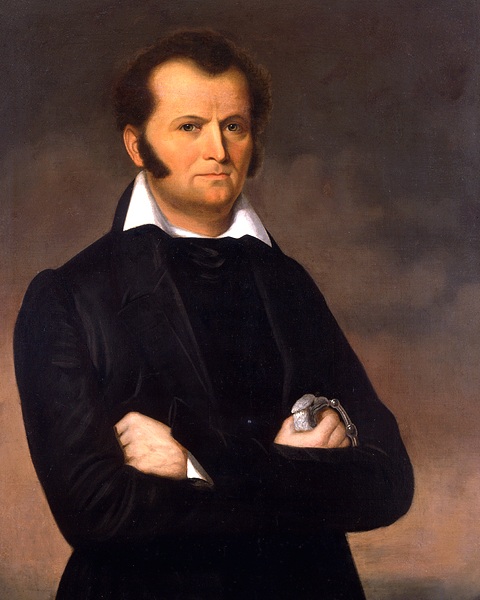
James Bowie
Born c. March 10, 1796, Kentucky / Tennessee border region (accounts vary) · Died March 6, 1836, The Alamo, San Antonio, Texas · Humble Cottage Lodge No. 19, Opelousas, Louisiana (believed membership)
Jim Bowie became known for the knife that bore his name and for his role in the Texas Revolution, dying among the defenders of the Alamo.
From Terrapin Creek to a Plantation Near Opelousas
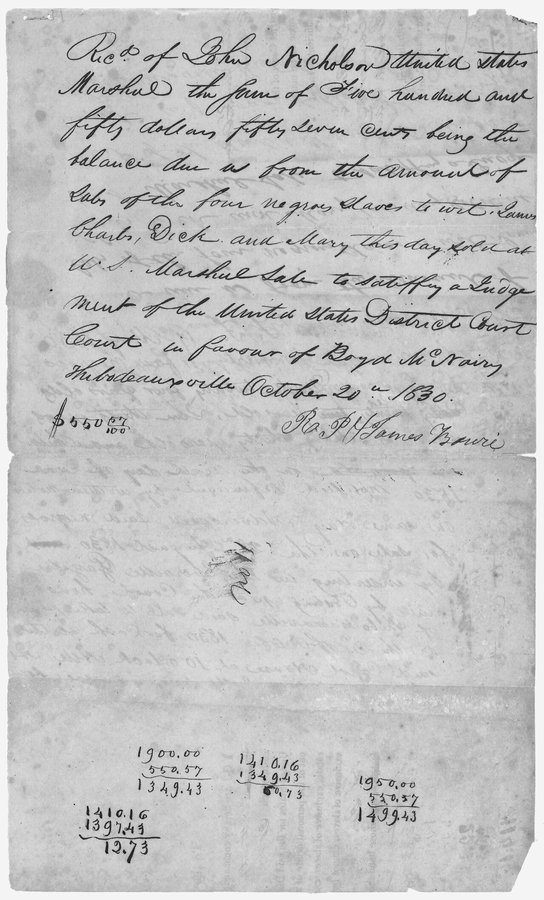
James Bowie was born near Terrapin Creek, in what was then Logan County, Kentucky, probably on April 10, 1796, the son of Reason (or Rezin) Bowie and Elve Ap-Catesby Jones. The family moved from Tennessee into Kentucky, then in 1800 to what is now Missouri, and in 1801 into Spanish Louisiana, where they settled first in present Catahoula Parish and, about 1809, in the Atakapa country. Reason developed a plantation near Opelousas, growing cotton and sugarcane and buying and selling enslaved people. In his teens James floated lumber to market in Avoyelles and Rapides parishes, invested in land on the Bayou Boeuf, and hunted. His brother John later described him as about six feet tall and 180 pounds, with light hair and “keen grey eyes.” During the War of 1812, James and Rezin P. Bowie joined a Louisiana unit; by family account they were on their way to Andrew Jackson at New Orleans when the war ended.
After the war the brothers trafficked in enslaved people obtained through the pirate Jean Laffite, who ran a market on Galveston Island. Laffite landed captives at Bowie’s Island in Vermilion Bay; the Bowies took them up the Vermilion and sold them in St. Landry Parish. When they had sixty-five thousand dollars they left that business. Their Arcadia plantation combined sugar production with speculation in land and enslaved labor, and operated a steam-powered sugar mill. In 1831 the brothers sold the plantation, other land and eighty-two enslaved people for ninety thousand dollars.
The Sandbar Fight, and a Knife the South Asked for by Name
On September 19, 1827, near Natchez, Bowie was present at a duel between Samuel Levi Wells III and Dr. Thomas Maddox. The principals exchanged shots without effect; the affair then became a general fight. Bowie was shot through the lower chest and in the thigh and stabbed in several places. An eyewitness said he “drew his butcher knife which he usually wears,” killed Norris Wright with it, and slashed another man. Witnesses remembered the “big butcher knife,” and reports of the encounter spread the weapon’s name; customers asked makers for knives like his. (Rezin had earlier given him a large hunting knife to carry.) Jesse Clifft, a blacksmith and a friend for whom William Barret Travis later did legal work, is often credited with making the first Bowie knife.
Texas Land, the Veramendis, and the Fight at Concepción
In 1830 Bowie traveled to Texas, took an oath of allegiance to Mexico, and began buying large eleven-league grants that Mexican citizens could obtain cheaply under a law of 1828. The speculation irritated Stephen F. Austin, who hesitated to approve some of the tracts. In San Antonio, Bowie attached himself to the wealthy Veramendi family, was baptized into the Catholic Church with their sponsorship, and on October 5, 1830, officially became a Mexican citizen. On April 25, 1831, he married Ursula de Veramendi. He declared his age as thirty-two (he was about thirty-five) and pledged a dowry of fifteen thousand dollars. The titles to a large Arkansas holding he valued in the marriage papers were fraudulent. The Bowies settled in San Antonio. In 1831 he led an expedition toward the ruined Santa Cruz de San Sabá Mission, in search of a rumored mine; six miles from San Sabá his party fought Native attackers for thirteen hours and then returned. In September 1833, Ursula, her parents, and, by family tradition, a child died of cholera at Monclova while Bowie, ill with yellow fever in Natchez, did not yet know of the deaths.
He had already taken part in the 1832 fighting at Nacogdoches, where he and a small party ambushed Mexican troops evacuating the town. In the autumn of 1835 he joined Stephen F. Austin’s volunteer army as a colonel. On October 28, in a heavy fog near Mission Concepción, Mexican forces attacked his detachment. After three hours Bowie’s men held the ground, captured a cannon and thirty muskets, and lost one man. Noah Smithwick later remembered him as “a born leader” who told the men, “Keep under cover boys and reserve your fire; we haven’t a man to spare.” The following month he took part in the Grass Fight, so called because the Mexican pack train proved to be carrying fodder for livestock. He had little interest in a formal, lasting command and twice asked to be relieved of it.
A Cot in the Alamo
On January 19, 1836, Bowie arrived at San Antonio from Goliad with about thirty men, carrying orders from Sam Houston that concerned the fortifications at the Alamo. On February 2 he wrote Governor Henry Smith that Bexar should be held as a strategic “frontier picqet guard.” Travis arrived with thirty men on February 3; David Crockett on the eighth. When Colonel James C. Neill left, the volunteers preferred Bowie as commander and elected him on February 12. On the thirteenth, Bowie and Travis agreed that Bowie would command the volunteers and Travis the regulars, with joint authority over garrison orders. On February 23, Mexican cavalry entered Bexar. Without consulting Travis, Bowie asked for terms; the demand that the Texans surrender was rejected. On February 24, suffering from a disease “of a peculiar nature”—later writers have often treated it as tuberculosis—he collapsed, ending his active command. He was confined to a cot, urged the volunteers to follow Travis, and was occasionally carried outside to visit his men. On March 6, Mexican troops stormed the mission before dawn. All the defenders died. Santa Anna asked to see the bodies of Bowie, Travis and Crockett; Francisco Ruiz, the mayor of Bexar, identified them. Bowie was found on his cot, in a room on the south side, shot several times in the head.
Loge L’Humble Chaumière, and a Lodge Inside the Alamo
From the sources we do have, it is believed that Bowie was a member of Loge L’Humble Chaumière, also known as Humble Cottage Lodge No. 19, in Opelousas, Louisiana, a lodge chartered in 1820. The lodge’s records were destroyed by fire in 1850, so the dates of his degrees are not known.
Texas Masons count him among the known Masons who died defending the Alamo, with James B. Bonham, David Crockett, Almeron Dickinson and William B. Travis. Twelve years after the siege, the Freemasons of San Antonio met within the same walls. After the Mexican War the United States Army’s Quartermaster Corps used the Alamo for storage and supply, and its quartermaster, Major James Harvey Ralston, a Freemason who had served in the Illinois legislature alongside Abraham Lincoln and Stephen Douglas, led army officers and local citizens in forming a lodge there. They fitted out a lodge room on the second floor of the Long Barrack, and the Grand Lodge of Texas chartered Alamo Lodge No. 44 on January 15, 1848, the first Masonic lodge in San Antonio and Bexar County. A plaque on the south wall of the Long Barrack marks the founding.
How does Bowie’s business in enslaved people complicate the frontier legend built around his name?
Sources
- Texas State Historical Association — James Bowie
- Masonry Today — The Battle of Nacogdoches (archived)
- Historical Marker Database — Humble Cottage Lodge No. 19
- Alamo Lodge No. 44 — About Alamo Lodge No. 44
Life & Masonic Timeline
Jim Bowie, c. 1831–1834. George Peter Alexander Healy. via Wikimedia Commons, cropped · Public domain · Source