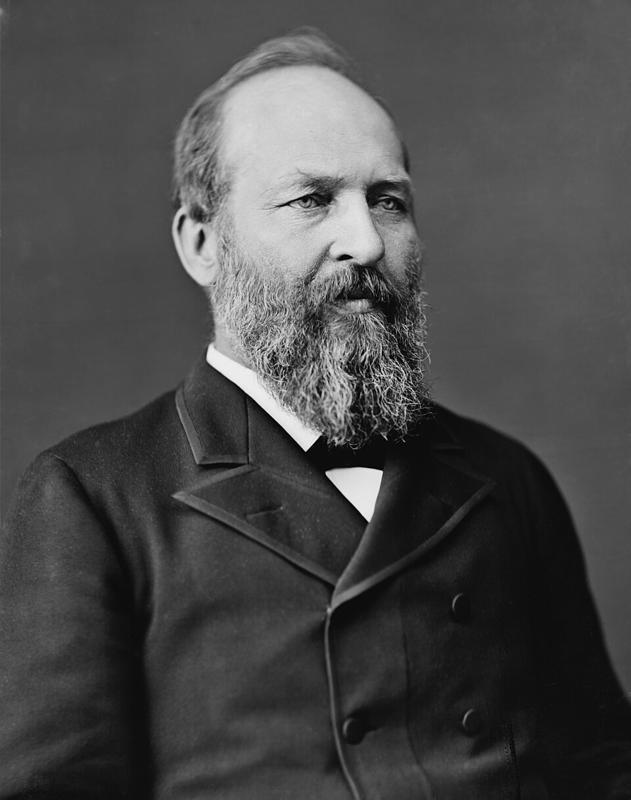
James a. Garfield
Born November 19, 1831, Orange Township (now Moreland Hills), Ohio · Died September 19, 1881, Elberon, New Jersey · Magnolia Lodge No. 20, Columbus, OH (raised in Columbus Lodge No. 30)
James A. Garfield rose from teaching and Civil War service to a long congressional career before an assassin cut short his presidency in 1881.
The elevation of the negro race from slavery to the full rights of citizenship is the most important political change we have known since the adoption of the Constitution of 1787.
A Cuyahoga County Log-Cabin Boy at Williams College
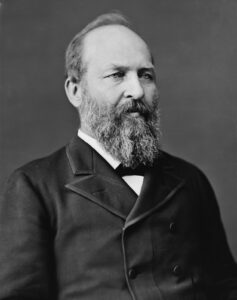
James Abram Garfield was born on November 19, 1831, on a frontier farm in Cuyahoga County, Ohio, the youngest of three living children. His father, Abram, died when James was two, and he grew up helping his widowed mother, Eliza, on a farm outside Cleveland. He was the last of the log-cabin presidents. He never knew his father, a strong man known for wrestling, and though James was good with his fists and loved the outdoors, he never liked farming; he dreamed of becoming a sailor. At sixteen he ran away to work on the canal boats that shuttled between Cleveland and Pittsburgh. In six weeks he fell overboard fourteen times and came home with a fever; while recovering he resolved to make his way with his mind rather than his strength. He worked as a carpenter and a part-time teacher, studied at Geauga Academy in Chester, Ohio, and from 1851 to 1854 at the Western Reserve Eclectic Institute in Hiram (later Hiram College), earning his keep as a janitor. In 1850, at eighteen, he was baptized into the Disciples of Christ, the Christian church of his parents.
In 1854, at twenty-three, he entered Williams College in western Massachusetts as a junior. He heard Ralph Waldo Emerson, took on the strong personality of the college’s president, Mark Hopkins, and graduated with honors in 1856. He was a serious student who also enjoyed hunting, fishing, billiards and drink in moderation, and refused to take the temperance pledge. He returned to the Eclectic Institute, formally as a teacher of classical languages but teaching English, history, geology and mathematics as well. By then he was a Disciples minister. He served as its president from 1857 to 1861. In 1858 he married Lucretia Rudolph, a classmate from the Institute; they had seven children. He read law on his own and passed the Ohio bar in 1861. In 1856 he campaigned in Ohio for John C. Frémont, and in 1859, as a Republican opposed to the extension of slavery, he was elected to the Ohio Senate, its youngest member. He did not condone John Brown’s raid on Harpers Ferry, but believed Brown’s trial and execution would “be the dawn of a better day.” When the Southern states began to leave the Union he urged the federal government to answer with force. “I am inclined to believe that the sin of slavery is one of which it may be said that without the shedding of blood there is no remission,” he said.
The 42Nd Ohio, and Seventeen Years in the House
In mid-August 1861 he organized the 42nd Ohio Infantry and rose quickly from lieutenant colonel to colonel. In January 1862, at Middle Creek in Kentucky, his outnumbered brigade defeated Confederate forces and left him in control of the eastern part of the state. At thirty-one he became a brigadier general. In September 1863, at Chickamauga, he made a daring ride under fire; by then he was a major general of volunteers and chief of staff to Major General William S. Rosecrans, commander of the Army of the Cumberland, though he undermined his superior by sending negative reports to the War Department. Ohioans had already elected him to Congress in 1862, without his having campaigned. President Abraham Lincoln persuaded him to resign his commission and take the seat, saying it was easier to find major generals than effective Republicans for Congress. Garfield entered the House in December 1863 and held it for seventeen years, becoming the leading Republican there. In the war years he was among the most radical Republicans in Congress; privately he thought Lincoln a “second-rate Illinois lawyer” who had failed to prosecute the war vigorously. Over eight terms he tempered that radicalism, often favored moderation toward the defeated South, and still voted to impeach President Andrew Johnson. He chaired the Banking and Currency, Appropriations and Military Affairs committees, sat on Ways and Means, and argued for a currency backed by gold against the inflationary mood of his own district. He called the Grange’s cooperative farm programs “communism in disguise,” opposed labor unions and the eight-hour day for federal workers, and in the depression of the 1870s opposed federally funded relief. He was among several congressmen identified with stock in Crédit Mobilier, a construction company for the Union Pacific Railroad; he said he had received $329 from the company. He also drew fire for voting for a retroactive salary increase and for links to a corrupt paving contract, and his 1874 reelection was hard fought. In 1876 he served on the electoral commission that awarded the contested presidency to Rutherford B. Hayes, and under Hayes he was Republican minority leader of the House.
Magnolia Lodge in Columbus, and Pentalpha in Washington
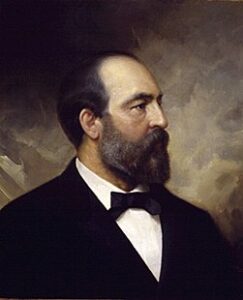
Garfield was initiated in Magnolia Lodge No. 20 in Columbus, Ohio, on November 19, 1861, his thirtieth birthday, and passed on December 23. The war delayed his advancement. Columbus Lodge No. 30 conferred the Master Mason degree for Magnolia on November 22, 1864, after he had left the army for Congress. He affiliated with Garrettsville Lodge No. 246 on October 10, 1866, and served as its chaplain in 1868 and 1869. He became a charter member of Pentalpha Lodge No. 23 in Washington on May 4, 1869, and was one of the petitioners for that lodge’s charter. He received the Royal Arch and Knights Templar degrees in 1866, and the fourteenth degree of the Scottish Rite, in the Lodge of Perfection, in 1872.
Robertson, Conkling, and the New York Customs House
At the deadlocked Republican convention in Chicago in June 1880, Garfield, heading the Ohio delegation, nominated Treasury Secretary John Sherman. After thirty-three ballots, with former president Ulysses S. Grant still leading, Wisconsin gave Garfield sixteen votes on the thirty-fourth. On the thirty-sixth the forces of James G. Blaine of Maine and of Sherman went over to him, and he won the nomination, 399 votes to Grant’s 306. The Ohio legislature had just chosen him for a United States Senate seat; he never occupied it. Chester A. Arthur, a New York Stalwart, was nominated for vice president. In one of the closest elections on record, Garfield defeated the Democrat Winfield Scott Hancock by 7,368 popular votes, with 214 electoral votes to Hancock’s 155, and took the oath on March 4, 1881.
The great patronage prize of the time was the collectorship of the Port of New York, whose harbor took in more revenue than all other American ports combined. Garfield named William H. Robertson, a rival of New York senator Roscoe Conkling, to the post. Conkling, who had long treated the office as a senatorial gift, tried to block confirmation. Garfield would not yield. “This,” he said, “will settle the question whether the president is registering clerk of the Senate or the Executive of the United States.” He withdrew his other nominations and left only Robertson’s before the Senate. Conkling and New York’s other senator, Thomas C. Platt, resigned, expecting the state legislature to send them back. It chose other men, and the Senate confirmed Robertson. In the same brief term the Treasury refinanced government bonds from 6 percent interest to 3.5 percent, a change that saved an estimated $10 million a year.
A Shot at the Baltimore and Potomac Station
On the morning of July 2, 1881, Garfield was walking through Washington’s Baltimore and Potomac railroad station with Secretary of State James G. Blaine, on his way to Williams College to introduce two of his sons to his alma mater, when Charles J. Guiteau shot him in the back. Guiteau, who had been refused a European consulship, had followed the president for weeks. Physicians could not find and remove the bullet; Alexander Graham Bell tried unsuccessfully with an electrical induction-balance device he had designed. Garfield lay in the White House for weeks, then was taken on September 6 to the New Jersey shore. He seemed briefly to improve, and died at Elberon on September 19, of infection and internal hemorrhage, about two hundred days into his term. He was forty-nine. He was buried at Lake View Cemetery in Cleveland. Guiteau was convicted and hanged on June 30, 1882.
What did Garfield’s stand against Conkling change about the power to appoint federal officials?
Sources
- White House Historical Association — James A. Garfield
- Miller Center, University of Virginia — James A. Garfield: Life Before the Presidency
- Miller Center, University of Virginia — James A. Garfield: Campaigns and Elections
- Miller Center, University of Virginia — James A. Garfield: Domestic Affairs
- Miller Center, University of Virginia — The Death of President Garfield
- Grand Lodge of Ohio — Ohio Masonry in the U.S. Presidency
- Kansas City Scottish Rite — Masonic Presidents: James A. Garfield
- Sir George Cathcart Chapter No. 617 — James Abram Garfield
Life & Masonic Timeline
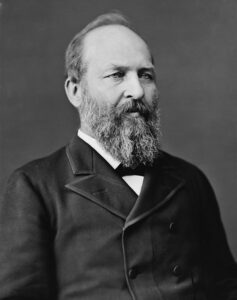
Unknown; part of Brady-Handy Photograph Collection., via Wikimedia Commons · Public domain · Source