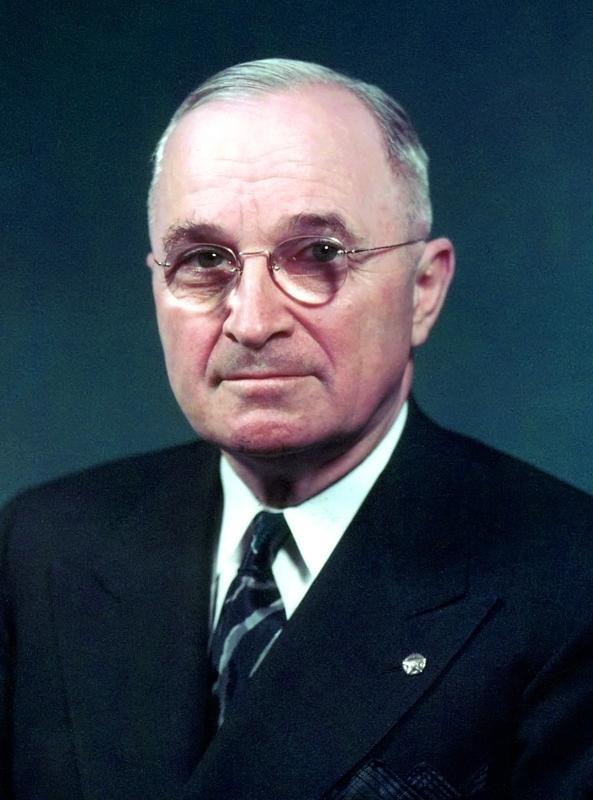
Harry S. Truman
Born May 8, 1884, Lamar, Missouri · Died December 26, 1972, Kansas City, Missouri · Belton Lodge No. 450, Belton, MO
Harry S. Truman led the United States through the end of World War II and the start of the Cold War, and served as Grand Master of Missouri.
Freemasonry is a system of morals which makes it easier to live with your fellow man, whether he understands it or not.
From Lamar and Independence to a Battery in France
Harry S. Truman was born in Lamar, Missouri, on May 8, 1884. In 1890 his parents, John and Martha, moved the family to Independence, a county-seat town of about 6,000 people, ten miles east of Kansas City. As a child he read history and literature, played the piano, and hoped to become a soldier. Poor eyesight made a commission to the United States Military Academy at West Point impossible, and his family’s finances kept him from a four-year college. He worked on the family farm between 1906 and 1914. The White House Historical Association describes those years as a period in which he prospered as a farmer; the Miller Center records that he detested farming. It was then that he courted Virginia “Bess” Wallace, whom he had known since childhood. She refused a proposal in 1911, but the courtship continued.
In 1917 his National Guard unit shipped to France with the American Expeditionary Force. He served as a captain in the Field Artillery and turned a battery that had a reputation for unruliness into a capable unit. After the war he married Bess, in 1919, and five years later they had their only child, Mary Margaret. With an army friend he opened a men’s furnishings store in Kansas City, which failed after a few years.
Jackson County, the Senate, and Eighty-Two Days as Vice President
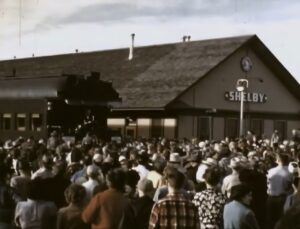
In 1922, Thomas J. Pendergast, the Democratic leader in Kansas City, asked Truman to run for a judgeship on the county court of Jackson County’s eastern district, an administrative post rather than a courtroom bench. He served one term, lost a bid for a second, and in 1926 became presiding judge, holding that office until 1934 and managing county finances in the early Depression. The Miller Center notes that, despite his association with the corrupt Pendergast organization, he earned a reputation for personal honesty and efficiency. In 1934, with Pendergast’s help, he was elected to the United States Senate and supported the New Deal. During the Second World War he chaired the Senate committee that investigated defense spending, exposing waste and corruption; the White House Historical Association estimates that the work may have saved as much as $15 billion.
President Franklin D. Roosevelt chose Truman as his 1944 running mate in part because Truman was acceptable to Southern Democrats and party officials. The ticket won, but Truman served only 82 days as vice president. On April 12, 1945, after Roosevelt’s death, he became the 33rd president of the United States.
Hiroshima, the Fair Deal, the Berlin Airlift, and a Limited War in Korea
Victory in Europe came in May 1945. After an urgent plea to Japan to surrender was rejected, and after consultations with his advisers, Truman ordered atomic bombs dropped on Hiroshima and Nagasaki on August 6 and 9, 1945. The Miller Center records that the bombings killed upwards of 100,000 people at once, with perhaps twice that number later dying from radiation. Emperor Hirohito agreed to surrender days later. In June 1945 Truman witnessed the signing of the United Nations charter. His administration later supported the creation of the state of Israel.
At home he presented Congress with a 21-point program—expansion of Social Security, a full-employment measure, a permanent Fair Employment Practices Act, and public housing—that became known as the Fair Deal. Truman wrote that the program “symbolizes for me my assumption of the office of president in my own right.” In 1947, after Soviet pressure on Turkey and a guerrilla threat to Greece, he asked Congress to aid both countries, a policy soon called the Truman Doctrine. The Marshall Plan, named for Secretary of State George C. Marshall, supported economic recovery in western Europe. When the Soviets blockaded the western sectors of Berlin in 1948, Truman supplied the city by air until the Soviets backed down. The North Atlantic Treaty Organization was established in 1949. The National Security Act of 1947 unified the armed services under a civilian secretary and created the Central Intelligence Agency and the National Security Council.
In 1948 Truman defeated New York Governor Thomas Dewey and a third-party challenge from former Vice President Henry Wallace, contrary to the predictions of pollsters. After the election, the Trumans moved out of the sagging White House so that it could be gutted and rebuilt; the work was completed in 1952. In June 1950, North Korea invaded South Korea. Truman later wrote, “There was no suggestion from anyone that either the United Nations or the United States could back away from it.” He committed American forces under United Nations authority, limited the fighting rather than accept General Douglas MacArthur’s demands for a wider war, and dismissed MacArthur for insubordination. Having served almost two terms, he decided not to run in 1952 and retired with Bess to Independence. He died on December 26, 1972. Of his presidency he said, “Well I wouldn’t say I was in the ‘great’ class, but I had a great time while trying to be great.”
Belton Lodge, Grandview’s First Master, and Grand Master of Missouri
Truman’s petition for initiation at Belton Lodge No. 450, dated December 21, 1908, is among the lodge records photocopied at the Harry S. Truman Library. He was initiated on February 9, 1909, passed on March 9, and raised on March 18. He served as Junior Warden in 1910, then left to organize a new lodge. In 1911 he led the effort to form Grandview Lodge No. 618 and was elected its first Master. About a month later he conferred the first degree given there. “Some time in the far distant future,” he wrote Bess on July 29, 1911, “I’ll be bragging about having performed that ceremony.” He later served as secretary for several years and was Master again in 1916. While he served in France, Grandview’s hall burned and its records were lost.
After the war he turned to the Masonic district covering Jackson County outside Kansas City. In 1925 he was appointed District Deputy Grand Master and Lecturer and, for about five years, gave courses of instruction throughout the district. Gaylon Babcock, a neighbor critical of Truman as a farmer, remembered the lodge work differently: “He did a good job in the lodge work. Excellent. He was an excellent director. If things weren’t going right along smoothly, Harry would come in and get them to going. He was a good lodge man.”
In 1940 Truman was elected Grand Master of the Grand Lodge of Missouri. His last duty in that office was to preside over the annual meeting in St. Louis on September 30 and October 1, 1941. “Well my tour of duty as Grand Master ended up in a blaze of glory,” he wrote Bess on October 3. On October 19, 1945, as president, he received the 33rd degree of the Supreme Council of the Scottish Rite for the Southern Jurisdiction. The Truman Library states that he is the only president to have received that distinction, and that he regarded it as the culmination of his Masonic career. In a letter of December 13, 1939, to Frank P. Briggs, he wrote: “Freemasonry is a system of morals which makes it easier to live with your fellow man, whether he understands it or not.”
How did Truman’s decision to supply Berlin by air reflect the choices facing the United States after the war?
Sources
- White House Historical Association — Harry S. Truman
- Miller Center — Harry S. Truman, Life in Brief
- Miller Center — Harry S. Truman, Life Before the Presidency
- Miller Center — Harry S. Truman, Foreign Affairs
- Harry S. Truman Library, Grandview Masonic Lodge 618
- Harry S. Truman Library, Belton Lodge No. 450 records
Life & Masonic Timeline
National Archives and Records Administration. Office of Presidential Libraries. Harry S. Truman Library., via Wikimedia Commons · Public domain · Source