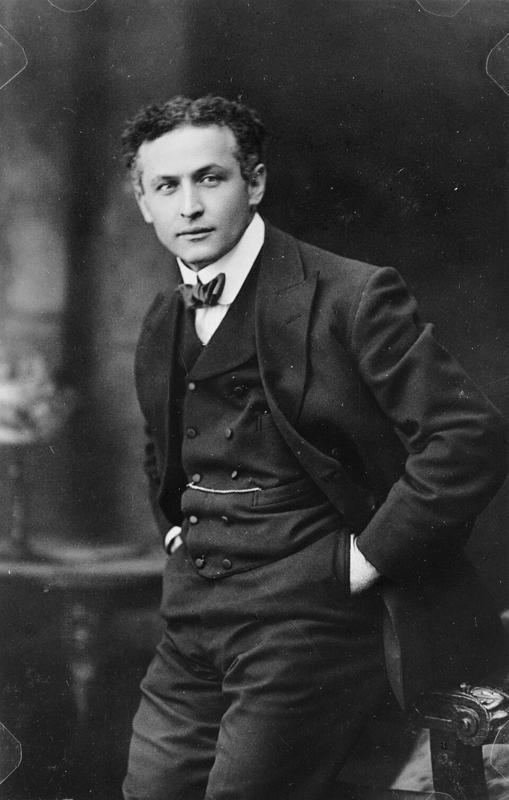
Harry Houdini
Born March 24, 1874, Budapest, Hungary · Died October 31, 1926, Detroit, Michigan · St. Cecile Lodge No. 568, New York City
Harry Houdini turned escape artistry into a worldwide stage sensation with handcuffs and water cells, then waged a long campaign against fraudulent mediums.
I have never entered a seance room except with an open mind devoutly anxious to learn if intercommunication is within the range of possibilities and with a willingness to accept any demonstration which proves a revelation of truth.
A Budapest Boy, and the Prince of the Air
Harry Houdini was born Erik Weisz in Budapest on March 24, 1874, to Rabbi Mayer Sámuel Weisz and Cecília Steiner, one of seven children. He later often claimed Appleton, Wisconsin, as his birthplace, but he was four when the family reached America, on the steamship Fresia, on July 3, 1878. They settled the German spelling Weiss and called the boy Ehrich. His father served as rabbi of the Zion Reform Jewish Congregation in Appleton until losing that post; Milwaukee and then, in 1887, a New York boarding house followed. Poverty put the children to work. At nine, Ehrich billed himself as a trapeze act — “Ehrich, the Prince of the Air.” He excelled at swimming, boxing and running, gifts that later served his act.
In 1891 he teamed with a friend, Jacob Hyman, as “The Brothers Houdini,” and they appeared on the Midway at Chicago’s World’s Columbian Exposition in 1893. After his father’s death in 1892, Ehrich took to the road. His younger brother Theodore (“Dash”) replaced Hyman for a time. In 1894 he married fellow performer Wilhelmina Beatrice “Bess” Rahner, who became his stage partner; the act became simply “The Houdinis.” They gained notice with a trunk escape they called the Metamorphosis, but life on the dime-museum circuit was grinding; in 1898 he thought seriously about quitting and even sent out a catalogue for “Harry Houdini’s School of Magic.” Taking the name Harry Houdini in homage to the French magician Jean Eugène Robert-Houdin, he struggled until 1899, when manager Martin Beck saw the handcuff work in a St. Paul beer garden, tested him with Beck’s own cuffs, and wired an offer. “This wire,” Houdini later wrote, “changed my whole Life’s journey.”
Handcuffs, the Water Torture Cell, and Europe
Beck booked him into leading vaudeville houses from the Midwest to California, and by early 1900 the act was a hit on the East Coast as well. Houdini then spent most of the next five years touring Europe, where a celebrated challenge came from the London Mirror, whose special handcuffs held him more than an hour before he emerged free. In Germany he caused an even bigger stir. When a Cologne policeman accused him of fraud, Houdini sued him for slander rather than back down; to win, he had to reveal some of his methods to the court, but the publicity only confirmed him as Germany’s “König der Handschellen,” the King of Handcuffs. Handcuffs, jail cells, water tanks, coffins, and buried-alive stunts made him the highest-priced escape artist of the age. In 1908 he introduced the Milk Can Escape, warning audiences that “Failure Means a Drowning Death.” By the early 1910s the Chinese Water Torture Cell — feet locked, lowered headfirst into a glass tank, a trick that required him to hold his breath for minutes — had become the signature climax he kept until the end of his life. The escapes rested on strength, agility, and lock craft, not supernatural claims.
In 1905 he returned to America and bought a brownstone in Manhattan that became the family home, especially for his mother, Cecília, to whom he was fiercely devoted. Word of her death reached him in Sweden in 1913; he later called himself “a Mothers-boy” and grieved for her the rest of his life.
Planes, Film, and a Magicians’ Society
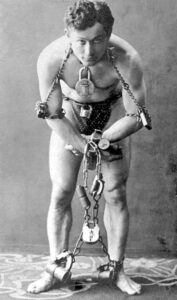
Fame paid for other obsessions. Houdini bought an airplane in 1909 and raced to be first over Australia, finishing months behind Capt. Colin Defries. He starred in escape films including The Master Mystery (1918), The Grim Game, and Terror Island, founded a film company in New York, though his movie ventures all lost money, and in 1923 became president of Martinka & Co., America’s oldest magic firm. From 1917 until his death he served as president of the Society of American Magicians, pushing local clubs in Buffalo, Detroit, and elsewhere into a national network and winning nine consecutive elections. In 1926 he reached Broadway with a two-and-a-half-hour one-man show that mixed illusions, escapes, and an exposé of Spiritualism, then took the show on the road.
He also spent the 1920s exposing fraudulent spirit mediums, publishing Miracle Mongers and Their Methods (1920) and A Magician Among the Spirits (1924). Serving on a committee organized by Scientific American, he helped expose the Boston medium Mina Crandon, known as Margery, and printed a pamphlet on her methods at his own expense. The campaign ended his friendship with Sir Arthur Conan Doyle, a leading advocate of Spiritualism. “I have never entered a seance room except with an open mind devoutly anxious to learn if intercommunication is within the range of possibilities,” he wrote in the 1924 book. After twenty-five years of research, and after making compacts with fourteen people that the first to die would try to communicate, he declared that nothing had convinced him such communication had been established.
St. Cecile Lodge No. 568, and a Halloween Death
Houdini was initiated in St. Cecile Lodge No. 568 in New York on July 17, 1923, passed on July 31, and raised on August 21. Known in the lodge by his birth name, Ehrich Weisz, he performed for about four thousand people at the Scottish Rite Valley of New York, directing the proceeds to brothers in need. After his raising he joined Mecca Shrine Temple. Other celebrated magicians, among them Harry Kellar, Howard Thurston and Harry Blackstone, were Freemasons as well, and today there is even an “Invisible Lodge” for Masons who are magicians or practice related arts.
On October 22, 1926, in a dressing room at the Princess Theatre in Montreal, Jocelyn Gordon Whitehead, a McGill University student, struck Houdini repeatedly in the abdomen — blows Houdini had invited as a test of strength. He kept touring. A doctor urged immediate surgery for appendicitis; Houdini went on. His last performance was October 24 at Detroit’s Garrick Theater, with a temperature of 104°F. He was admitted to Grace Hospital, and his appendix was removed on October 25, but infection had already set in. He died of peritonitis from a ruptured appendix on Halloween, October 31, 1926, at fifty-two. What role, if any, the blows played in that illness remains unsettled. More than two thousand mourners attended his New York funeral on November 4. Stage gear passed to his brother Theodore Hardeen; a later museum collection was auctioned in 2004, with pieces going to the magician David Copperfield.
How did Houdini’s campaign against fraudulent mediums relate to his work as a professional magician?
Sources
- PBS American Experience — Harry Houdini (1874–1926)
- Grand Lodge of Ohio — Harry Houdini
- Harry Houdini, A Magician Among the Spirits (1924), at Project Gutenberg
- Grand Lodge of British Columbia and Yukon — Harry Houdini
- Wild About Harry — The 100 year history of the Water Torture Cell
Life & Masonic Timeline
Campbell-Gray, Ltd., via Wikimedia Commons · Public domain · Source