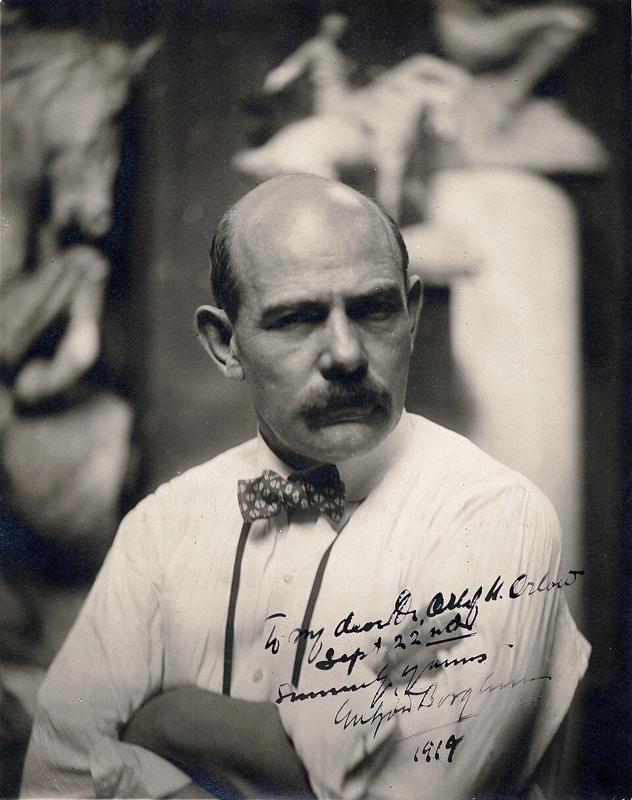
Gutzon Borglum
Born March 25, 1867, St. Charles, Idaho Territory · Died March 6, 1941, Chicago, Illinois · Howard Lodge No. 35, New York City
Gutzon Borglum designed and directed the carving of Mount Rushmore, creating monumental portraits of four American presidents in the Black Hills.
An Idaho Homesteader’s Son Who Found His Calling in California
John Gutzon de la Mothe Borglum began life on a homestead near Bear Lake, Idaho, in March 1867. His father, James Borglum, had come to America from Denmark only a few years earlier, and the family moved on to Utah and then to Fremont, Nebraska, where they were living by the time Gutzon was seven. He showed an early interest in art but had no formal training until he attended a private school in Kansas.
After finishing school he moved with his family to California, where he spent six months as a lithographer’s apprentice before striking out on his own with a small studio. His 1888 portrait of General John C. Frémont was the turning point. It won him recognition and the friendship of Jessie Benton Frémont, the general’s wife, who encouraged him and helped him sell enough work to pay for study in Europe. Shortly before he sailed, Borglum married Elizabeth Putnam, an artist and teacher twenty years his senior; the constant travel proved too much for her, and they later separated and divorced.
From the Paris Salons to a Marble Lincoln in the Capitol
Borglum spent two years in Paris at the Académie Julian and the École des Beaux-Arts, showed successfully at the major salons and became a close friend of the sculptor Auguste Rodin. After a year in Spain and a return to California, he went back to Europe in 1896 and settled in England, where some of his work was displayed at Windsor Castle for Queen Victoria. He came home to the United States in 1901 and settled in New York.
The next two decades produced many of his finest works. The Metropolitan Museum of Art accepted his bronze group Mares of Diomedes. Theodore Roosevelt unveiled his equestrian statue of General Philip Sheridan in Washington. He created a memorial to Pickett’s Charge at Gettysburg, and for Newark, New Jersey, the Wars of America memorial and a seated Abraham Lincoln.
In 1908 he carved a colossal head of Lincoln directly from a block of marble, with no plaster model to copy. He worked the right side of the face, which he believed carried Lincoln’s intellect and common sense, more fully than the left, which he associated with the president’s gentleness and warmth. Robert Todd Lincoln wrote that it was “the most extraordinarily good portrait of my father I have ever seen.” Eugene Meyer Jr. presented the bust to Congress that same year, and it stands today in the Capitol Crypt. Two more of his statues, Zebulon Vance and Alexander Hamilton Stephens, are in the National Statuary Hall Collection.
Borglum was just as active outside the studio. He married Mary Montgomery in 1909, and they raised two children, James Lincoln and Mary Ellis, at their home and studio near Stamford, Connecticut. He campaigned for Theodore Roosevelt in 1912, took part in the 1913 Armory Show that introduced modern art to American audiences, and during the First World War was appointed by President Woodrow Wilson to investigate the aircraft manufacturing industry. His findings were serious enough that Wilson ordered a further inquiry under Charles Evans Hughes.
A Sculptor Who Lost One Mountain and Found Another
The marble Lincoln drew Helen Plane, president of the United Daughters of the Confederacy, to ask Borglum about a head of Robert E. Lee on Stone Mountain in Georgia. When he saw the cliff in 1915 he told the committee that a head alone “would look like a postage stamp on a barn door,” and proposed instead a vast group of Lee, Stonewall Jackson and Jefferson Davis on horseback, followed by a column of soldiers. The war delayed the work until 1923. Carving began with jackhammers and chisels until a visiting Belgian engineer showed Borglum how to use dynamite for precise work, and Lee’s head was unveiled in 1924.
Disputes with the businessmen directing the project ended with his abrupt dismissal. Borglum destroyed his models to protect his design, the directors had a warrant issued for his arrest, and he left Georgia.
Stone Mountain also tied Borglum to the Ku Klux Klan, which had been reborn in a torchlit ceremony on the mountain in 1915 and helped fund the carving. There is no proof he formally joined, but he became deeply involved in Klan politics, and infighting within the Klan helped stall the project’s fundraising. He had no ties to the Confederacy, yet his letters fretted about a “mongrel horde” overrunning the “Nordic” purity of the West, and of the sculptor hired to replace him, Henry Augustus Lukeman, he later said, “They got a Jew.” His head of Lee was removed when another sculptor took over, and none of his carving survived in the finished monument.
By then South Dakota’s state historian, Doane Robinson, had already written to him about carving a mountain in the Black Hills. Borglum first visited in September 1924, at fifty-seven, with his twelve-year-old son Lincoln; the granite near the Needles proved unsuitable. On a second trip in August 1925 he found Mount Rushmore. He chose Washington to stand for the nation’s birth, Jefferson for its growth, Theodore Roosevelt for its development and Lincoln for its preservation, and described the memorial’s purpose as communicating “the founding, expansion, preservation, and unification of the United States.”
Fourteen Years on the Face of Rushmore
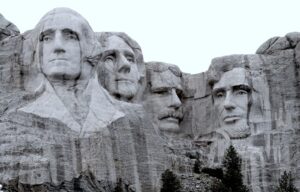
Carving ran from October 4, 1927, to October 31, 1941, and employed nearly 400 men and women over its course. Each day the crews climbed some 700 stairs to the top of the mountain to clock in, then were lowered over the 500-foot face in bosun chairs on steel cables while winch operators above raised and lowered them. About ninety percent of the rock was removed with dynamite, set in measured charges until only three to six inches remained above the final surface. Drillers then “honeycombed” the granite with closely spaced holes so it could be broken away, and the faces were finished smooth with hand tools. In fourteen years of work, some 450,000 tons of stone came off the mountain, and no one was killed.
Lincoln Borglum became his father’s right-hand man, working unpaid for several years before he was hired in 1934, promoted to chief pointer in 1935 and made superintendent of all work in 1938. Gutzon Borglum directed the project until his death in Chicago following surgery on March 6, 1941, a few days before his seventy-fourth birthday. He was buried at Forest Lawn in Glendale, California, and Lincoln brought the work to its finish and served as the memorial’s first National Park superintendent from 1941 to 1943.
Master of Howard Lodge in the Years of His Rising Fame
Borglum was raised a Master Mason in Howard Lodge No. 35 in New York City on June 10, 1904, three years after he came home from England. He served the lodge as Worshipful Master in 1910 and 1911, the same years his Lincoln bust and Sheridan statue were bringing him national attention. He was later appointed Grand Representative of the Grand Lodge of Denmark to the Grand Lodge of New York, a fitting honor for the son of a Danish immigrant.
He also received the degrees of the Ancient and Accepted Scottish Rite in the New York City Consistory on October 25, 1907. When carving began at Rushmore in 1927, he had been a Master Mason for twenty-three years.
How did Borglum’s experience at Stone Mountain affect the much larger work he undertook at Mount Rushmore?
Sources
- National Park Service — Sculptor Gutzon Borglum
- National Park Service — Carving History
- National Park Service — Lincoln Borglum
- National Park Service — Why These Four Presidents?
- National Park Service — Mount Rushmore History & Culture
- Architect of the Capitol — Abraham Lincoln Bust
- Scottish Rite Valley of Orlando eNews, “Notable Brothers of Freemasonry: Gutzon Borglum”
- Victoria Lodge No. 474, “Mount Rushmore: Gutzon Borglum’s Colossus in Granite”
- Smithsonian Magazine — The Sordid History of Mount Rushmore
Life & Masonic Timeline
Unidentified photographer, via Wikimedia Commons · Public domain · Source